


Labour law enforcement now Bangladesh’s key test: ILO chief

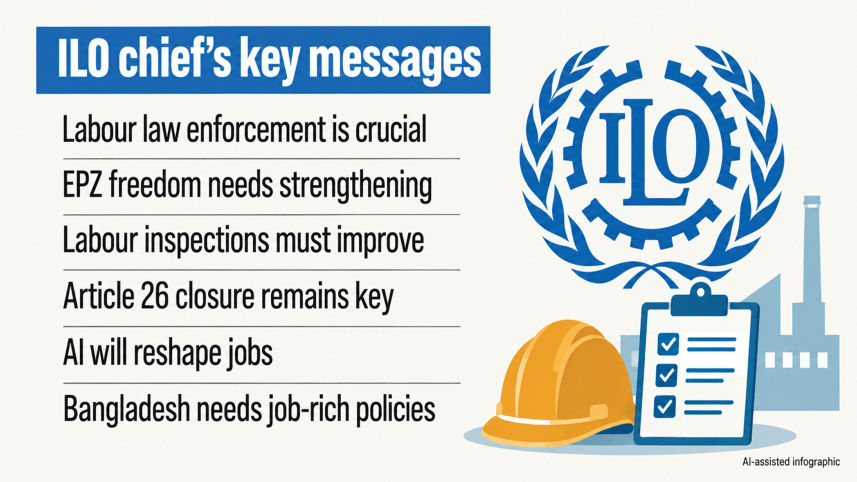
Bangladesh has made significant progress in reforming its labour laws, but the real test now lies in implementation, particularly enforcement of the Labour Act, freedom of association in export processing zones and the effectiveness of labour inspections, according to Gilbert F Houngbo, director general of the International Labour Organisation (ILO).
The progress will also be important for Bangladesh’s efforts to have an Article 26 complaint filed against it at the ILO in 2019 closed. A joint group representing employers and workers is expected to visit Bangladesh in October to assess the progress.

In an interview with The Daily Star during his July visit to Bangladesh, the ILO chief said the reform process had begun much earlier, but “decisive progress” had been made over the past two years.
The Article 26 complaint concerns alleged failures by Bangladesh to comply with certain ILO conventions it has ratified. The government has been seeking its closure, but according to Houngbo, the matter rests with the ILO Governing Body.

What is specifically important for us is to make sure that workers in the EPZs can also benefit from freedom of association.
He said proper implementation of the amended Labour Act, along with progress on freedom of association in the EPZs and effective labour inspection, would help create an environment conducive to closing the complaint.
“Proper implementation of BLA at field level will really, really create a good environment for that, plus other issues that we are talking about,” he said. The amended Labour Act incorporates many of the concerns the ILO had raised with the government, Houngbo said.
“We have to recognise and welcome that,” the ILO chief said. But passing the law is only one part of the reform process. “Adopting the law is one thing, enforcing the law is another,” he said, adding that it was still too early to assess implementation of the amended law.
The October visit by the joint group of employers and workers will be an important next step. Its assessment will provide an indication of how the reform process is progressing.
One area requiring further attention is labour rights in export processing zones, particularly freedom of association, Houngbo noted.
He said the ILO was not necessarily seeking completely uniform labour laws inside and outside the EPZs, given their special position in Bangladesh’s international trade. Instead, he stressed the need for “harmonisation”.
“What specifically for us is important is to make sure that workers in the EPZ also could benefit from the freedom of association, just like any other sector in the BLA,” he said.
Houngbo said he had a positive impression of the response from different levels of the authorities and that the ILO office could begin with pilot cases before moving towards fully implementing freedom of association in the EPZs.
Labour inspection is another key test of implementation.
Houngbo recalled that Bangladesh had fewer than 100 labour inspectors when he visited in 2015. The number has since risen to more than 400.
“That is a lot of progress,” he said.
But increasing the number of inspectors alone would not be enough. The effectiveness of the system would also depend on whether inspectors can conduct unannounced visits.
“If they need permission to be able to arrive for the visit, otherwise it would not be effective,” he said.
Bangladesh ratified three ILO conventions in November 2025, becoming the first country in Asia to ratify all 10 fundamental ILO conventions. The April amendment to the BLA introduced further measures on labour protections and institutions.
Beyond labour-law reform, Houngbo identified climate change, heat stress, migration and automation as major challenges for Bangladesh’s labour market.
 For all latest news, follow The Daily Star's Google News channel.
 Bangladesh is particularly exposed to climate-related pressures, including heat stress, floods and other extreme weather events, he said. The ILO considers the impact of the transition towards a greener economy on workers as part of the “just transition”.
On automation and artificial intelligence, Houngbo said workers would need to acquire the skills needed in the changing economy.
“It’s not automation that will take away your job. It’s your neighbour that knows how to use AI that will take your job,” he said.
Fair labour migration is another priority for Bangladesh, which sends large numbers of workers abroad. Houngbo said the ILO’s focus was on ensuring orderly migration and reducing the risk of abuse.
As Bangladesh prepares for its graduation from the least developed country category, he said economic policies should take a “job-rich” approach, encouraging new sectors while keeping employment at the centre of economic planning.
But job creation alone should not be the goal. “We have to ensure that jobs that are created are decent jobs,” he said.
Asked what single indicator would show whether the reforms had transformed Bangladesh’s labour landscape in two years, Houngbo pointed to the closure of the Article 26 complaint. He said the next phase should focus on stronger ILO cooperation and effective enforcement of labour laws.
Comments