


Early cultivation on charlands strains fertiliser supply

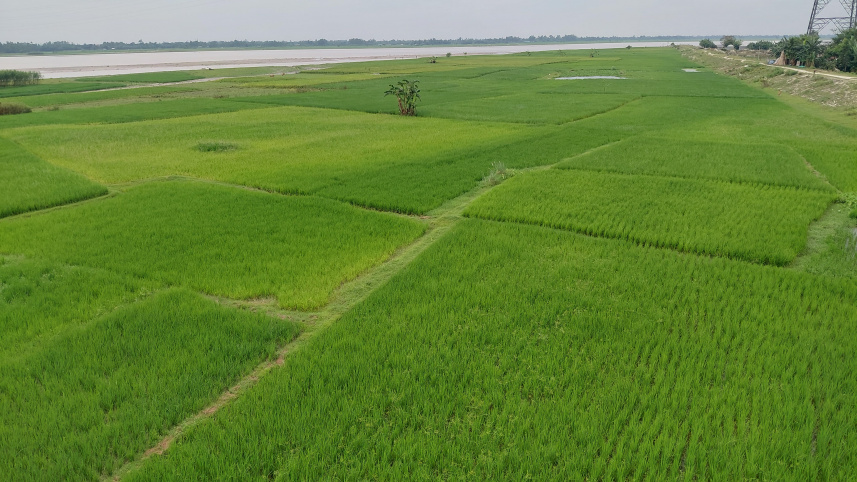
With no significant flooding in the rivers across the Rangpur region this year, large areas of char land have remained above water, allowing farmers to cultivate Aman rice, vegetables and other crops earlier than usual.
The early cultivation of additional char land, however, has pushed up demand for fertiliser, creating shortages in several riverbank and char areas. Farmers in some places have protested and blocked roads, demanding adequate fertiliser supplies.

Agriculture officials said a large portion of char land that normally remains submerged during floods was brought under cultivation this year as river water did not remain high for long.
The additional cultivation has created higher-than-usual demand for fertiliser, particularly along the Brahmaputra and Dudhkumar rivers in Kurigram.
Rakibul Hasan, executive engineer of the Kurigram Water Development Board, said the Brahmaputra did not cross the danger level in Kurigram this year, resulting in no flooding along its banks.
Although water in the Dudhkumar crossed the danger level once, it receded within a day. Water in the Teesta crossed the danger level three times in Lalmonirhat, Nilphamari, Rangpur and Kurigram, but receded within 12 hours. As a result, no major flooding occurred, he said.
Baktar Ali, 65, a farmer from Anantapur village on the Brahmaputra river bank in Kurigram’s Ulipur upazila, said he usually started cultivation in the first week of October. This year, he began in early September because there was no floodwater.
“I have planted early Aman on seven bighas this year, compared with five bighas last year. I need to apply fertiliser regularly, but I am not getting it according to my needs. So I have to keep visiting dealers’ shops and wait,” he said.
He said almost all farmers in the area had cultivated early Aman and vegetables on additional land, increasing fertiliser demand. Without adequate fertiliser, achieving the expected yield would be difficult, he added.
Hasmat Ali Sheikh, 70, of Char Parbati in Kurigram Sadar, said he cultivated crops on five bighas last year but has brought eight bighas under early Aman and vegetable cultivation this year.
“Previously, fertiliser was available in the open market. Now we have to collect it from dealers. We have to travel about 10 kilometres from the char to reach a dealer, but even there we do not get enough,” he said.
Azahar Ali, 55, of Gunaiyer Kuti area in Bhurungamari upazila, said farmers had started cultivation almost a month earlier this year. The area is known for vegetable production, which requires considerable amounts of fertiliser.
“If we cannot apply fertiliser to vegetable fields on time, production will be severely affected,” he said.
Khairul Islam, 60, of Char Mahipur in Gangachara upazila of Rangpur, said the Teesta riverbed had already turned green with Aman rice in September.
“Usually, there is water in the Teesta at this time and cultivation starts in some areas around mid-October. This year, farmers have cultivated a vast area of the riverbed,” he said.
Habibur Rahman, 65, of Char Doani area in Hatibandha upazila of Lalmonirhat, said farmers were preparing land for maize cultivation earlier than usual and would begin sowing this week.
According to the Department of Agricultural Extension (DAE), Aman rice has been cultivated on 621,550 hectares in Rangpur region’s Lalmonirhat, Kurigram, Rangpur, Gaibandha and Nilphamari this season. Vegetables are being cultivated on 44,289 hectares, including 3,656 hectares under early cultivation, while maize covers 123,386 hectares.
The region received 23,737 tonnes of urea, 3,543 tonnes of TSP, 7,857 tonnes of MOP and 11,698 tonnes of DAP in September.
SM Abu Bakar Saiful Islam, additional director of DAE in Rangpur, said additional char land, particularly along the Brahmaputra, had been brought under early cultivation this year.
“As a result, additional demand for fertiliser has been created. Field-level officials have been instructed to assess the additional cultivated land and determine the resulting demand,” he said.
 For all latest news, follow The Daily Star's Google News channel.
 He said Kurigram received an additional 1,000 tonnes of urea, 300 tonnes of DAP and 32 tonnes of TSP in September.
“Char farmers rush to dealer points as soon as they hear that fertiliser is being distributed. When they fail to get it according to their demand, protests and other untoward incidents occur,” he said.
“We have informed the higher authorities in detail about the additional cultivation in char areas so that farmers can get fertiliser according to their needs from October,” Saiful Islam added.
Comments