


Youth climate innovations struggle to move beyond pilot stage: Experts
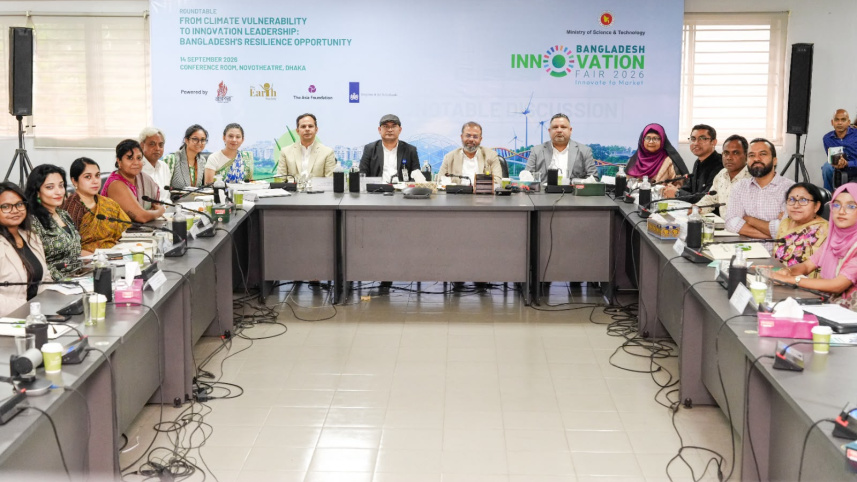
Bangladesh needs better access to finance, testing facilities and markets to help young people turn climate innovations into scalable businesses, speakers said at a roundtable in Dhaka on Monday.
They identified limited financing, weak market linkages, inadequate testing facilities, skills shortages and fragmented coordination among government agencies as major barriers to scaling youth-led climate solutions.

The discussion was held at the “From Climate Vulnerability to Innovation Leadership: Bangladesh’s Resilience Opportunities” roundtable, organised by The Earth Society as part of the Bangladesh Innovation Fair 2026, reads a press statement.
The event brought together policymakers, youth innovators, researchers, climate advocates, financial institutions, development partners and private-sector representatives, it added.
Md Saimum Parvez, special assistant to the prime minister on environment, forests and climate change, said financing remains a major constraint for promising innovations that have yet to move beyond the pilot stage.
He stressed the need to expand access to global green finance and cited the government’s “Ujjibito” mechanism, which combines a Tk 10 lakh loan with a Tk 10 lakh government grant through Bangladesh Bank.
Parvez also called for a cross-sectoral mechanism to connect innovators with government programmes, research institutions, financial institutions, technical expertise and private-sector markets.
Shaikh Faridul Islam, state minister for environment, forest and climate change, said climate action and economic development should be pursued together.
He highlighted value for money, profitability, employment generation and environmental benefits as key considerations for climate-related initiatives.
Referring to communities affected by climate impacts in fisheries, agriculture and coastal areas, he stressed the importance of community-based solutions that respond to local realities.
The state minister also highlighted the role of financial institutions, including Bangladesh Bank, in creating targeted financing opportunities for climate-focused enterprises.
Participants also noted that young Bangladeshis are already developing solutions in areas such as waste management, agriculture, the circular economy, technology and disaster resilience. But many such innovations struggle to progress from ideas and small-scale pilots to wider adoption.
Iftekhar Mahmud, editor-in-chief of Dhaka Stream, proposed preparing a national priority list of climate entrepreneurs and innovations so that promising solutions can be connected with relevant government programmes, investors and support services.
Other participants called for better testing and validation facilities, stronger research partnerships, blended finance and improved skills development.
M Assaduzzaman, senior climate policy adviser at the Embassy of the Kingdom of the Netherlands, highlighted the need to better connect ideas with institutions, knowledge and market.
Md Anwar Hossain, secretary of the Ministry of Science and Technology, stressed the need for stronger government-innovator partnerships and skills development as Bangladesh develops its green economy.
The discussion also highlighted the need to include young women and communities in climate-vulnerable areas in innovation and entrepreneurship programmes.
The roundtable was held under Green Voices, an initiative supported by the Embassy of the Kingdom of The Netherlands that works to strengthen the leadership of women and young people in climate action, support locally driven green innovations, and create stronger connections between emerging solutions, policy and practice. Green Voices works in partnership with Bonhishikha and The Earth Society.
 For all latest news, follow The Daily Star's Google News channel.
Comments