


High prices at pumps trickling into every thing


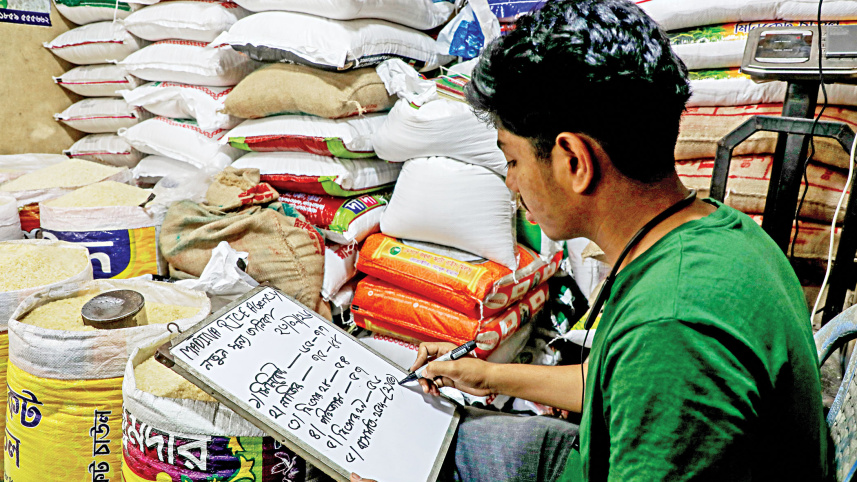
Just days after the fuel price hike, household budgets are already feeling the squeeze, with commuting costs rising and higher transport expenses pushing up the prices of groceries and other essentials.
Inflation fell for the second consecutive month in August but remained high at 8.26 percent.

Afroza Akhter, 27, supports herself with a modest income from a part-time job while pursuing a master’s degree at a private university.
Until recently, she spent around Tk 300 a day commuting between home, work, and university on ride-sharing bikes. Since the fuel price hike and subsequent fare increases, that has risen to around Tk 450.
“Yesterday, I paid Tk 170 for a Pathao bike ride from Joy Kali Mandir in Old Dhaka to Mohammadpur Beribadh. Just two days ago, it cost Tk 120 to Tk 130,” she said.
Rising prices of vegetables and other essentials are adding to the strain. Yesterday, she paid Tk 350 for a bottle gourd, Tk 80 a kg for okra and Tk 100 a kg for pointed gourd.
“Vegetable sellers are reluctant even to sell green chillies worth Tk 20. I haven’t bought fish or meat for myself in the last two months because I can’t afford them on a student’s budget.”
Data from the Trading Corporation of Bangladesh for September 23 show that prices of several kitchen staples rose over the previous week. Green chillies, which cost Tk 80-160 per kg a week earlier, rose to Tk 140-160. Eggplant price rose to Tk 90-120 per kg from Tk 80-120, while prices of eggs increased to Tk 48-55 per hali (four pieces) from Tk 48-Tk 50.
Other staples also became costlier. Price of loose flour rose to Tk 50 per kg from Tk 48-50, while that of packaged flour increased to Tk 60-70 per kg from Tk 60-65. Red lentils (masur dal) rose to Tk 95-100 per kg from Tk 90-100.
Like Afroza, many students and low-income people are struggling with higher transport fares amid rising living costs.
On September 20, the government raised prices of all four major petroleum products by Tk 20 a litre, passing on much of the higher import costs resulting from the US war on Iran to consumers.
Diesel rose to Tk 135 a litre from Tk 115, octane to Tk 165 from Tk 145, petrol to Tk 160 from Tk 140, and kerosene to Tk 155 from Tk 135. The Tk 20-a-litre increase was the biggest since August 2022, when fuel prices were raised amid the global energy crisis triggered by Russia’s invasion of Ukraine.
Following the hike, bus fares were raised by 17 paisa per kilometre on Tuesday. Long-distance fares rose to Tk 2.40 per kilometre from Tk 2.23, while fares in Dhaka and Chattogram rose to Tk 2.70 from Tk 2.53. Transport owners had sought a 20-paisa increase.
Water transport fares also rose by 7.54 percent. Launch fares increased by 23 paisa per kilometre for the first 100 kilometres and by 20 paisa beyond that, while the minimum fare rose to Tk 35 from Tk 32.
Road Transport and Bridges, Railways and Shipping Minister Shaikh Rabiul Alam, who announced the increases, said no decision had yet been made on train fares despite mounting pressure within the railway ministry to raise them.
“Bangladesh Railway is running at a loss. We haven’t raised fares in 10 years. Even when fuel prices went up last time, we didn’t increase them,” he said.
“We want to see if we can manage without a fare hike. No steps have been taken yet, and existing fares remain unchanged. Let’s wait a few more days and see how the pressure develops.”
Meanwhile, passengers on several long-distance and city routes alleged that operators were charging above government-approved fares despite warnings of fines and route permit cancellations.
Passengers travelling to southern and southwestern districts reported fare increases of Tk 50 or more, while AC fares on some routes rose by Tk 200-Tk 300.
Abul Kalam, a Golden Line passenger travelling from Dhaka to Khulna, said he paid Tk 1,300 for an AC ticket, up from around Tk 1,100.
 For all latest news, follow The Daily Star's Google News channel.
 City passengers also reported higher fares. Md Touhid said Shikor Paribahan charged him Tk 15 instead of Tk 10, while Tushar Mia said a Bihanga Paribahan conductor demanded Tk 30 for a trip to Agargaon, citing higher fuel prices.
Launch passengers made similar allegations. At Sadarghat, passengers said fares on several routes had risen even before the revised rates took effect.
On the Dhaka-Barishal route, single-cabin fares rose to Tk 1,200-Tk 1,400 from around Tk 1,000 and deck fares to around Tk 350 from Tk 250-Tk 300. Passengers also reported a Tk 100 increase on the Dhaka-Bhola route, while fares on the Dhaka-Chandpur route rose to Tk 200 from Tk 130-Tk 150.
Launch owners, however, said the government-approved increase did not fully cover rising operating costs.
Siddiqur Rahman Patwary, general secretary of the launch owners’ association, told The Daily Star that operators had sought a much larger adjustment, taking into account fuel and labour costs, docking charges, taxes, maintenance and higher spare-parts prices.
They had proposed raising fares for the first 100 kilometres to Tk 4.45 per kilometre from Tk 2.95 and those beyond 100 kilometres to Tk 4.02 from Tk 2.52.
Patwary denied that operators were charging above government-set fares, saying many had historically charged below official rates due to competition with buses and declining passenger numbers.
Md Saiful Alam, secretary-general of the Bangladesh Road Transport Owners Association, also said operators were not charging more than what was justified by rising operating costs. Besides the Tk 20 diesel hike, he cited the taka’s depreciation and higher prices of imported spare parts.
He said owners had sought a 20-paisa-per-kilometre increase but accepted the government’s 17-paisa hike, adding that fares would be reduced if fuel prices fell.
Truck, lorry and covered-van fares are also expected to be reviewed this week, said Md Hasanul Kabir, general secretary of the Bangladesh Truck-Covered Van Owners’ Association.
(Our JnU correspondent contributed to this report.)
Comments