


Jamaat’s 1971 role: How the apology was repeatedly thwarted

A section of Jamaat-e-Islami leaders made repeated efforts to persuade the party’s top leadership to issue a formal, unqualified apology for opposing Bangladesh’s independence in 1971.
Several drafts were prepared over the years, but the initiative never materialised as influential figures within the party repeatedly blocked the move.

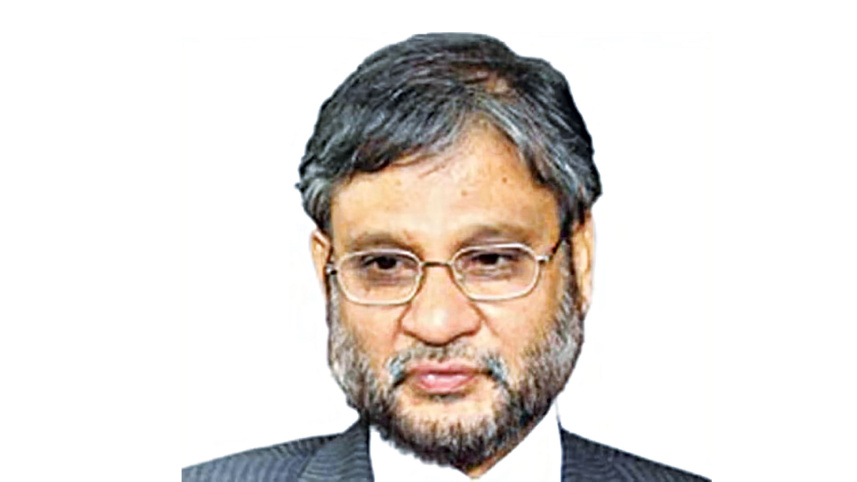
Lawyer Abdur Razzaq, who served as Jamaat’s assistant secretary general from 2003 to 2019 before quitting the party, reveals the internal disputes within its top echelon in his posthumous memoir, “Bangladesh Jamaat-e-Islami: Its History and Politics”, which will be formally launched tomorrow.
In the memoir, he details the background to the push for an apology, the arguments for and against it, and the drafts prepared over more than two decades.
The question of an apology first arose in 1994, ahead of a public address by then Jamaat ameer Ghulam Azam following a Supreme Court verdict that restored his Bangladeshi citizenship. Further moves related to the apology were made between 2001 and 2016.
“Each time an attempt was made, certain powerful figures within the Jamaat establishment intervened and held the party back. In the end, the new ameer did not address the issue. As in the past, the matter was once again relegated to cold storage,” Razzaq wrote, summing up the repeated efforts to resolve the issue.
Recalling the 1994 attempt, Razzaq wrote that a committee was formed to assist Azam in preparing his speech. It suggested that he address Jamaat’s role in 1971.
“An apology offered from a position of strength would be perceived as sincere and could put an end to the harsh -- and often unwarranted -- criticism of Jamaat’s role in 1971. Professor Azam agreed in principle with our suggestions,” Razzaq wrote.
However, when the moment came, Azam alluded to Jamaat’s role only indirectly, in a one-line statement: “In the past, if I have committed any mistakes, please forgive me.”
“The media largely ignored this statement, which could, at best, be described as a half-hearted apology,” he wrote.
The issue resurfaced after the four-party alliance’s victory in the October 2001 elections, which Razzaq saw as another historic opportunity to address the 1971 question from a position of strength.
He began lobbying Jamaat to address the issue before December 16, Victory Day, and contacted three professors of Dhaka University, who readily agreed to help prepare a draft statement.
Once the draft was ready, Razzaq embarked on the more difficult task of securing approval from the Jamaat leadership.
The initial meeting was chaired by the then ameer Matiur Rahman Nizami and attended by senior leaders Ali Ahsan Mujahid, Muhammad Kamaruzzaman, Abdul Quader Mollah and ATM Azharul Islam. A small subcommittee was subsequently formed under Mujahid to finalise the draft. Only Azharul Islam is alive now.
The committee met at least half a dozen times to finalise the statement, and a tentative decision was made to hold a press conference before Victory Day.
Mujahid, Kamaruzzaman and Mollah were very eager to see the matter through and close the chapter once and for all, according to Razzaq.
However, Azharul, who became secretary general after the arrests of the ameer and secretary general in June 2010, had “his reservations”.
Azharul was not available for comment, as he did not respond to repeated phone calls or text messages.
“Every word had to be carefully chosen, and each sentence meticulously crafted. I can no longer recall exactly how many drafts we prepared, but it must have been upwards of seven. In the end, an agreed statement was finalised.
“As we completed our draft, Mr Mujahid informed me that he sensed Maulana Nizami may have changed his mind regarding the apology, upon advice from one of the elders. Mr Mujahid did not divulge the name of the elder, nor did I ask him for details,” Razzaq wrote.
 For all latest news, follow The Daily Star's Google News channel.
 Razzaq continued pursuing the matter, hoping the party would address the issue before Independence Day on March 26, 2002.
That did not happen. Nizami gave no reason for changing his mind, instead saying the matter would be placed before Jamaat’s Working Committee, which comprised 35-40 members.
“The issue now had to go through Jamaat’s bureaucracy,” Razzaq wrote.
The matter was finally placed before the Working Committee in October 2005, four years after the draft apology had been prepared.
In his opening remarks, Razzaq argued that nowhere in the history of the world had a party that opposed a country’s independence been elected to office. His proposal was defeated by an overwhelming majority in a voice vote.
At that meeting and in subsequent meetings -- there were many between 2005 and 2010, when the party’s top leaders were arrested -- Razzaq repeatedly raised the fundamental question of whether it was politically and morally right for Jamaat to support the Pakistan army after March 25, 1971.
The opposition was so strong that those who favoured addressing the issue were intimidated into silence and became submissive, Razzaq wrote.
The arguments against an apology varied. Some said, “Jamaat supported the unity of Pakistan, the second-largest Muslim country, and there was nothing wrong with that.”
Others said, “We were apprehensive of Indian hegemony, and history shows we were justified in our actions;” while another argument was, “Even if we ask for an apology, the Awami League and their allies are not going to accept it.”
Two opinions expressed by senior members of the Working Committee were particularly disconcerting to Razzaq.
A former member of parliament said, “If we apologise, Pakistan will become displeased with us.”
The then head of Jamaat’s Education wing said, “In Bangladeshi politics, this is not an issue at all. Twice a year, in March (the month of independence) and December (the month of victory), this issue comes up for public discussion only to die out soon after. To discuss this issue in the Working Committee would be a waste of the committee’s (valuable) time.”
“I have always wondered whether the Working Committee member was correct in asserting that Pakistan would be displeased with Jamaat if it were to apologise for its actions in 1971. Subsequent events have convinced me that his assessment was far from accurate,” Razzaq wrote.
Between October 2005 and June 2010, when Nizami and other Jamaat leaders were arrested, the party’s role in 1971 was discussed on numerous occasions at meetings of the Working Committee and the Executive Committee.
Yet, as usual, no decision was taken.
Jamaat’s failure to address the 1971 issue repeatedly led to embarrassing situations for its leadership in the run-up to the December 2008 elections. Following the Awami League’s landslide victory, it became almost certain that Jamaat leaders would be tried for war crimes committed in 1971, Razzaq wrote.
In the last open session of the Majlish-e-Shura before the August 2024 uprising, held in July 2011 at the Al-Falah building in Moghbazar, Razzaq again stressed the need to address the 1971 issue. He specifically appealed to younger members to take the matter forward.
Azharul, then acting secretary general, said, “If we could fly the national flag on the cars of two of our leaders without addressing the 1971 issue, why should we be worried about it?”
“In my view, this was not an appropriate approach to an otherwise grave and serious matter,” Razzaq wrote.
Following a spate of hangings in mid-2016, a leadership vacuum emerged within Jamaat. A new ameer was elected in November that year.
Shortly after his election, Jamaat again decided to address the 1971 issue. A committee was formed, and the party’s secretary general approached Razzaq, asking him to draft a statement.
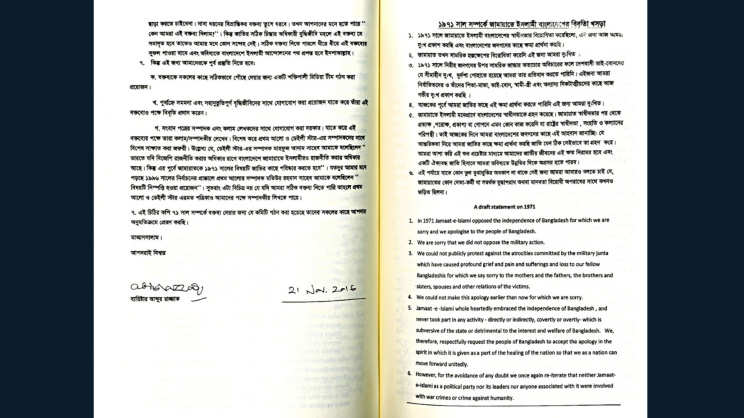
On November 21, 2016, Razzaq wrote a personal letter to the ameer, with copies to members of the committee, commending his decision to address the 1971 issue. He attached a draft apology statement.
The draft read, “In 1971 Jamaat-e-Islami opposed the independence of Bangladesh for which we are sorry and we apologise to the people of Bangladesh. We are sorry that we did not oppose the military action.”
“We could not make this apology earlier than now for which we are sorry… Jamaat-e-Islami whole heartedly embraced the independence of Bangladesh, and never took part in any activity- directly or indirectly, covertly or overtly- which is subversive of the state or detrimental to the interest and welfare of Bangladesh.
“We, therefore, respectfully request the people of Bangladesh to accept the apology in the spirit in which it is given as a part of the healing of the nation so that we as a nation can move forward unitedly. However, for the avoidance of any doubt we once again re-iterate that neither Jamaat-e-Islami as a political party nor its leaders nor anyone associated with it were involved with war crimes or crime against humanity.”
Following the December 2018 national polls, Razzaq learnt that the team of lawyers who had advised Jamaat on war crimes issues had already recommended that the party withdraw from politics.
Meanwhile, reports emerged that the government was considering banning Jamaat through the War Crimes Tribunal. Faced with the impending crisis, the party was forced to reassess its position.
The Executive Committee convened an emergency meeting and, by an overwhelming majority, decided to pursue the following course of action: (a) address the 1971 issue, (b) dissolve the party, and thereafter (c) form a new party.
“I was tasked by the Secretary General to draft an apology and a resolution for the dissolution of the party. Since a draft statement of apology was already in place, I quickly drafted a dissolution resolution with the assistance of my legal team,” Razzaq wrote.
Members of the Shura met in small groups, gathering the views of approximately 80 percent of its 300 members. The vast majority supported dissolving the party, while one-third favoured issuing an apology.
However, after the ban did not materialise, the Executive Committee made a complete U-turn, deciding against both an apology and dissolution. Razzaq then decided to resign.
Razzaq wrote that the July-August 2024 uprising marked a pivotal moment in Bangladesh’s political landscape.
He said Ameer-e-Jamaat Shafiqur Rahman had recently handled media interviews with calmness, confidence and dignity.
But the absence of a clear policy from the present-day Jamaat regarding the actions of its predecessors more than half a century ago meant that his answers were naturally unconvincing.
“Jamaat’s role in 1971 remains its Achilles heel,” wrote Razzaq, who died in May 2025.
Comments