Where did gold come from?

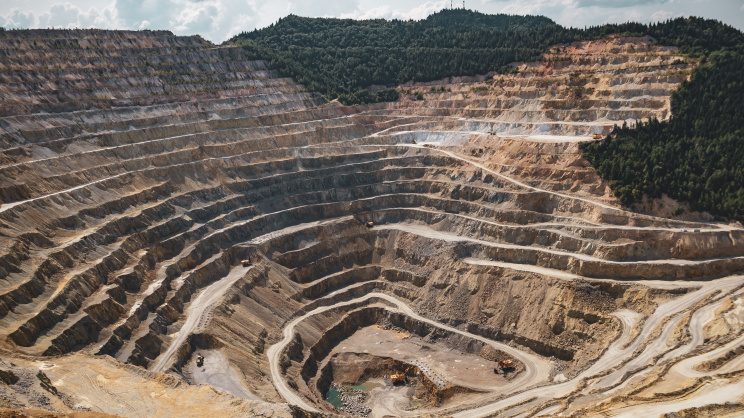
We rarely stop to think about where the everyday matter around us truly came from. Look at the gold jewellery we wear. Where does this gold come from? You may say it comes from a gold mine. But where does the gold in the mines come from? Or look at your hand. The cells of your hands contain hydrogen, carbon, oxygen, and nitrogen. They also contain iron, phosphorus, sodium, calcium, etc. Where do these elements come from? Were they forged in the Earth’s interior, or in the Sun? No. To answer these questions, we have to travel back many billions of years.
Unlocking the secrets of the cosmos
There are a number of spectacular discoveries that have come from the sky and changed the way humans look at themselves, especially their place within the universe. Only within the last one hundred years have we come to know that the cosmos is vastly larger than we ever imagined. Even when Einstein formulated his general theory of relativity in 1915, he did not imagine that our Milky Way could be just one galaxy among myriad galaxies in the universe. Now we estimate that our observable universe contains about two trillion galaxies, and we have no idea how big the unobservable universe is. That could be really big, or, for that matter, it could be almost infinite.
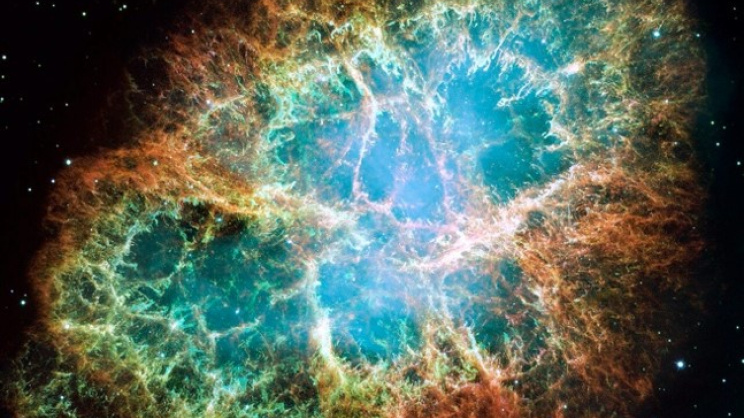
In the 1920s, Georges Lemaître showed theoretically that the universe could be expanding, while Edwin Hubble’s observations established that distant galaxies generally recede from us, with more distant galaxies receding faster.
We have learned so far that massive stars and their supernovae make and disperse many elements up to the iron region.
But more than that, within a couple of decades of Hubble’s discovery, the true origin of solar energy was deciphered. In the late 1930s, Hans Bethe worked out the nuclear reactions that power the stars. Solar energy is generated by the constant conversion of hydrogen into helium, with some of the hydrogen’s mass being converted into energy according to Einstein’s famous formula, E equals mc-squared. At the centre of the Sun, the temperature reaches about 15 million degrees Celsius, while the pressure is about 250 billion times the atmospheric pressure on Earth, creating the conditions necessary for this process. After thousands of years, at last, the true nature of the Sun was revealed to us.
First elements and the star furnaces
Our observations and calculations show that the universe was born about 13.8 billion years ago. Within the first few minutes, protons and neutrons formed the nuclei of hydrogen and helium, along with tiny amounts of a few other light nuclei. About 380,000 years later, electrons combined with nuclei to form neutral atoms. At that time, by mass, ordinary matter was roughly 75 per cent hydrogen and 25 per cent helium. Almost none of the heavier elements that surround us today yet existed.
So where did elements like carbon, nitrogen, and oxygen come from? Astronomer Fred Hoyle played a major role in showing that they are forged in the interiors of stars.
Iron wall and the supernova explosion
But it is not enough to make these elements within large stars; they also need to be thrown out of their interiors so that they can mix with hydrogen and helium and become part of the next generation of solar systems. A sufficiently massive star—more than roughly ten times the mass of the Sun—not only produces helium in its core but later, as it evolves, produces increasingly heavy nuclei. These elements include carbon, oxygen, neon, magnesium, silicon, sulfur, and ultimately iron. But once the core becomes mostly iron, fusion can no longer provide enough energy to support the star. Fusing iron into still heavier nuclei consumes rather than releases energy.
Without nuclear fusion providing the energy needed to support the core, the iron core collapses catastrophically. A shock wave forms deep inside the star. As the core collapses, electrons combine with protons to form neutrons, releasing enormous numbers of neutrinos. These neutrinos help drive the shock wave outward, blowing the star’s outer layers into space. The star then explodes spectacularly as a core-collapse supernova.
What remains after such a supernova may become an extraordinarily dense neutron star—or, if the collapsing core is sufficiently massive, a black hole. We will return to neutron stars shortly.
The race to capture neutrons
We have learned so far that massive stars and their supernovae make and disperse many elements up to the iron region. But our story of the elements cannot end with iron. We know that nature somehow makes many elements heavier than iron—including the gold with which we began our story. How are they made?
Scientists discovered that within certain regions of these massive stars, before they explode, heavier elements can be built up slowly by capturing neutrons in the nuclei of lighter elements. Some of these neutrons then turn into protons, transforming the nuclei into new, heavier elements. This is called the slow, or s-process. It mainly produces the lighter neutron-capture elements, such as strontium.
Ironically, to produce even heavier elements, we have to turn to stars only a few times the mass of the Sun, which do not explode as supernovae. In these stars, the s-process can produce heavier elements such as barium and lead. Near the end of their lives, these stars lose their outer layers through powerful stellar winds, spreading these newly made elements into space.
But to produce large amounts of elements such as gold, platinum, and uranium, a much more intense flood of neutrons is needed, in which nuclei capture neutrons faster than they can decay. This is the rapid, or r-process. For decades, scientists wondered where in the universe such an enormous concentration of neutrons could be found.
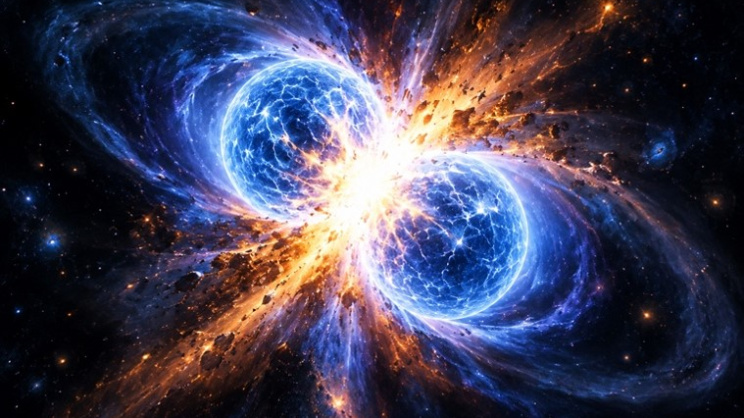
In 2017, astronomers detected gravitational waves from a distant source that also produced gamma rays and X-rays, as well as optical, infrared, and radio waves. They deduced that all these waves and forms of radiation were created by the merger of two neutron stars. The optical and infrared spectra showed that the material thrown out by the collision contained newly formed heavy elements. In particular, the strong infrared emission was a sign that very heavy r-process elements had been created. These might include elements such as gold, platinum, and uranium. For the first time, astronomers had witnessed in the sky the kind of cosmic event that can create gold.
Scientists discovered that within certain regions of these massive stars, before they explode, heavier elements can be built up slowly by capturing neutrons in the nuclei of lighter elements.
Neutron-star collisions may not be the only source. Some scientists think that the collapse of certain very massive stars into black holes could also produce large amounts of r-process elements.
Children of stellar cataclysms
Over generations of stars, stellar winds, supernova ejecta, and neutron-star collisions enriched the interstellar gas with heavier elements. Eventually, this enriched material became part of the cloud from which our Sun and planets formed about 4.6 billion years ago, and some of these elements are now part of our bodies.
It is already clear that not one, but a number of stars were responsible for seeding the protosolar nebula with heavier elements. Scientists studying material found in meteorites had concluded that the elements in the early Solar System had come from different stellar sources. It seems we have solved a longstanding mystery about where gold and other heavier elements come from.
Carl Sagan used to say that we are made of stardust. Much of us indeed is. The hydrogen in our bodies goes back almost to the beginning of the universe, while our carbon, oxygen, calcium, and iron were forged in stars. And some of the heaviest elements around us, like the gold in your jewellery or uranium in the soil beneath you, were born in even more violent cosmic events.
We are stellar children. And we are also children of stellar collisions.
Dipen Bhattacharya is a California-based writer and retired professor of physics and astronomy. His work spans fiction as well as writings on Bangladesh’s geological history and astronomy.
Send your articles for Slow Reads to slowreads@thedailystar.net. Check out our submission guidelines for details.

Do we understand the children we try to teach?

AI is here. Can Bangladesh’s education system adapt?

Why are we in such a hurry to live?

Why I chose teaching over a corporate career

The moral hierarchy of blood

The curious case of Bangladeshi ‘tension’

What can a teacher give that AI cannot?

What phuchka and jhalmuri can teach us about the science of taste

Remembering Yayoi Kusama: My encounters with the master of infinity