


BB holds the line as risks mount
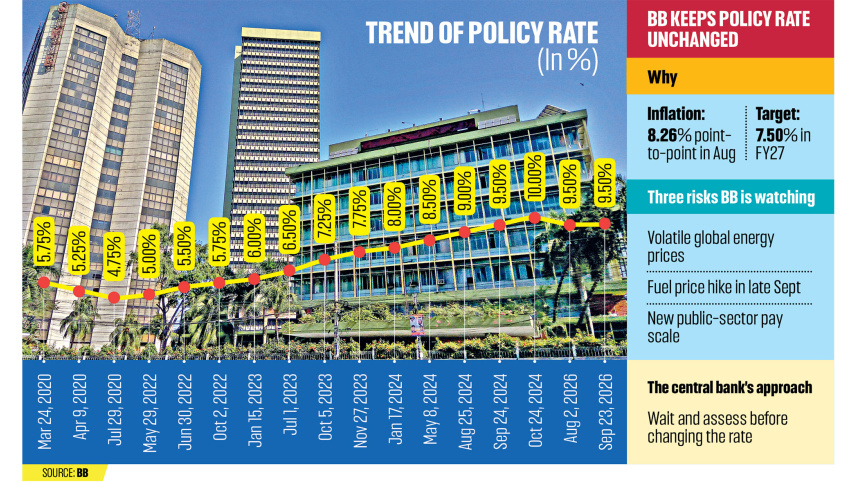
The Bangladesh Bank (BB) has kept its main interest rate unchanged at 9.50 percent, citing volatile global energy prices, a recent increase in domestic fuel prices and the introduction of a new pay scale for public employees as risks to inflation.
The central bank said it would assess the impact of domestic and global shocks before making any changes to the policy rate.

The Monetary Policy Committee, led by Governor Md Mostaqur Rahman, met yesterday and noted that inflation has been trending down but still remains above the government target of 7.5 percent in the current fiscal year.
In July, the central bank cut its policy, or repo, rate to 9.50 percent from 10 percent, marking its first reduction in six years.
The committee said yesterday that several factors could push prices higher again. Global energy prices remain volatile because of the ongoing conflict in the Middle East, while the government has recently raised fuel prices at home.
A new pay scale for government employees is also about to roll out, which could add to inflationary pressure.
Given these risks, the BB decided to wait and assess their impact before deciding whether to raise or lower interest rates.
The 12-month moving average inflation stood at 8.66 percent in August, according to the Bangladesh Bureau of Statistics (BBS), while point-to-point inflation was 8.26 percent that month.
Bangladesh Bank Governor Mostaqur Rahman, who took office in February, wanted to ease monetary policy to support economic growth and businesses, marking a shift from the tighter stance adopted by his predecessor, Ahsan H Mansur.
The central bank kept the repo rate at 4.75 percent from July 2020 to May 2022. It then raised the rate repeatedly to tackle rising inflation, pushing it to a record 10 percent by October 2024. It remained there until this year.
The central bank cut the rate from 10 percent to 9.5 percent in July, its first such move in six years. Industry insiders said the decision was wise as the country is facing structural challenges, particularly in the energy sector.
Fahmida Khatun, distinguished fellow of the Centre for Policy Dialogue (CPD), told The Daily Star that, given the current domestic and global price situation, the central bank’s decision to keep the policy rate unchanged at 9.5 percent seems appropriate.
“Though inflation in July and August showed a decline, it is still high. Given the current domestic inflationary pressure, the increase in fuel prices, and global uncertainty, a reduction in the policy rate could create further price pressures. Lowering the rate now could weaken the central bank’s inflation-fighting stance,” she commented.
The economist said raising the rate, on the other hand, would increase borrowing costs and could constrain already weak private investment, employment and economic recovery.
A cautious approach therefore provides time to assess how energy costs, exchange-rate movements, domestic demand and global developments affect inflation and growth, she said, adding that maintaining the policy rate alone would not be sufficient.
Fahmida said that the central bank needs to strengthen monetary policy transmission, improve banking-sector discipline and monitor credit allocation.
If inflation shows a sustained decline, supported by stable food and energy prices, the authorities could then consider a gradual, data-driven reduction in the policy rate.
The BB has kept the policy rate unchanged at a time when some major economies, including the US, have been raising rates to fight inflation.
The US recently raised its key rate for the first time in more than three years. The Federal Reserve increased rates to 3.75-4 percent from 3.5-3.75 percent in a unanimous decision, despite fierce opposition from President Donald Trump, who had called for rates to be cut.
Ashikur Rahman, principal economist at the Policy Research Institute of Bangladesh, said recent fuel-price increases and international supply disruptions are adding to inflationary pressures, while the central bank’s concessional credit windows could dilute monetary restraint when they inject additional liquidity.
 For all latest news, follow The Daily Star's Google News channel.
 “Therefore, an unchanged headline policy rate does not add any additional credibility to the monetary policy’s disinflationary objectives for the current fiscal year,” he added.
Taskeen Ahmed, president of the Dhaka Chamber of Commerce and Industry (DCCI), said the business community is facing serious challenges because of the electricity and energy crisis and the hike in diesel prices.
“We have been telling the government including the interim administration that in a country where the informal economy accounts for more than a half, you cannot contain inflation by using policy rate alone,” he added.
Taskeen said many businesses have lost their working capital because of the increase in interest rates.
Prolonged high borrowing costs are discouraging private investment, increasing working-capital expenses and putting particular pressure on small and medium-sized businesses, he added.
“So, we have been hoping that at least some relief could be found from the burden of interest rates, but unfortunately the Bangladesh Bank has decided otherwise,” he said. “If inflation continues to ease, Bangladesh Bank should consider gradual rate cuts and ensure that the benefits are effectively transmitted to businesses through lower lending rates.”
Comments