


Precision farming can help fix fertiliser overuse

Bangladesh uses 319kg of fertilisers per hectare, the highest in South Asia and one of the highest rates in the world, partly reflecting the intensive use of farmland in the land-scarce country of 180 million people.
Against this backdrop, fertiliser supply chain stakeholders and agricultural experts at a discussion at The Daily Star yesterday said the issue now is not about using less fertiliser, but about where, how much and exactly when it should be used.

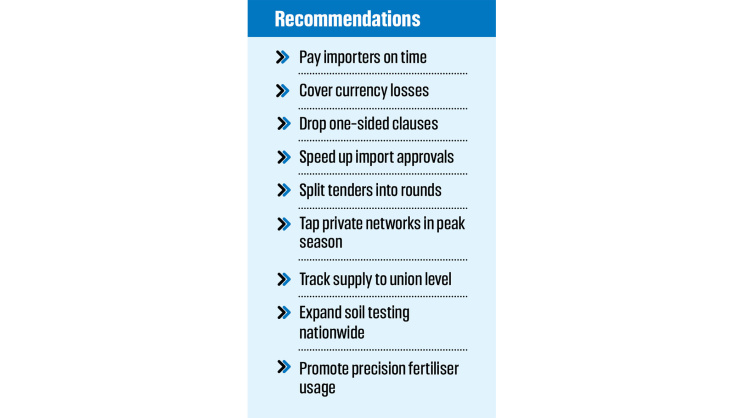
To improve fertiliser efficiency, they recommended precision farming, which uses modern agricultural technologies such as drones and sensors to assess how much fertiliser a crop needs.
They also called for wider soil testing across the country, with private players brought in if necessary.
At the discussion, titled “Fertiliser Crisis: Who Is Responsible?”, Wais Kabir, former executive chairman of the Bangladesh Agricultural Research Council (BARC), said Bangladeshi farmers often use more fertiliser than their crops require, even though detailed recommendations on fertiliser use already exist.
He said soil testing has been conducted across the country for decades, with information available at upazila, union and, in some cases, mouza levels.
The Soil Resource Development Institute, in collaboration with BARC, produces a fertiliser recommendation guide every five years. The recommendations are based on soil conditions and individual crops, rather than treating all farmland in the same way.
The information has also been digitised through the “Khamari” mobile app, which can provide recommendations on the type and quantity of fertiliser required for a particular crop and location, he said.
The former BARC executive chairman agreed that the bigger challenge is getting that information to farmers.
The fact is not necessarily that farmers need to get the information to their phone, Wais said, adding that agri officials can access the recommendations and guide farmers in this regard.
“But the reality is that the recommendations are not reaching the field as effectively as they should,” he commented.
Referring to his experience, Wais said urea is particularly prone to overuse because its effect is visible quickly. Farmers see greener leaves after applying it and may assume that more fertiliser will produce better results.
According to him, that is how fertiliser overuse usually occurs.
According to a recent World Bank (WB) report, around 95 percent of farmers in Bangladesh use unbalanced combinations of nitrogen, phosphorus, potassium and sulphur.
The WB study found that about two-thirds of farmers overuse phosphorus, nearly nine in 10 apply too little sulphur, and six in 10 fall short on potassium. Nitrogen use is also uneven, with underapplication among rice growers and excessive use in onion and vegetable cultivation.
The report said nutrient imbalances vary significantly across regions. Underdosing is more common in Barishal and Sylhet, while excessive application is more prevalent in Khulna and Rajshahi.
Correcting these imbalances could increase yields by 33 percent for Boro rice, 65 percent for Aman rice and 87 percent for potatoes, the report said.
At the discussion, Md Faizur Rahman Bokul, chairman of Noapara Group, a large chemical fertiliser importer, said Bangladesh could make greater use of balanced fertilisers such as NPK instead of relying heavily on individual products such as urea, DAP and TSP.
NPK fertiliser contains three essential nutrients: nitrogen, phosphorus and potassium. In neighbouring India, NPK is widely used to provide crops with balanced nutrients and support healthy growth, yield and soil fertility.
Faizur said different crops require different combinations of nutrients. Using a more balanced fertiliser mix could potentially reduce unnecessary application of individual nutrients while improving nutrient efficiency.
 For all latest news, follow The Daily Star's Google News channel.
 Md Mosharraf Hossain, chairman of the Bangladesh Fertilizer Association, said the debate around fertiliser use in Bangladesh should move beyond questions of supply and pricing to focus more seriously on what kind of fertiliser is being supplied in the first place.
He said the private sector has long been ready to introduce a wider range of balanced fertiliser products, including mono-ammonium phosphate (MAP), but uptake has remained limited because farmers are not sufficiently informed about the benefits of switching away from conventional single-nutrient products.
“We can import and market alternative products, but if farmers don’t understand why a balanced formulation works better for their soil, they will keep going back to what they know,” Mosharraf said, adding that this is where government agencies, agricultural extension officers and private importers need to work together rather than in isolation.
He said quality control and standardisation should also be strengthened as more diversified fertiliser products enter the market, since inconsistent quality could undermine farmer confidence in newer alternatives before they have a chance to prove their value.
MAP contains less nitrogen than DAP while providing a similar phosphate component, which, he said, can make it more suitable for some applications. Such alternatives are already widely used in other countries.
Nano fertiliser was also discussed as an emerging option.
Faizur said nano urea and nano phosphate could reduce the amount of fertiliser required by delivering nutrients more directly to plants. This could also help reduce pressure on soil and the environment. However, the immediate priority is ensuring that conventional fertiliser reaches farmers on time.
Riaz Uddin Ahmed, executive secretary of the Bangladesh Fertiliser Association, and Md Mosharraf Hossain, former additional secretary of agriculture ministry, also spoke at the programme.
Arun Debnath, deputy editor of The Daily Star, hosted the discussion, while Kamal Ahmed, consulting editor of The Daily Star, was also present.
Comments