


Why exporters are losing their competitive edge

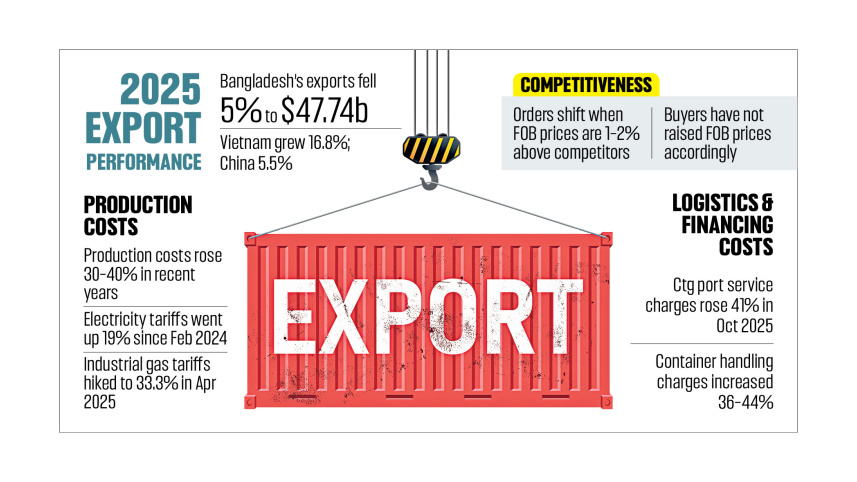
Bangladesh’s exporters are losing ground to regional competitors as rising energy, financing and logistics costs squeeze profit margins and make it increasingly difficult to match the prices and delivery times offered by countries such as Vietnam, China and India.
The pressure is becoming harder to absorb because exporters have little scope to pass higher costs on to overseas buyers, raising the risk of lost orders and shrinking market share.

Bangladesh’s merchandise exports declined by nearly 5 percent in 2025, falling to $47.74 billion compared with the previous year, according to official data.
By comparison, Vietnam’s exports grew 16.8 percent in 2025 and China’s 5.5 percent, while global merchandise exports increased 7.2 percent, data from the World Trade Organization and UN Trade and Development (UNCTAD) showed.
Even a small difference in price can determine where an order goes, industry leaders say. The continuing conflict in the Middle East and the Trump administration’s additional 10 percent tariff are now adding to the pressure on exporters, making it harder for them to compete.
Buyers may shift orders when Bangladesh’s free-on-board (FOB) price – the price before shipping and insurance – is just 1-2 percent higher than that of a competitor, said Asif Ibrahim, vice-chairman of New Age Group.
For a $4 garment, a 1-2 percent difference amounts to only 4-8 cents per piece.
But on a one-million-piece order, that could mean a difference of $40,000-$80,000, explained Asif, who is also a former director of the Bangladesh Garment Manufacturers and Exporters Association (BGMEA).
“Bangladesh has already lost orders to Vietnam, India, Pakistan, Sri Lanka and Indonesia, particularly when buyers prioritise price and delivery reliability,” Ibrahim said.
He said industry estimates suggest production costs have risen by around 30-40 percent over the past several years, driven by higher gas and electricity prices, wages, interest rates and exchange-rate depreciation.
But buyers have generally not increased the FOB prices proportionately.
ENERGY, LOGISTIC COSTS RISE
Energy has emerged as one of the biggest constraints. Bangladesh’s electricity tariff increased nearly 19 percent, from Tk 8.95 per unit in February 2024 to Tk 10.63 in June 2026.
In April 2025, gas tariffs for new industrial connections rose 33.3 percent to Tk 40 per unit, while captive power gas prices increased 36.6 percent to Tk 42.
“Even a 2–3 percent reduction in manufacturing costs would be transformative. On $40 billion in RMG exports, 2 percent represents about $800 million in competitiveness,” Ibrahim said.
Meanwhile, logistics costs are adding to the pressure.
Chattogram Port’s October 2025 tariff revision raised service charges by an average 41 percent, while charges for a 20-foot container increased 37 percent to Tk 16,243 from Tk 11,849, according to Fazlee Shamim Ehsan, executive president of the Bangladesh Knitwear Manufacturers and Exporters Association (BKMEA).
Private inland container depots also increased export-container handling charges by roughly 36-44 percent, he said.
“Exporters often have limited scope to pass these additional costs on to overseas buyers,” Fazlee said.
He said longer logistics lead times, partly linked to the lack of a deep-sea port, are further weakening Bangladesh’s position, while poor branding, bureaucracy, skills shortages and slow automation are compounding the problem.
 For all latest news, follow The Daily Star's Google News channel.
 Riad Mahmud, managing director of Shoeniverse Footwear, said higher interest rates and disruptions in energy supply had significantly increased operating costs and put pressure on cash flow.
He said many banks are either not providing sufficient working capital or are taking too long to process financing, despite government calls for support.
“If the government’s incentives are not implemented in time, high costs will erode our export competitiveness. We risk losing orders and market share to competing countries, and those markets may be difficult to regain,” Riad said.
PROFIT MARGIN FALLING
For some exporters, the squeeze is already hitting profitability.
RN Paul, managing director of RFL, said rising electricity, gas, port and freight costs had increased production expenses, while the company had little room to raise prices because it competes directly with suppliers from China and Vietnam.
“We have no scope to increase prices because we have to compete with China and Vietnam. Our prices have remained static,” he said.
RFL has installed solar power and improved labour productivity to contain costs, but Paul said these measures have not been enough to offset the increase.
The company’s profit margin may have fallen from around 3 percent to 1 percent, he estimated.
As a result, RFL is avoiding some export orders that could result in losses, a shift Paul said would slow market growth.
The competitiveness problem extends beyond individual exporters and could affect investment, employment and economic growth, said Mustafizur Rahman, distinguished fellow at the Centre for Policy Dialogue.
“The ongoing Middle East crisis, the enforcement of an additional 10 percent tariff under the Trump administration, and other trade-related measures have emerged as serious challenges to exporters’ competitiveness. These factors are significantly increasing the cost of doing business,” he said.
He warned that losing buyers could have long-term consequences because relationships built over years can be difficult to restore once orders move to competing countries.
“Export competitiveness is linked to employment and GDP growth, as well as the inclusiveness of growth. SMEs suffer more from these pressures,” Mustafizur said.
Comments