


IFRS 9 adoption to challenge banks amid high NPLs: experts
Implementation of international best practice of accounting, IFRS 9, in the banking sector would be challenging amid the huge non-performing loans and the sector’s current state, according to investment experts.
Although countries like Pakistan, Nepal and Sri Lanka have already implemented IFRS 9 — a move from provisioning based on incurred losses to forward-looking expected credit losses before default — it is difficult for Bangladesh as many banks are already struggling, according to the CFA Society Bangladesh.

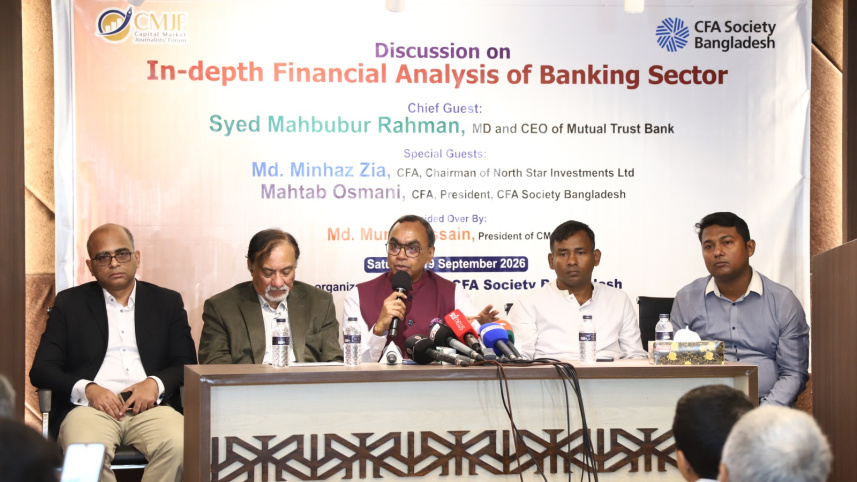
The association of chartered financial analysts (CFAs) presented the findings at an event on financial analysis of the banking sector organised by the CFA Society Bangladesh and the Capital Market Journalists’ Forum (CMJF) today at the CMJF auditorium in the capital.
Syed Mahbubur Rahman, a former chairman of the Association of Bankers, Bangladesh (ABB), said it is essential to assess the actual risk of bank loans and maintain adequate provisions in line with international standards.
However, implementing IFRS 9 could pose “a major challenge” for banks under pressure from high non-performing loans and capital shortages.
Therefore, while adhering to international standards, IFRS 9 should be implemented gradually, taking into account the current realities of the country’s banking sector, he said while speaking at the event as the chief guest.
Bangladesh is going to follow IFRS 9 in banking accounts partly on a pilot basis in the current year. Full application for credit will be implemented from 2028.
Referring to the fact that non-performing loans in the banking sector have exceeded 32 percent, Rahman, also managing director and CEO of Mutual Trust Bank, said such a high level of bad loans is putting pressure on banks’ earnings, provisioning and capital.
To restore the capacity of banks, liquidity, capital, lending and non-performing loans must all be considered together. Banks need to be made effective not merely as deposit-taking institutions but as the primary channel for financing productive sectors of the economy.
He said reforms in the banking sector should be undertaken gradually, taking into account the realities on the ground. A sudden major change could put pressure not only on banks but also on depositors and businesses.
Minhaz Zia, chairman of North Star Investments, proposed that at least 50 percent of the boards of commercial banks should comprise independent directors to improve the banking sector. He also said that no member of a bank’s board of directors should be allowed to sit on its credit committee.
Loan approvals should be handled by a completely independent credit team, while an internal control committee comprising only independent directors should oversee internal controls.
He also stressed the need to modernise the bankruptcy law, or Bankruptcy Act.
At the event, Mahtab Osmani, president of the CFA Society, and Md Munir Hossain, president of the CMJF, also spoke.
Md Iqbal Hossain, chief financial officer of Sonali Bank PLC; Sakib Chowdhury, head of research at UCB Stock Brokerage, and S M Galibur Rahman, head of research at Shanta Securities, gave presentations.
In the presentations, they said banks in Bangladesh will need at least Tk 2,000 crore in paid-up capital to be eligible to pay cash dividends, although this is an uncommon practice in any neighbouring country.
A comparison with other South Asian and Asian banking systems also shows that many jurisdictions principally use risk-based capital, asset quality, distributable earnings and regulatory compliance when determining whether banks can distribute dividends.
The analysis illustrates the distinction by comparing BRAC Bank and National Bank. As of June 30, 2026, National Bank had about 41 percent more paid-up capital than BRAC Bank. Yet National Bank’s shareholders’ equity, excluding non-controlling interests, was negative Tk 46.7 billion, while BRAC Bank’s stood at positive Tk 113.1 billion.
 For all latest news, follow The Daily Star's Google News channel.
Comments