Why Dhaka cannot simply ban the rickshaw
Every year or so, Dhaka decides that rickshaws have to go. In May 2024, the roads minister ordered battery-run rickshaws off the capital's streets. Within days, after drivers themselves took to the streets in protest, the decision was reversed. That November, the High Court gave the authorities three days to remove them from Dhaka; within a week, the Appellate Division had stayed the directive. Another ban followed in 2025. Then, this August, the government changed course, proposing an eight-zone plan to register the vehicles, license their drivers and restrict them to internal roads rather than trying once again to sweep them away.
That change of course makes sense. But to understand why, it is worth asking why the earlier attempts kept failing. Weak enforcement was certainly part of the problem. The deeper reason, however, is that the bans were trying to eliminate a form of transport that exists because it meets a very real need. People ride rickshaws because, for many of the journeys they make across Dhaka, nothing else works. You cannot ban a need. You can only leave it unmet.
There is an old line that fits the situation better than any traffic model: you don't cut off the head to cure a headache. Dhaka's congestion is real, and battery rickshaws bring genuine problems of their own. But removing a mode of transport before providing anything that can replace it, is not a cure. It is an amputation.
The more honest question is not simply how much road space Dhaka has, but who occupies that space, and for whom. Private cars carry a relatively small share of the city's passengers and yet, by one working-paper estimate, consume close to a third of the available road space. Rickshaws, by contrast, move a far larger share of people while occupying considerably less space. When rickshaws are cleared to “free up the road”, that space does not necessarily go to the many. Too often, it goes to the few who were already using most of it.
The space we don't have
Start with the ground beneath us. Roads occupy less than eight percent of Dhaka's land area, and much of that road network cannot accommodate large vehicles. Of the roughly 4,000 kilometres of road in the city, only about 300 kilometres are wide enough for a full-size bus. The rest is a maze of lanes and connecting roads—the streets on which much of the city actually lives.
The more honest question is not simply how much road space Dhaka has, but who occupies that space, and for whom. Private cars carry a relatively small share of the city's passengers and yet, by one working-paper estimate, consume close to a third of the available road space. Rickshaws, by contrast, move a far larger share of people while occupying considerably less space. When rickshaws are cleared to “free up the road”, that space does not necessarily go to the many. Too often, it goes to the few who were already using most of it.
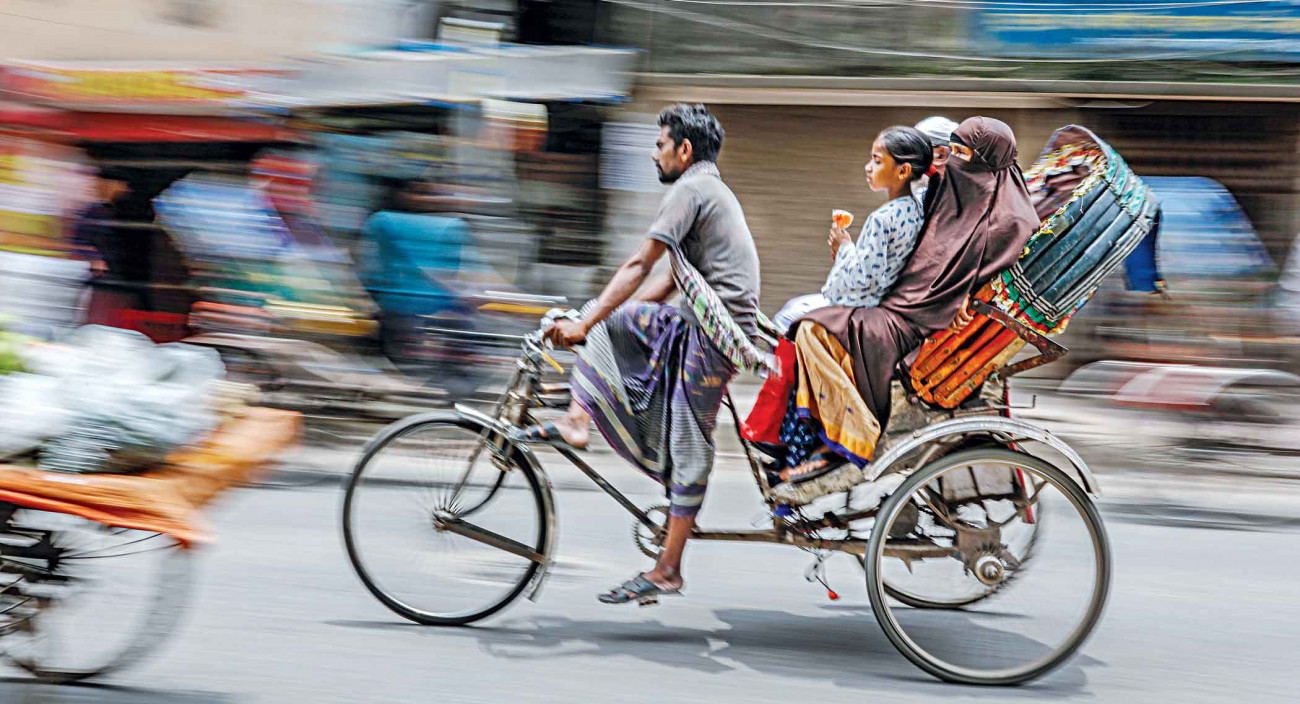
Then there is the shape of Dhaka itself. Old Dhaka was not laid out on a grid; it grew organically. Its lanes are narrow and winding, opening onto tight junctions that cars often cannot negotiate. In much of the old city, a rickshaw is not simply the preferred vehicle; it is sometimes the only one that fits. Remove it and you do not modernise the neighbourhood. You risk cutting it off. The same logic applies, in a quieter way, to planned areas such as Gulshan, where residents still reach for a rickshaw to travel a few blocks because taking a car for a five-minute journey makes little sense.
A city you can't walk
The usual response is that people should walk. In principle, they should. Most short journeys in any well-functioning city ought to be possible on foot. And Dhaka's residents already walk a great deal: more than half of all trips in the city are made on foot, by cycle or by rickshaw. But people often walk because they have no better option, not because the city has made walking pleasant, convenient or safe.
In many areas, there is no footpath at all. Where one exists, it may be broken, sunken, occupied by shops or blocked by parked vehicles, forcing pedestrians back into the traffic from which the pavement is supposed to protect them. Fixing this is not the work of a season.
Rebuilding walkable streets across a city of this size requires years of investment, planning and political commitment that, so far, have not been sustained at the necessary scale.
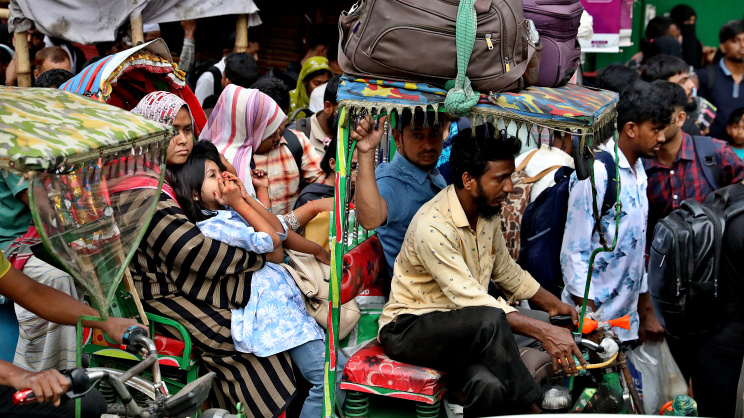
Until that happens, walking alone cannot bridge the distance between people's homes and the places where buses or trains can pick them up or drop them off. Something has to fill that gap, and in much of Dhaka, that something is the rickshaw. It is, in practice, the city's first- and last-mile connection.
The bus that isn't there
Behind all of this lies a more fundamental failure: Dhaka has never built a public transport system capable of meeting the needs of a city of its size. Instead, much of the city depends on a fragmented network of privately operated buses competing for passengers, often poorly maintained and offering little assurance of comfort, reliability or safety. For something that is supposed to function as mass transit, the system remains remarkably uncoordinated.
The consequences are visible in the speed at which Dhaka moves. Average traffic speed in the city has fallen to around six or seven kilometres an hour, barely faster than walking, while residents can lose more than two hours a day on the road. A bus trapped in the same congestion cannot function effectively as mass transit; it simply becomes a larger, slower and more crowded part of the same traffic jam.
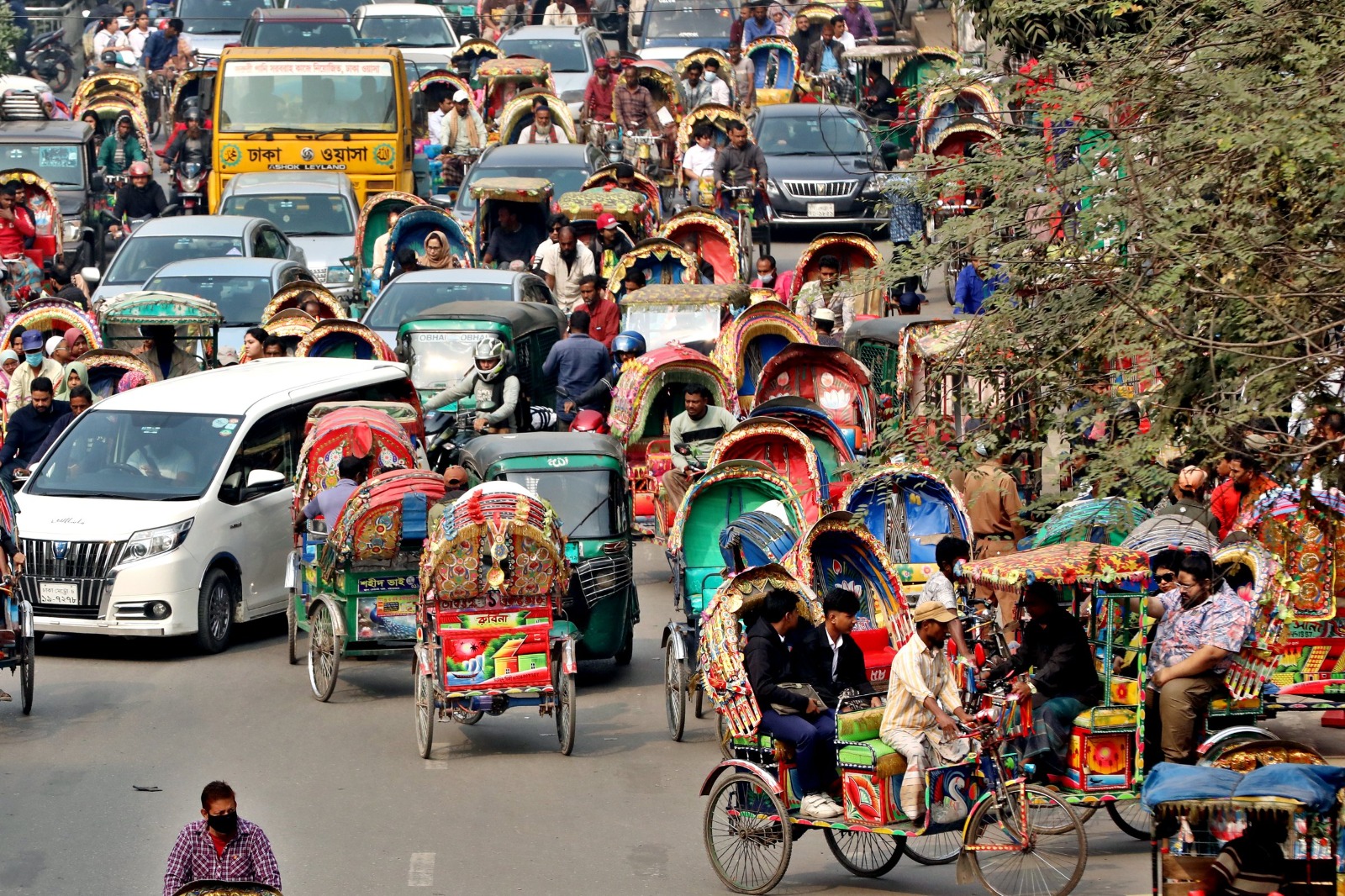
There is also a mismatch between the journeys people make and the journeys buses can serve. Many everyday trips are short: to the local market, a school, a clinic or a relative living a few lanes away. For a journey of a kilometre or two through side streets, walking to a main road and then waiting twenty or forty minutes for an unpredictable bus makes little sense when a rickshaw is waiting at the corner. The bus network was never designed to serve these small, lateral journeys through the capillaries of the city.
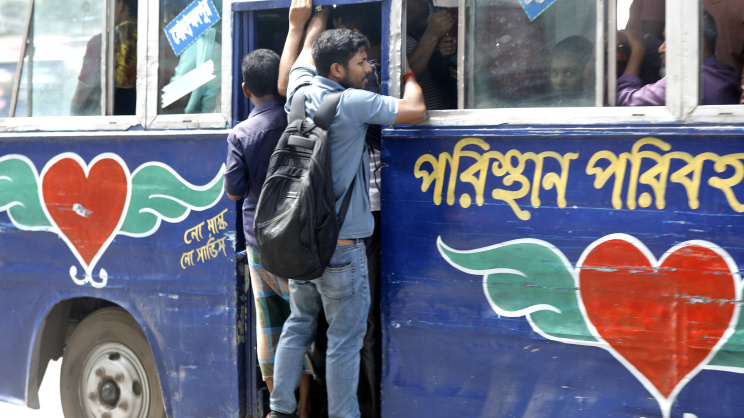
Nor is the bus equally accessible to everyone. Buses are frequently overcrowded, their steps are high, their aisles packed, and drivers do not always come to a complete stop before passengers are expected to get on or off. For an elderly person, a pregnant woman, a small child or someone with limited mobility, these are not minor inconveniences. They can make the bus practically unusable. Remove the rickshaw without providing an accessible alternative, and for many people, moving around the city becomes considerably more difficult.
Why women choose the rickshaw
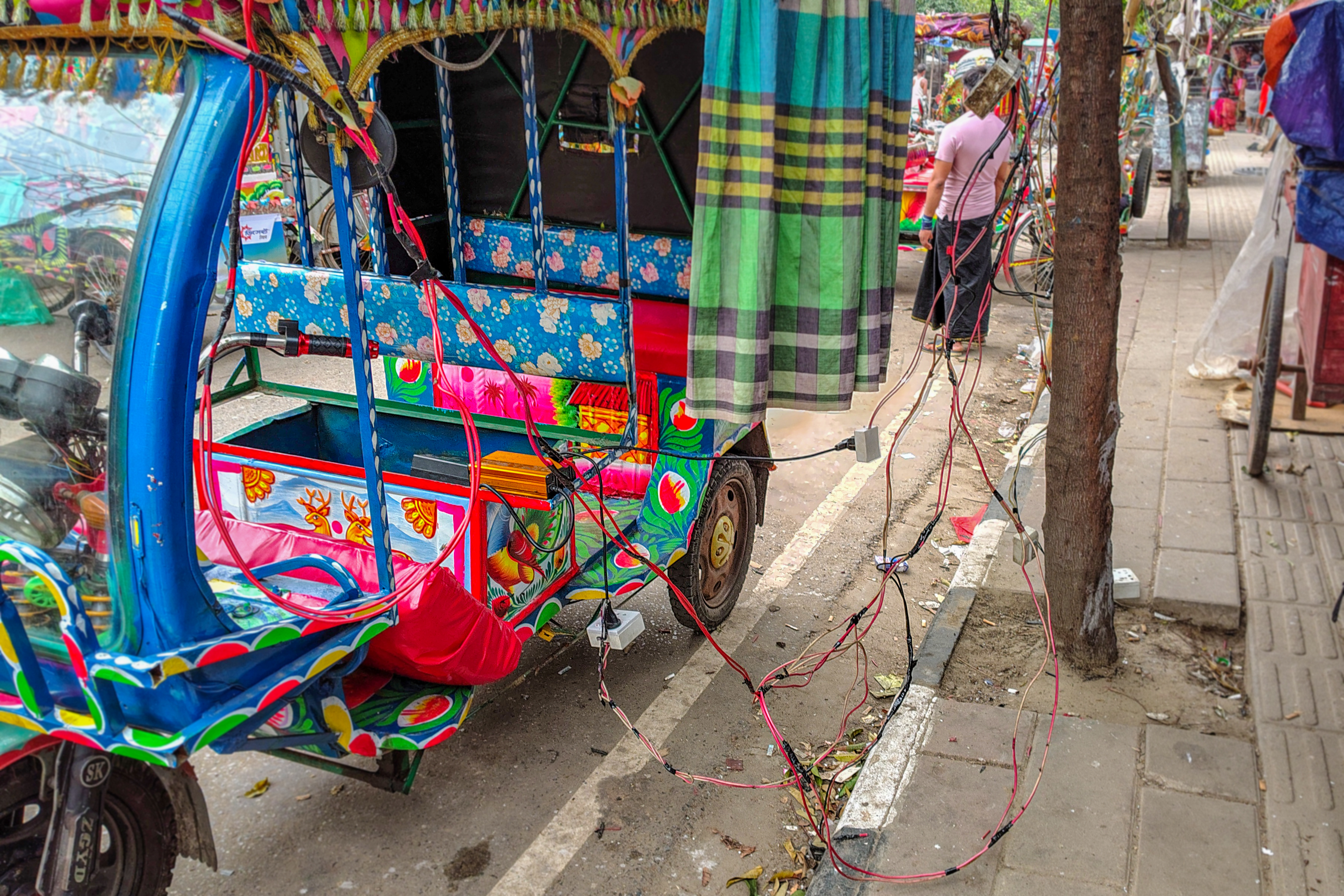
For women, the calculation is sharper still. A BRAC study found that 94 percent of women using public transport in Bangladesh had experienced some form of sexual harassment. The figure points to a broader reality: for many women, choosing how to travel through Dhaka is not simply a question of time, cost or convenience. It is also a calculation about personal safety.
The alternatives can become even narrower after dark. The informal safety provided by a busy daytime street—the shopkeepers, passers-by and ordinary eyes on the street—thins out as evening falls. Women, children and the elderly are often among those for whom walking then becomes more difficult or intimidating. In such circumstances, a rickshaw offers something other modes often cannot: a degree of separation from the crush of a crowded bus, an alternative to walking along an unlit stretch of pavement, and a journey that can end at the door rather than at a bus stop several broken lanes away.
This is why removing rickshaws in the name of decongestion cannot be treated simply as a traffic-management decision. Push women out of rickshaws and onto buses without first making those buses safer and more accessible, and the cost of that decision is transferred from the road network to the passenger.
The battery rickshaw problem is a regulation problem
None of this amounts to a defence of the status quo. The number of battery-run rickshaws has grown rapidly, largely without effective regulation. Estimates of how many are operating across Bangladesh range from a few hundred thousand to as many as four million; the enormous gap between those figures itself reveals how poorly the sector has been documented. In Dhaka, their numbers surged after August 2024, when enforcement weakened. Around 97 percent of battery rickshaws on the road are reportedly unregistered.
The problems are serious. A conventional pedal-rickshaw frame with rudimentary brakes was not designed to carry a motor, yet adding one allows the vehicle to travel considerably faster without necessarily giving it the braking capacity to match. The Centre for Policy Dialogue has linked electric three-wheelers to roughly a fifth of road-crash deaths in 2024. Lead-acid batteries create another, potentially longer-lasting danger: research by icddr,b has linked informal battery recycling to dangerously high levels of lead in children's blood. Charging presents yet another problem, with electricity often drawn through unauthorised connections at unlicensed charging points.
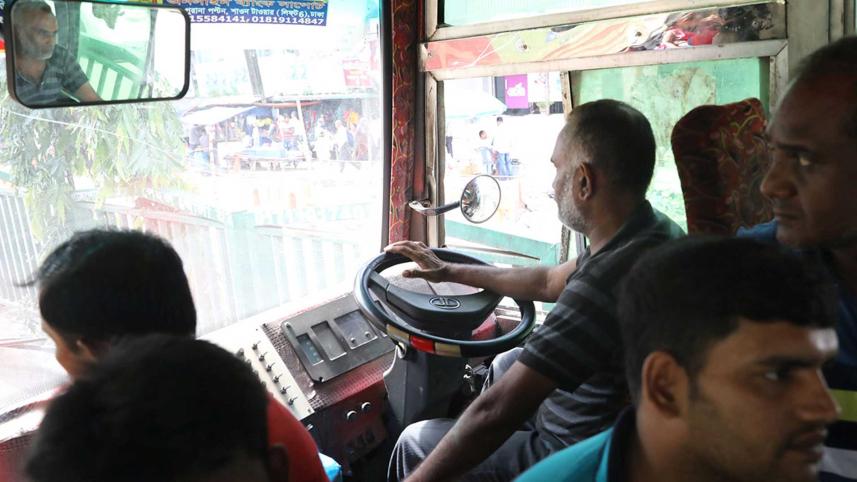
But these problems also reveal why prohibition is such a blunt instrument. The vehicles are largely unregistered because an effective registration system has not been established and enforced. Many are unsafe because adequate technical and safety standards have not been consistently imposed. Battery recycling becomes dangerous when disposal and recycling are left to poorly regulated informal operators. Unauthorised charging proliferates when a legal, regulated charging system is absent.
These are failures that regulation can address. A ban, by itself, cannot. It may instead push vehicles, charging and battery disposal further into informality, making them harder to count, inspect and control. At the same time, an abrupt prohibition threatens the incomes of drivers and others who depend on the sector, including people who have taken on substantial debt to buy their vehicles. With millions of livelihoods reportedly connected to battery-run rickshaws, removing them without creating either a regulated pathway or a viable alternative risks shifting the problem rather than solving it.
A sequence, not a switch
There is no single switch that Dhaka can flip to solve its rickshaw problem. The answer lies neither in keeping rickshaws on the streets indefinitely nor in trying to eliminate them overnight. Any reduction has to come at the end of a transition, not at the beginning. Transport experts have made the point for years: build the alternative first, then reduce dependence on rickshaws. The sequence matters.
First, formalise. Start by knowing what is actually on the road. Count and register the vehicles, license their drivers, and bring charging into a legal, metered and regulated system so that electricity is no longer drawn illegally from the grid. BUET has already developed a standard design for electric three-wheelers, with hydraulic brakes, a governed top speed, fixed dimensions and proper lights. These standards can be made mandatory for vehicles being sold or assembled. This is broadly the logic behind the government's eight-zone registration plan, and it should be implemented consistently rather than abandoned when enforcement becomes difficult.
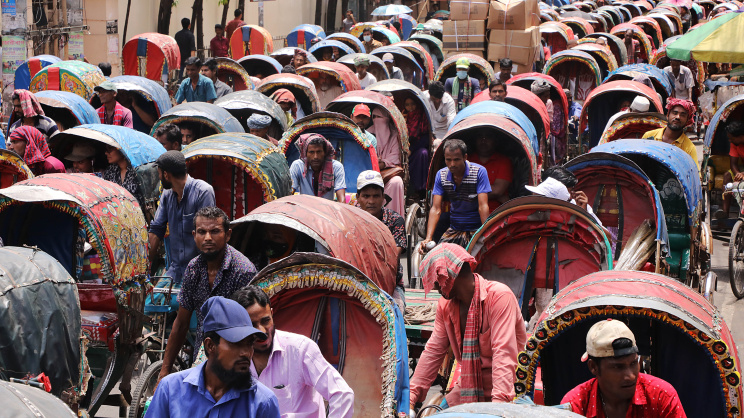
Second, make rickshaws work with mass transit rather than against it. As Dhaka's metro network expands, the success of each station will depend partly on how easily passengers can reach it from the surrounding neighbourhoods. Properly regulated rickshaws can serve as feeders, carrying passengers through narrow residential streets to metro stations and other public transport hubs. Zoning can keep that system manageable: vehicles can be licensed for designated areas, colour-coded and restricted from travelling indiscriminately across the city.
Third, reclaim the main roads—but only when the alternative exists. Once Dhaka has a reliable, accessible and harassment-free bus system capable of carrying the people who currently depend on rickshaws, slow-moving three-wheelers can gradually be removed from major arterial roads, where mixing vehicles travelling at very different speeds creates congestion and safety risks.
Fourth, make short journeys walkable. Rickshaws should recede from local streets only when those streets no longer require them. That means continuous and accessible footpaths, adequate lighting, safe crossings and neighbourhoods in which children, women, older people and people with disabilities can move around safely on foot. Build a city capable of carrying its people without forcing them to depend on rickshaws, and the rickshaw's role will diminish naturally. There will be less need for confiscation drives because there will be less need for the vehicle itself.
That is the difference between a plan and a purge. Congestion is the headache, and it is real. But the cure is to build a city that gradually makes the rickshaw less necessary, not to take the rickshaw away first and call the resulting chaos a solution. Until Dhaka has built the alternative, removing the transport people already depend on simply reverses the order in which the problem needs to be solved.
Dhrubo Alam is Deputy Transport Planner at the Dhaka Transport Coordination Authority (DTCA).
Send your articles for Slow Reads to slowreads@thedailystar.net. Check out our submission guidelines for details.
The elephants had to be rescued again. Where is the accountability?
‘Situation under control’, but at whose expense?
The untold side of Bangladesh's climate migration
Dhaka's unbearable heat: Who suffers the most?
Enforced disappearance in Bangladesh / Who investigates the state?

Gibbons, kingfishers and the changing world of Adampur Reserved Forest

More than refugees: How Rohingya youth are reclaiming their story
Behind every cup / The mental toll on women tea workers
From Shyamnagar to Kurigram: Women work, but where is the income?