‘Situation under control’, but at whose expense?

There is a phrase I have been noticing more often than usual in news reports from Bangladesh: পরিস্থিতি নিয়ন্ত্রণে—the situation has been brought under control.
It is an ordinary administrative phrase, and usually a reassuring one. Something has become tense, officials have intervened, and violence has been prevented. I would normally read past it without thinking much about the words themselves. Recently, though, I have found myself wondering what exactly had to happen for that control to be restored. Who stopped doing something? Who went home? Who was persuaded to compromise? And who discovered that creating enough pressure could change what everyone else was allowed to do?
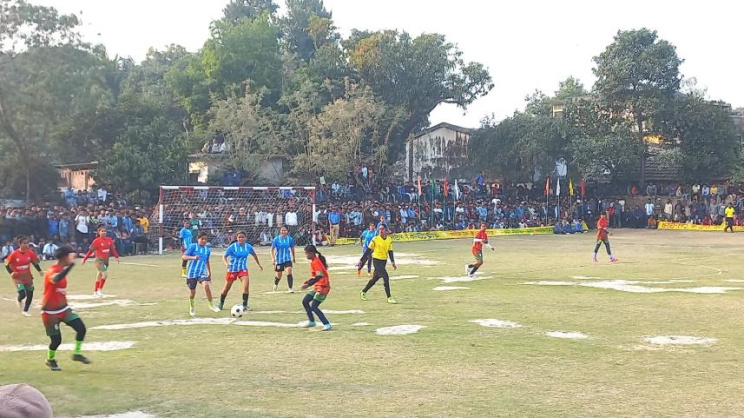
The question stayed with me after the disputes over women’s football last year. In Joypurhat, protesters objecting to women playing football vandalised fencing around a venue, and a match was postponed. The government condemned the disruption and instructed the authorities to reorganise the match. A few days later, it was played, with senior district officials present. People had tried to stop a lawful sporting event and, eventually, the state made sure it went ahead.
Around the same time, another girls’ football match in Taraganj, Rangpur, ended differently. Opposition was organised on religious grounds, the local administration imposed Section 144 around the venue, and the match was cancelled. Officials had prevented a confrontation. But the girls also did not get to play.
The difference between those two outcomes seems important. Not because every difficult local situation can be handled identically; administrators sometimes face genuine risks that are easy to underestimate from a distance. What matters is what each response teaches. In one place, intimidation did not ultimately determine the outcome. In another, creating enough pressure was sufficient to stop the event altogether.
I thought about this again when the scheduled screening of Bonolota Express in Brahmanbaria was cancelled this May. There had been an online campaign against the screening. The organisers later said permission to use the venue had been withdrawn and complained of administrative non-cooperation. Ten local cultural organisations subsequently protested the cancellation, describing it as evidence of growing intolerance towards cultural practice. There were disagreements over the precise administrative history of the venue permission, which is worth acknowledging. But the practical result was straightforward: the film was not screened there.
None of these incidents constitutes violence against women in the criminal sense, and I would not want to force them into that category. But they returned to my mind when I saw Bangladesh Mahila Parishad’s figures for August.
Its Central Legal Aid Sub-Committee, drawing on reports in 15 national newspapers and two online news outlets, documented 252 women and girls subjected to different forms of violence during the month. Fifty-five were killed. Fifty-four were reported to have been raped, 36 of them girls. Thirteen women and girls were subjected to gang rape; two were killed after being raped.
These figures have an important limitation. They come from incidents that reached the media, not from a national prevalence survey. They cannot tell us how many women never reported an assault, how many families kept an incident private, or how many cases were handled somewhere between a household, a neighbourhood and a police station without ever appearing in a newspaper. It would therefore be wrong to describe 252 as the number of women and girls who actually experienced violence in Bangladesh in August.
What unsettled me was something else: how familiar the act of reading such a monthly tally has become.
Bangladesh has spent decades strengthening the legal framework around violence against women. Rape carries extremely severe punishment. There are specialised tribunals. Governments repeatedly promise swift justice and zero tolerance. These developments are not meaningless. Many were achieved because women’s organisations, lawyers, journalists and activists fought for them.
But getting from a complaint to a verdict is another matter.
A joint study by the Supreme Court of Bangladesh and BRAC examined 4,040 cases handled by 46 Women and Children Repression Prevention Tribunals in 32 districts. Although the law envisages disposal within 180 working days, the cases studied lasted an average of 1,370 days—roughly 3.7 years. Each was scheduled for a hearing an average of 22 times. The overall conviction rate was three percent, and in 15 districts the cases examined produced no convictions at all.
The Rape Law Reform Coalition has separately drawn attention to more than 10,000 rape cases that have remained unresolved for over five years. Among the problems it identified were weak investigations and inadequate survivor support, as well as political interference and forced settlements outside court.
I do not think the main lesson here is that Bangladesh needs to become angrier about rape. We are already capable of enormous anger after a particularly horrific case. Nor is it obvious what another escalation in maximum punishment would achieve when rape can already be punished with life imprisonment or death. The difficult part begins much earlier than sentencing.
A man does not need to know national conviction statistics to form an impression of how consequences work. He knows his family. He knows the local police station. He knows whether the woman is likely to complain, whether her family will stand by her if she does, whether his own family has influence, whether somebody can speak to somebody, whether the matter can somehow be settled. People learn what the law means partly by watching what happens around them.
Political interference is especially difficult to discuss because the phrase makes us imagine something unusually dramatic: a powerful politician calling an officer and ordering a case closed. Influence does not always operate so tidily.
A local figure takes an interest. A telephone call is made. Someone advises a family that pursuing the matter may create problems. An informal settlement begins to sound more sensible than a trial. A witness becomes less certain about appearing.
Not every such story is political. Money, family hierarchy, neighbourhood standing and professional connections can matter just as much. Nor am I suggesting that every rape allegation is subject to lobbying. The Rape Law Reform Coalition’s concern about political interference and forced settlements matters because these are vulnerabilities within the system, not because they provide a universal explanation for every case that fails.
Women are particularly familiar with this world because their lives are governed by considerably more than statute.
Most girls learn quite early that freedom has a practical side. There is the place you are legally entitled to go and the place your family thinks you should go. There is the hour at which you are perfectly entitled to be outside, and the hour after which being outside begins to invite judgements about your character. There is the man whose behaviour is inappropriate and the calculation about whether confronting him will make the encounter safer or worse.
Some of these lessons are offered with love. Parents worry because danger is real, which is what makes the subject complicated. A mother telling her daughter not to travel alone at night may be reproducing a gendered restriction, but she may also be responding rationally to the world in which her daughter actually lives. The difficulty is that the burden of adapting to danger gradually settles on the person exposed to it.
What begins as advice about safety can become a map of female life. Avoid this road. Do not return at that hour. Do not make him angry. Think of the family. Do not make the matter bigger than it already is. Eventually, restriction does not always require somebody actively imposing it. Women learn to anticipate. Behaviour is adjusted in advance.
As a social researcher, I find the language of “choice” inadequate here. A woman may choose not to complain, not to leave a marriage, not to attend an event, or not to challenge harassment. But knowing that she made a choice tells us very little unless we also know what she expected would happen if she chose differently.
This is one reason the recent willingness of organised groups to test the limits of public authority bothers me in a way that goes beyond the particular event being disrupted.
I am not arguing that conservative opposition to women’s football produces sexual violence. Domestic abuse, rape, mob iintimidation,and the cancellation of a film screening involve different actors, different ssettings,and different immediate causes. Trying to collapse them into a single explanation would make the argument easier to dramatise and harder to defend.
The connection I see lies in how people learn where power resides.
Consider Taraganj from the point of view of the girls who were supposed to play. They had done nothing unlawful. Yet whether their match could take place depended not simply on their right to play, but also on how the administration assessed the threat posed by people determined to stop them. Once Section 144 was imposed, the legal right itself did not disappear. Its exercise did. That distinction—between protecting a right and preventing trouble—is easy to miss because the two often coincide. Sometimes they do not.
Political parties, religious organisations, students, workers, and local communities have all mobilised collectively for very different reasons. Protest itself is not the problem. The problem begins when the ability to threaten disorder becomes more powerful than the right being ddisputed.
A public official facing an angry crowd may conclude that cancelling an event is the safest option. A family may decide that persuading a daughter to remain with an abusive husband is safer than confronting the husband’s family. The relatives of a survivor may think a settlement will spare her years of court appearances, expense, and gossip. None of these decisions has to arise from hostility towards the person being asked to compromise. They may even seem sensible in the moment. But somebody bears the cost of that sense.
This is where I think discussions of Bangladesh’s “mob culture” sometimes stop too early. We count incidents and condemn mobs, but the institutional response matters just as much. Crowds have existed throughout Bangladesh’s political history. Political parties, religious organisations, students, workers, and local communities have all mobilised collectively for very different reasons. Protest itself is not the problem. The problem begins when the ability to threaten disorder becomes more powerful than the right being disputed.
Women enter that contest with an existing disadvantage. Their freedom has long been subject to claims made in the language of family honour, modesty, morality, safety and social order. A society does not have to formally withdraw women’s rights for women’s public space to become narrower. That can happen bit by bit, whenever defending a right is treated as more troublesome than asking a woman to accommodate those who oppose it. Something similar happens in private life.
Bangladeshis do not generally announce that husbands should beat their wives. Yet domestic violence can very quickly be translated into the language of marital trouble. Families discuss adjustment. Children are mentioned. The woman’s financial future is considered. Divorce carries consequences. The moral clarity with which violence is condemned in the abstract can become much less clear when a particular woman is deciding whether she can actually leave.
Sexual violence creates its own negotiations. A survivor may have to contend not only with the alleged offender but also with questions about reputation, family standing, evidence, delay,and whether enduring the process will make her life worse. The criminal case may formally be between the state and the accused, but socially many more people enter it. That is one reason low conviction rates matter beyond the cases from which they are calculated. A woman considering whether to report will have a sense of what is likely to follow. So will her family. And so will the accused.
I would still treat the three-percent figure with caution. It comes from the particular group of Women and Children Repression Prevention Tribunal cases examined by the Supreme Court and BRAC. It is not a national rape conviction rate, and presenting it as one would be misleading. What it does show is how difficult the journey from allegation to accountability can become. There is no dramatic legislative answer to this.
Much of what needs improvement is mundane: investigation, evidence collection, forensic capacity, police practice, witness protection and support, prosecution, court administration, and services for survivors. These things do not satisfy public anger in quite the way that a demand for the harshest possible sentence does. They do, however, determine whether punishment is ever likely to occur.
Political parties have a responsibility as well. A government cannot credibly insist upon law and order nationally while politically influential people are capable of securing protection locally. Allegations involving politically connected individuals must be able to proceed without becoming a contest between the complainant’s connections and those of the accused. That principle should not depend upon which party is in office.
Administrations facing organised intimidation also have to think beyond the immediate crisis. Joypurhat offers one example. A match was disrupted, the government condemned the disruption, the event was reorganised and the women eventually played. Taraganj offers another: the danger of confrontation ended, but so did the match.
Neither incident tells us anything simple about Bangladesh. Their difference is what matters. The state does have choices about how it responds to informal coercion, even if those choices are sometimes difficult and constrained.
The August figures make such choices harder to dismiss as peripheral. Among the 252 women and girls whose experiences became visible enough to enter the newspapers monitored by Mahila Parishad, there will be very different histories. Some violence happened inside families and some outside them. Some victims were children. Different perpetrators, circumstances and relationships are hidden within the categories of a monthly report. There is no single cultural explanation for all of it, no single political party responsible for it and no single reform that will make it disappear.
What they do share is that each woman or girl lived within a network of relationships and institutions that affected what could happen before the violence, what she could do afterwards, and whether accountability would eventually follow.
That is why I keep returning to পরিস্থিতি নিয়ন্ত্রণে.
There will always be situations a government has to control, and sometimes there will be genuine security risks with no perfect decision available. Families, too, make compromises when every option appears bad. I do not think it helps to judge those choices as though fear, power and risk were evenly distributed.
What interests me is what happens when accommodation keeps travelling in the same direction.
If a threatened football match disappears, the situation becomes calmer. If a cultural programme is abandoned, there is nothing left to disrupt. If a woman concludes that pursuing a complaint will cost more than she can bear, a difficult case may also disappear from view.
All of these can look, from a distance, like situations that have been resolved. I am less sure about what has actually been resolved.
Dr Lubna Ferdowsi is a researcher and educator whose work engages with society, culture, public policy and questions of citizenship.
Send your articles for Slow Reads to slowreads@thedailystar.net. Check out our submission guidelines for details.
The untold side of Bangladesh's climate migration
Dhaka's unbearable heat: Who suffers the most?
Enforced disappearance in Bangladesh / Who investigates the state?

Gibbons, kingfishers and the changing world of Adampur Reserved Forest

More than refugees: How Rohingya youth are reclaiming their story
Behind every cup / The mental toll on women tea workers
From Shyamnagar to Kurigram: Women work, but where is the income?
Waiting for April: The other side of migration in the Sundarbans
Where have Bangladesh’s hilsa gone?