“Why do fireflies die so young?”
Arguably, few Studio Ghibli films leave behind quite the same sense of loss and helplessness as Isao Takahata’s Grave of the Fireflies (1988). Set in Kobe and Nishinomiya in Japan’s Hyogo Prefecture during the final months of World War II, the film follows 14-year-old Seita and his four-year-old sister, Setsuko, as they struggle to survive.
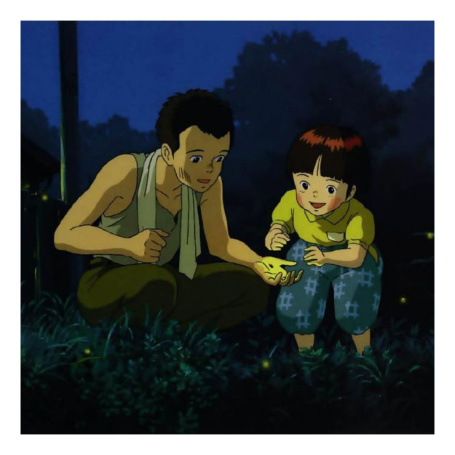
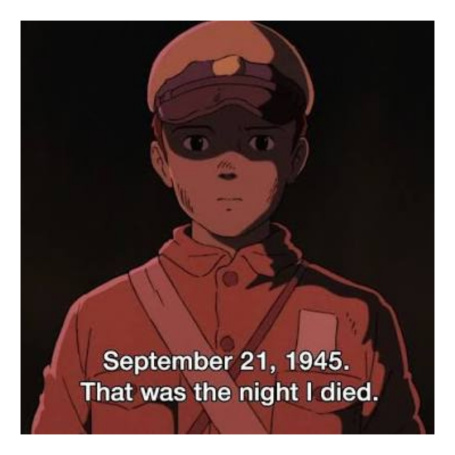
Death frames the story, leaving us mourning two children we have barely begun to know. Even their happiest moments unfold under the shadow of an ending we cannot change. Yet, when the siblings play at the beach or watch fireflies illuminate the darkness, it is difficult not to wish, however foolishly, that things might turn out differently. For a little while, we see what their childhood could have been, had the world around them been a little less cruel.

Although fictional, their story draws on very real suffering. Adapted from Akiyuki Nosaka’s semi-autobiographical short story, the film carries echoes of the author’s own wartime losses, including the death of his younger sister from malnutrition.
After an American bomber destroys their home and fatally injures their mother, Seita and Setsuko move in with a distant aunt. Here, they attempt to rebuild whatever semblance of normalcy they can manage, although their mother’s absence follows them into the unfamiliar household.
Before they have had much chance to grieve, even the belongings she has left behind become things they must learn to live without. At one point, their aunt suggests exchanging their mother’s kimonos for rice. It is a practical suggestion, given how little there is to eat.
But for the siblings, letting go of the clothes means surrendering one of their last physical connections to her. Something they could have held on to in her absence must be given away so that they can survive it. There is a particular cruelty in being asked to make that choice. The rice will feed them for a while, but eventually it will run out, leaving them hungry again, with even less of their mother to remember her by. Much like the memory of their mother, the past, and the brief flicker of the fireflies – it is fleeting.
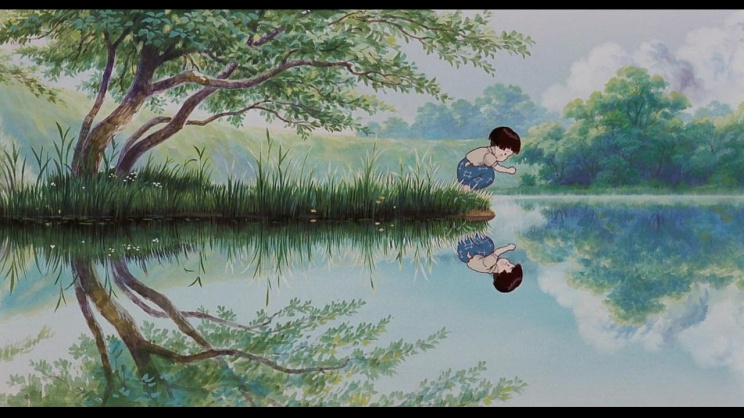
Seita, nevertheless, tries to preserve what remains of his sister’s childhood. He keeps their mother’s death from her, offering candies, distractions, and half-truths when the truth feels too painful to explain. Watching him find ways to make her laugh, we want to believe that he can keep doing so, that there might still be something he can protect her from. His determination sometimes becomes obstinacy, and his decisions can be frustrating to watch.
But it is easy to forget, in expecting him to take better care of Setsuko, that Seita is only 14. He, too, has lost his mother and home. He is trying to look after a younger child while barely being given the space to be one himself. Perhaps keeping the truth from Setsuko also allows him to hold on to the possibility of their mother for a little longer. Explaining that she will never come back would mean saying aloud something he has barely begun to accept. His attempts to comfort his sister become inseparable from his own grief, which he has little idea how to express while trying so hard to appear capable.
However, Setsuko knows more than he realises. When Seita finds her burying the dead fireflies, she reveals that their aunt has already told her about their mother. Her question about why fireflies have to die so soon becomes especially painful in this moment. She is looking at the tiny creatures she is burying but seems to be asking about her mother too and about the unfairness of someone disappearing before she is ready to let them go.
Despite Seita’s efforts, death has already found its way into his sister’s understanding of the world. Setsuko may not comprehend the permanence of their loss in quite the same way he does, but she knows that their mother is gone. Digging a grave for the fireflies gives her something to do with that knowledge, a small act of mourning for a loss she cannot yet put into words.
The fireflies bring together the haunting beauty and devastation that run throughout the film, love and loss co-existing within the same frame. For one evening, their light transforms the siblings’ shelter into somewhere that almost feels safe. By morning, they are dead, leaving Setsuko to bury the very things that had brought her joy only hours before. Their brief brightness mirrors the children’s transient happiness, and the lives that will end before either has had the chance to grow up.
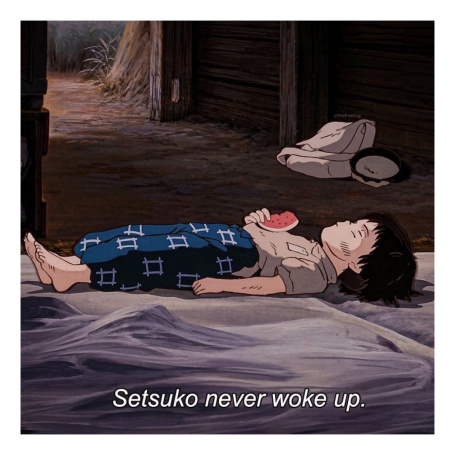
However, this does not make the comfort the fireflies bring any less real for the children. Seita and Setsuko are happy that evening; however, they have little time left to be so. Perhaps that is why the scene hurts as much as it does. His love for her is present in every attempt to make their circumstances bearable, even as his ability to care for her slips away. He can make her laugh and help her fall asleep, but he cannot keep her fed or promise that she will wake up somewhere safe.
Watching the film now, amid the continuing devastation in Palestine, makes it difficult to leave this grief in the past. Seita’s attempts to protect his sister bring to mind Palestinian children in Gaza who have lost their families and homes and who must somehow carry on without the people who should have been there to look after them.
The histories of wartime Japan and Palestine cannot be folded into one another, and Palestinian children’s lives deserve to be understood beyond their resemblance to a story we already know. Yet, watching Grave of the Fireflies now makes it harder to think of its grief as belonging only to the past. Setsuko’s question stays with us because she should have had years in which to grow older and understand more of the world. Seita and Setsuko’s story is fictional, but the suffering it remembers is real, just as the lives being lost in Gaza are real.
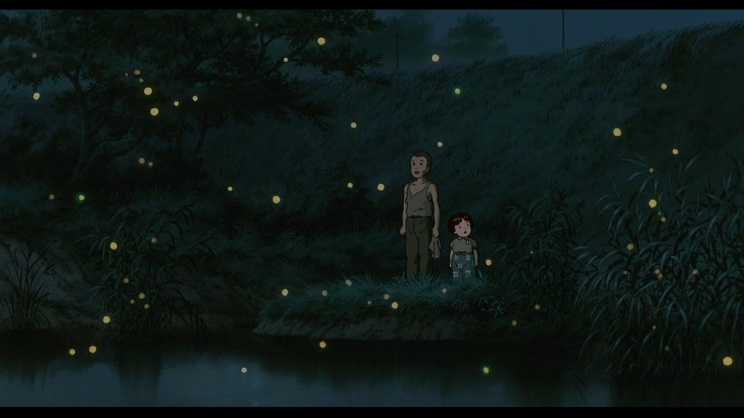
We watch the film knowing we can do nothing to change its ending. Beyond the screen, however, children are still alive, and their futures should not seem as inevitable as the ending of Grave of the Fireflies.
Sara Kabir loves Ghibli movies so much that she wrote an entire master’s dissertation on them. Find her on Instagram @scarletfangirl, where she is constantly juggling life in academia with her many hobbies and passions.
 For all latest news, follow The Daily Star's Google News channel.
JU campus home to 34 species of amphibians, reptiles
JnU JCD allegedly assaults man before handing him over to police over suspected BCL links

Opinion / Can fluency in English be a measure of intelligence?

Press Release / Grand finale of Startup World Cup Bangladesh 2026 Held at Daffodil International University

Press Release / UIU secures fourth place at Student Unmanned Aerial Systems (SUAS) 2026

Fellowships / Apply to Chevening Oxford Centre for Islamic Studies Fellowship

Gemini, ChatGPT feature in DU exam cheating as 64 students punished
Two years, no probe report: Shamim Molla’s family waits for answers

Several injured after clash following inter-department football match at RU