


Why Ducsu’s faculty evaluation move matters

Three years ago, while pursuing my bachelor’s degree at Dhaka University (DU), I penned an article for this publication titled “Faculty evaluation should be a must in all universities” about faculty evaluation and included this line in it: “Dhaka University has recently implemented faculty evaluation, viewed as a significant step for its students’ benefit.” I have since finished my undergrad in 2025, and my master’s this year. Yet, this evaluation system still hasn't materialised.
In 2023, we were given tutorials on how we could evaluate the faculty members. A seminar was held, and a video was showcased on one of our student portals, so I thought faculty evaluations might actually be on the horizon. It’s been three years, and the horizon kept slipping away, but the administration kept assuring us that it was going to happen, although no one could say when. The process remained stalled in meetings and reviews, as many things do in this part of the city.

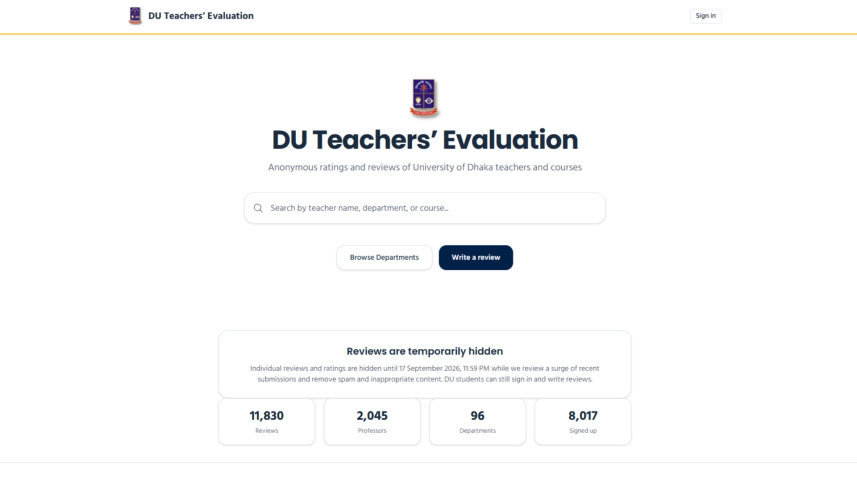
But on September 10, 2026, the Dhaka University Central Students' Union (Ducsu) launched a faculty evaluation website named “DU Evaluation” for students to rate their respective faculty members. Students can rate their teachers based on the course design, teaching method, engagement and support, assessment and feedback, professionalism, and overall satisfaction. At the time of writing, over 11,800 reviews have been submitted.
Many faculty members were less than thrilled about Ducsu’s decision to introduce the website. Dhaka University Pro Vice-Chancellor (Academic) Prof. Abdus Salam argued that the initiative was simply not within Ducsu’s purview. Pro Vice-Chancellor (Administration) Prof. Mohammed Almujaddade Alfasane also questioned the appropriateness of DUCSU taking up such an activity. According to him, however, DU students will be able to evaluate their teachers starting from the 2026-27 academic year. The same was voiced by the Vice-Chancellor, Prof. ABM Obaidul Islam.
The initiative was inspired by Rate My Professors, the website where students have long been able to say what they really think about their teachers. Ducsu’s platform aims to create a public record of students’ views on their teachers and, more broadly, on the academic environment at DU.
Action-reaction from both camps has its merit. The teachers feel as though the ratings may cultivate a culture of fear. The ratings may also be a source of public ridicule and harassment. They are not wrong in their thinking, because photocards of student reviews are circulating online to garner reactions. Such behaviour, by any means, is not constructive. If anything, it erodes the symbiotic relationship between teachers and students that must be nurtured to make an academically conducive environment.
As a student, I must also say that globally, faculty evaluation is a regular practice to ensure that students can provide feedback to their teachers so that they can better understand where they can improve in terms of pedagogy. Without it, the feedback system remains one-way, with only the teacher having the option of choosing whether to listen to students’ concerns.
Another important point to be noted is the length of time that has passed since students were given the assurance of a faculty evaluation system. It is, thus, not unnatural for students to develop a sense of frustration.
The result is a distrust between the teachers and the students; the teachers are wary of a parallel administrative system, and the students are channelling their internal grievances through a website after years of vapid promises.
Rate My Professors ratings are often taken with a grain of salt because the reviews can be constructive and destructive at the same time. Simply leaving a negative review because one didn’t score well on a test doesn’t help with the overall educational context because reviews should be detailed and helpful for students taking the class or for teachers who are receptive to feedback.
Acknowledging that students are free to have opinions about their teachers and that rating systems for professors exist in other countries, Pro VC Prof. Abdus Salam clarified that this is not an official form of evaluation. Such initiatives, he said, may exist informally. But ironically enough, a probe committee has been formed to investigate the matter and submit a report within seven working days.
The point I am hammering on is that the inception of such a drastic measure for students to give their two cents to faculty members indicates one thing that has been plaguing DU for far too long: promises that remain promises for years on end. Only when push comes to shove does the pressure unsettle the administration.
Of course, there should be a balance of responsibilities from both sides. The students have a major task of being objective in their judgements, and the university must facilitate a conversation where the students can remain anonymous so they can evaluate the quality of the education they are receiving without the fear of being singled out by teachers.
It’s been three years since the first time I heard “teachers’ evaluation”, and it still sounds elusive to me because of the lack of interest from the university’s end. Instead of seeing the ratings as a threat, the administration should view this as an opportunity to propel the central teachers’ evaluation process. The conversation about faculty evaluations should disperse to other public universities in Bangladesh. Public universities should also take this pertinent fact into consideration: student voices are integral when it comes to nurturing an equally beneficial relationship between students and teachers.
References:
1. The Daily Star (September 15, 2026). ‘No scope for a parallel administration’ at DU.
2. Prothom Alo (September 11, 2026). DUCSU launches teacher evaluation at Dhaka University, administration questions its legitimacy.
3. Dhaka Tribune (September 8, 2026). Ducsu member launches online platform to evaluate DU teachers.
4. New Age (September 12, 2026). DU teachers criticise DUCSU rating website, fear partisan misuse.
 For all latest news, follow The Daily Star's Google News channel.
Comments