


Gaibandha’s Sundarganj a hotspot for Anthrax in Rangpur region



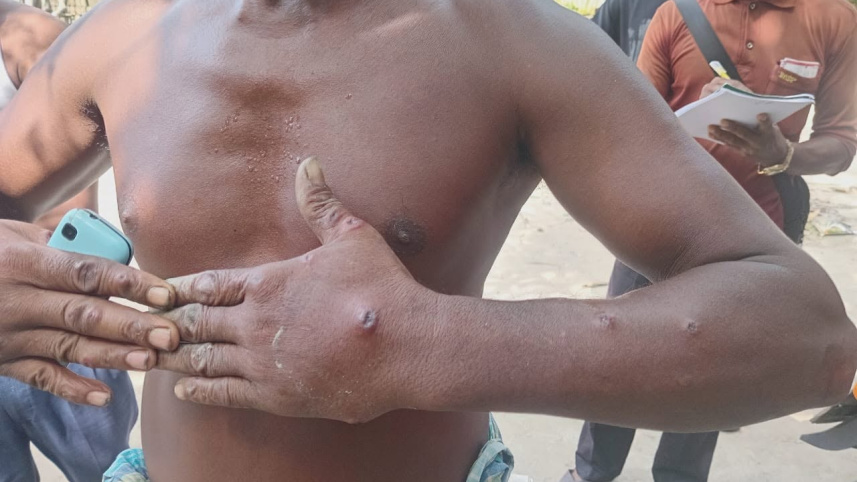
At least 53 people in Rangpur, Dinajpur, and Gaibandha have received treatment for anthrax symptoms over the past month.
Among them, 16 people in Rangpur and Dinajpur were already diagnosed with anthrax and have since recovered after treatment.

Meanwhile, as of August 24, a total of 37 people -- 19 women, 14 men, and 4 children -- with symptoms of the disease were treated at the upazila hospital in Gaibandha's Sundarganj alone.
Health officials from Rangpur, Dinajpur, and Gaibandha stated that the meat consumed by the infected individuals came from cattle raised mainly in Sundarganj upazila of Gaibandha and the neighbouring Pirgacha upazila of Rangpur.
An outbreak of anthrax was also reported in these same areas around this time last year as well.
In Sundarganj, the recent outbreak originated after a sick cow was slaughtered and its meat distributed among 100 families in Bachhati village, Sabarnanda union, on September 9.
Over the past two weeks, symptoms have spread across five unions: Sabarnanda, Tarapur, Kanchibari, Sonaray, and Ramjiban.
In Dinajpur, an army person and his parents tested positive for anthrax in a lab test after eating meat of a home-reared cow in Pirgacha upazila on August 29.
Later, they were admitted to Kholahati Combined Military Hospital (CMH) and recovered by September 17.
Dinajpur District Livestock Officer (DLO) Abdur Rahim confirmed the matter to The Daily Star, saying no new case has been found so far.
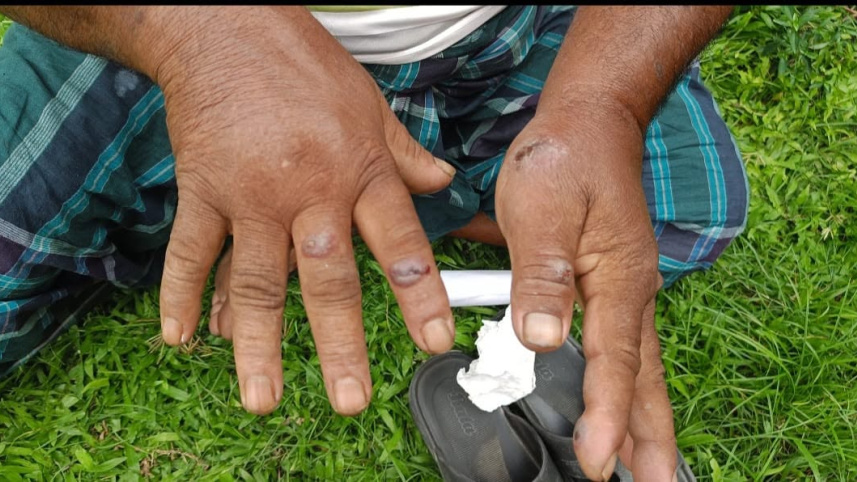
In Rangpur district, a total of 13 people have been diagnosed with anthrax so far.
According to Rangpur Civil Surgeon Shaheen Sultana, anthrax was detected in Adampara village under Chaola union in Pirgachha upazila of Rangpur on September 22.
She told The Daily Star, “Thirteen people, including four members of the same family, were admitted to the Pirgachha Upazila Health Complex, received treatment for ten days, and have since returned home healthy."
During the incident, an icddr,b team that came to the spot collected samples from the bodies of the thirteen people and confirmed anthrax after testing, she added.
Abdul Hakim, a member of the Chaola Union Parishad, said that the cow was bought from Sundarganj upazila in neighbouring Gaibandha and slaughtered.
Kamrul Hasan, Sundarganj upazila Health and Family Planning Officer (UHFPO), said, “Anthrax is highly infectious and primarily spreads to humans through contact with infected livestock, although secondary transmission can occur via contact with an infected person's blood or pus.
“Anthrax is completely curable if the patients take medicines properly,” he said.
In Sundarganj, anthrax symptoms were first seen in early September this year, when six residents of Kanchibari union fell ill with fever and skin blisters after consuming meat from a sick cow, the UHFPO said.
 For all latest news, follow The Daily Star's Google News channel.
 Later, on September 9, another sick cow was slaughtered in Bacchhati village, and meat was distributed among 100 families.
Goleza Begum, 29, of Bachhati village of Sundarganj upazila, told The Daily Star that blisters developed on her hands shortly after cooking and consuming the sick cow's meat.
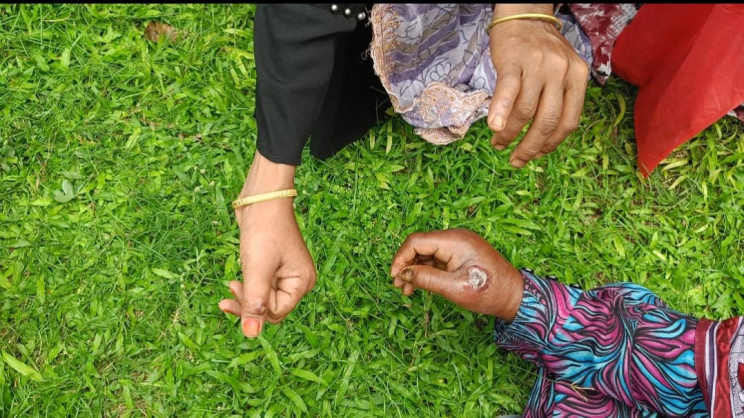
Another patient from the same village, Shafiq Alam, 45, said, “I did not eat the meat. I only helped slaughter the animal, but blisters appeared on both my hands.”
During slaughtering the sick cow, blood touched my hands, he added.
The Sundarganj Upazila Livestock Office collected two meat samples from Bachhati village on September 21 and dispatched them to the Central Disease Investigation Laboratory (CDIL).
The report was delivered on September 23, and both samples tested positive for anthrax, Sundarganj Upazila Livestock Officer KM Iftekharul Islam confirmed to The Daily Star.
Following the outbreak, six officials from the Institute of Epidemiology, Disease Control and Research (IEDCR) and two researchers from icddr,b arrived in Sundarganj from Dhaka on September 24, confirmed UHFPO Kamrul Hasan.
The IEDCR officials emphasised mass awareness and mandated veterinary clearance before slaughtering sick animals in affected areas.
Sundarganj Upazila Nirbahi Officer (UNO) Iffat Jahan Tuli told The Daily Star that public awareness campaigns are underway via loudspeaker announcements, administrative meetings, and mosque imams instructing village residents.
She added that officials are actively locating individuals with symptoms who have not visited hospitals to ensure that they receive medical treatment.
Only cattle vaccinated; other livestock left out
According to the Sundarganj upazila livestock office, it hosts approximately 254,000 cattle in the upazila.
Following a localised outbreak in the region in October 2025, the government initiated a ring vaccination programme across 15 unions in July this year, administering 19,000 cow vaccines till date.
Official guidelines mandate 100 percent livestock vaccination within a 3km radius of an affected zone.
Livestock Officer KM Iftekharul Islam told The Daily Star that 11,000 vaccine doses remain in stock while a requisition for 15,000 additional doses has been submitted.
However, the icddr,b and IEDCR researchers at the upazila livestock office said that anthrax can also spread through goats, sheep, and buffaloes.
Last year, on October 5, a woman, Rozina Begum, 45, wife of Abul Hossain from Pashchim Belka village of the Sundarganj upazila, died while undergoing treatment for anthrax symptoms at Rangpur Medical College Hospital.
At that time, upazila health officials and Rozina Begum's family told local journalists that she developed blisters on her fingers after cooking and consuming meat from a slaughtered sick goat.
When asked why the other animals were not being vaccinated, the Gaibandha District Livestock Officer Md Zobaidul Kabir told The Daily Star that cattle are being prioritised because outbreaks in the region historically originate from bovine sources, though non-bovine livestock are currently being kept under observation.
Comments