


Was Payra Port a mere pipe dream?
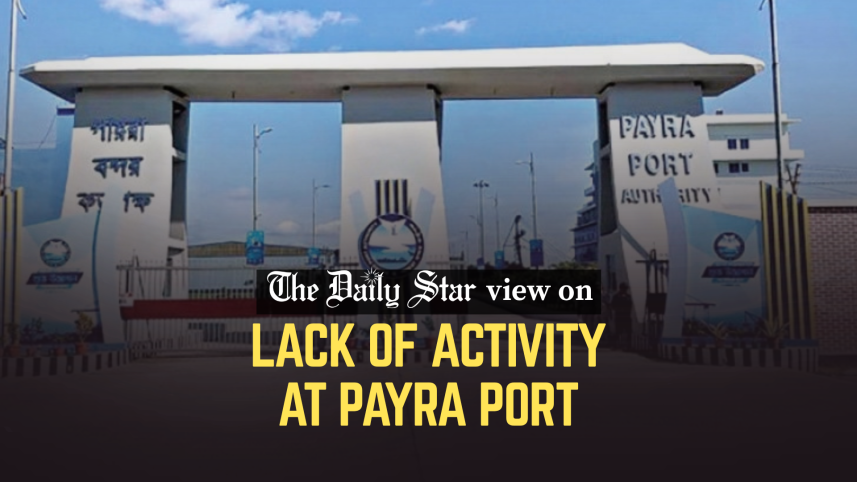
It is a shocking revelation that the Payra Port, despite an investment of Tk 15,691 crore made with the promises of transforming the economic landscape of the southern region, has remained largely underutilised. Currently, the port handles only a limited volume of imports, primarily coal for a local power plant, while chronic navigability problems and a lack of regional industry have prevented the expected volume of international shipping and exports.
The fundamental problem, according to a report, lies with the Rabnabad Channel, the port’s main navigational route, which was supposed to maintain a depth of 10.5 metres to allow larger vessels to reach the port. In reality, its depth routinely falls to 5-6 metres during the peak monsoon season, preventing deep-sea access. The only way to increase the depth is through dredging, but Tk 6,500 crore has already been spent on it. What is unfathomable is why such a large investment failed to deliver a sustainable solution. How could the then government and relevant departments embark on such an expensive port without ensuring its viability? Where are the economic zones, industries, terminals, and smart city that were proclaimed as part of this mega project?

Payra has a 650-metre jetty, a large backup yard, and a container freight station, but there is very little commercial activity around them. Meanwhile, companies have had to bear additional costs to transfer cargo to smaller vessels, prompting some businesses to shift to other ports. Clearly, without sufficient business activity in the surrounding region, a port cannot operate at its intended capacity. At present, there is little manufacturing or export activity and, consequently, limited cargo to handle. The business community in Patuakhali has complained that thousands of acres were acquired for the project but the promised economic benefits have not materialised. The project thus has become another example of a pattern seen during the AL government: expensive mega projects undertaken without creating the conditions needed to make the infrastructure economically productive.
The port authorities have reportedly submitted a fresh proposal costing Tk 4,600 crore for permanent dredging and the procurement of dedicated dredgers. But before committing more money, the government must establish why previous dredging failed, what the long-term maintenance costs would be, and whether sufficient cargo and commercial activity can be generated to justify continued expenditure. We’re told that the impending completion of the Andharmanik River bridge could be a game-changer for road freight, and if the proposed Patuakhali EPZ and planned industrial zones are developed, overall port activity could increase. But that’s where the challenge lies: the port can be commercially viable only if the interrelated infrastructure around it is developed. This includes reliable roads, navigation infrastructure, bridges, and industrial and special economic zones.
But before pouring more money into the project, the government should first demand accountability for the previous investment and assess how any new investment can create the conditions for a commercially viable port.
 For all latest news, follow The Daily Star's Google News channel.
Comments