The $5 billion opportunity Bangladesh is failing to see
On the cutting floor of a garment factory in Gazipur, as a worker cuts around a shirt panel, a piece of fabric can become worthless within seconds. The excess that falls to the floor is too small for the export order, too irregular to become another shirt, and no longer useful to the factory that bought the fabric. It looks like waste.
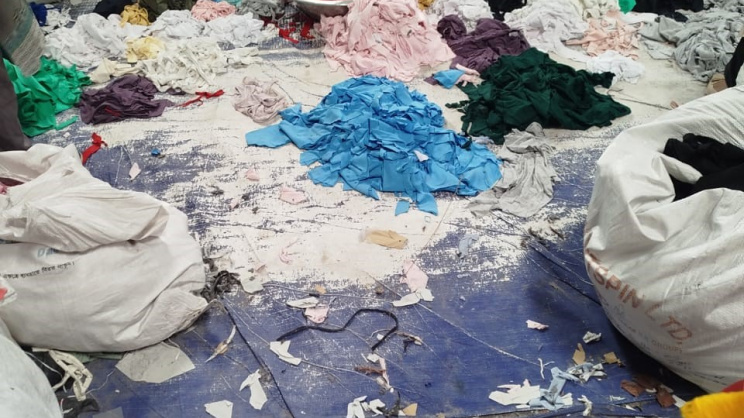
But before the day is over, it may be swept into a sack, sold to a trader, carried to a sorting cluster and separated by colour, composition and quality. A larger piece may be reused. A cotton scrap may move towards recycling. Another piece may be sold again, perhaps several times, before reaching its next destination.
The factory has finished with it. However, the economy has not.
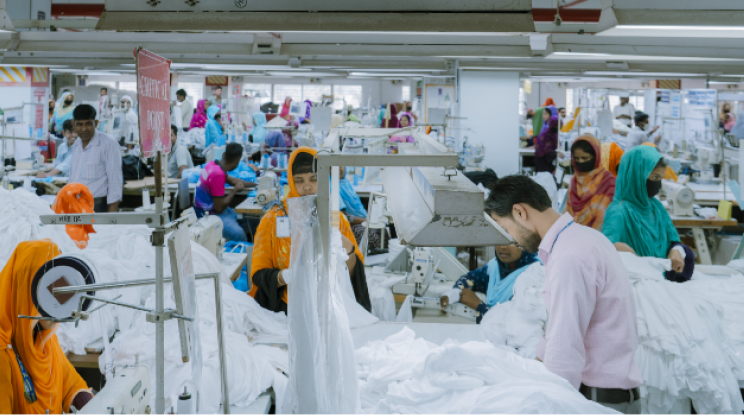
This is ‘jhut’: a term derived from the Urdu word ‘jhuta’, meaning waste. It has become Bangladesh's vast, largely informal market for post-industrial textile waste. An estimated 195,000 to 214,000 workers earn their livelihoods across 18,400 to 22,000 informal enterprises linked to this trade, according to field research across twelve districts by Reed Consultancy Bangladesh and Circle Economy.
Most of the sorting is done manually, predominantly by women. Research cited by the Thomson Reuters Foundation estimates that women account for roughly 70 percent of jhut sorters. The Daily Star has reported from a Gazipur facility where workers, most of them women aged between 20 and 50, had remained in the trade for five to twenty years. Their work is largely invisible in official statistics and almost absent from the language of climate action. Yet they are doing something that the global circular economy now considers highly valuable: keeping materials in circulation.
The arithmetic of a scrap
Bangladesh's garment industry generates an estimated 400,000 to 577,000 tonnes of pre-consumer textile waste every year. The strange part is not simply how much waste we produce. It is how much value leaves with it. Less than 5 percent is reportedly recycled domestically into value-added textile products, while more than half is exported for recycling and other forms of processing. The numbers become more striking when viewed in the context of the global market.
A 2024 study by GIZ and H&M estimated that Bangladesh could generate an additional $4 billion to $5 billion annually by developing a stronger circular textile industry. Industry leaders have since placed the potential even higher. In 2026, a BGMEA vice-president said that recycling the country's RMG waste could support a circular economy worth nearly $8 billion annually.
The scrap on the cutting-room floor is not economically insignificant. It is feedstock. It is raw material. It is unnoticed cash.
These figures are projections, not money Bangladesh is currently earning. But they point towards something important. The scrap on the cutting-room floor is not economically insignificant. It is feedstock. It is raw material. It is unnoticed cash. And Bangladesh is increasingly being asked to see it that way. The question is: what happens to the people who have been seeing it that way all along?
Informal jhut economy
For decades, the informal jhut economy has performed the work of circularity without calling itself a circular economy.
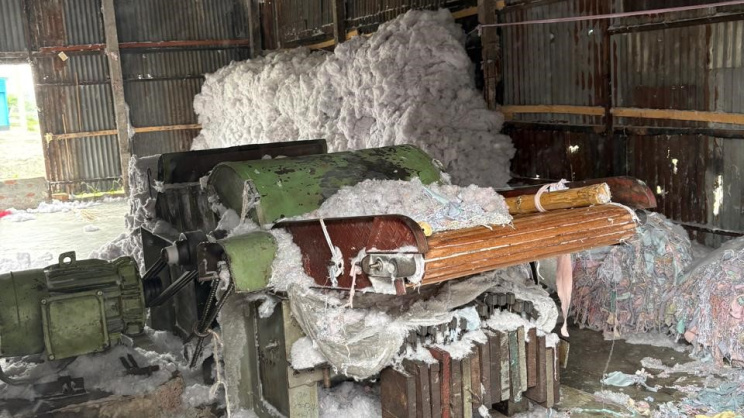
Traders collect the waste. Workers sort it, make it business-grade and resell it. Recyclers then transform some of it into new materials, while some larger textile pieces are reused or remanufactured, and smaller cotton scraps become recycled fibre or yarn.
The system is messy, fragmented and often exploitative. However, it is also remarkably persistent.
Research published by Lone Riisgaard in Circular Economy and Sustainability describes Bangladesh's informal textile-waste system as an established form of circularity. The researcher found that existing networks already recover and reuse substantial quantities of apparel production leftovers, while formal recycling capacity remains limited.
This creates an uncomfortable paradox.
Bangladesh is now preparing to build the circular economy that its informal workers have already been operating. The difference is that the new version comes with traceability, certification, investment, international buyers, and potentially billions of dollars.
That changes the question from whether waste has value to who gets to capture that value.
When circularity becomes formal
Global brands increasingly want textile waste that can be traced, measured and verified. Large recyclers therefore have an incentive to source cleaner, higher-value scraps directly from factories rather than through the fragmented networks that have traditionally handled jhut, according to the same Riisgaard study.
From an industrial perspective, this is understandable. Direct sourcing can improve traceability. Formal recycling can improve environmental standards. Better technology can produce higher-quality recycled fibres. But formalisation has a blind spot.
What happens to the workers and small businesses whose livelihoods depend on the informal chain?
A 2026 study warns of what it calls “green value appropriation”: the transition towards formal circularity can allow larger global value-chain actors to capture the new economic value associated with sustainability, while existing informal workers lose access to the materials that have sustained their livelihoods.
A factory can become greener while a sorting worker becomes poorer. A recycled yarn can carry a sustainability certificate while the hands that separated its original fibres remain unprotected.
The danger is not that formal recycling is inherently harmful. It is that we may mistake formalisation for progress. A factory can become greener while a sorting worker becomes poorer. A recycled yarn can carry a sustainability certificate while the hands that separated its original fibres remain unprotected. An industry can close its material loop while opening a new social gap.
Who owns the next life?
This is where Bangladesh's circular transition becomes a question of justice. The country does need better recycling infrastructure. At the same time, it also needs investment, technology, traceability and policies that make domestic recycling economically viable. It needs to ensure that valuable textile material is not lost because of a fragmented recovery system.
But it also needs to recognise the economy that already exists. That means treating informal waste workers not as obstacles to modernisation, but as participants in it. It means bringing occupational safety, social protection and fairer working conditions into the circular-economy conversation. It means designing formal systems that connect existing workers and enterprises to new markets rather than simply routing around them. Otherwise, the transition could repeat an old pattern. The material stays. The value moves. And the people doing the work are left behind.
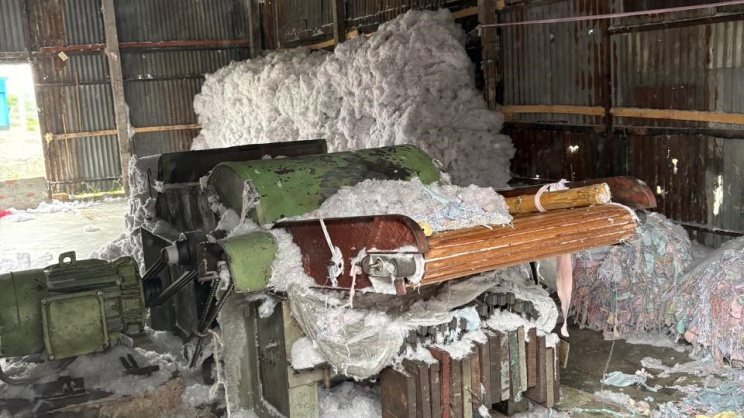
A scrap of fabric does not become valuable because a policy document calls it a resource. It was already valuable. Someone simply had to see it. And, for decades, someone did.
The real question facing Bangladesh is therefore not whether it has a circular economy. It does. The question is what happens when an economy built by invisible workers becomes valuable enough for everyone else to notice. If Bangladesh counts the recycled yarn but not the hands that sorted the waste, it may succeed in closing the loop for materials while leaving the people who built that loop outside it.
The future of Bangladesh's circular economy may begin on a cutting-room floor. But who owns that future will be decided somewhere else.
Nishat Tasnim is a research officer at the International Centre for Climate Change and Development (ICCCAD), where her work focuses on Just Transition and Loss and Damage (L&D) related to Climate Change. She can be contacted at nishat.tasnim@icccad.org
Send your articles for Slow Reads to slowreads@thedailystar.net. Check out our submission guidelines for details.
How Bangladesh is failing its Qawmi graduates
Why is water-rich Bangladesh running short of water?
Bangladesh's education crisis: The future has already begun

The global injustice behind Bangladesh’s shipbreaking industry
How to make essential medicines affordable and accessible in Bangladesh
Can Bangladesh make its plastic waste policy work?
Dhaka accidentally built the city planners now want. Can we make it liveable?
Can Bangladesh produce its own knowledge?
How we are killing Dhaka