


‘Aim should be to reduce gap with world standards’

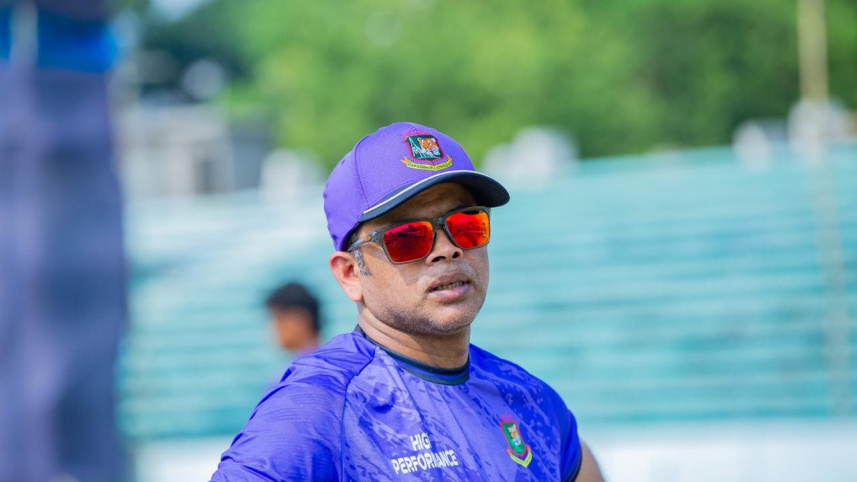
Veteran left-arm spinner Abdur Razzak was nearing the twilight of his playing career when he was approached to join the national selection panel in 2021, a move that eventually brought his playing days to an end. Last year, Razzak stepped down from the role and briefly served as a director of the Bangladesh Cricket Board (BCB). However, the 44-year-old had always wanted to pursue coaching after retiring and finally got the opportunity when the BCB appointed him as their High Performance spin coach in June. Bangladesh’s most successful first-class bowler, Razzak will now take charge of Rajshahi Division in the upcoming National Cricket League (NCL). In an interview with The Daily Star’s Samsul Arefin Khan, he spoke about his long-standing ambition to become a coach, his experiences in various roles, and his plans for Rajshahi. The excerpts are as follows:
The Daily Star (DS): How do you feel about your first stint as a coach in the NCL?

Abdur Razzak (AR): I have always wanted to pursue coaching. Since it was my own desire, it feels really good. Regarding experience, there isn’t much to say. I am enjoying it and still gathering experience.
DS: Could you sum up your journey of serving in various roles after a long domestic career and representing Bangladesh as a player?
AR: When I was still playing, it was already on my mind that I would go into coaching and stay connected with cricket. Naturally, coaching came to mind first, and from that point on, I made up my mind that I would pursue coaching. When I became a selector, that was also connected to cricket – not directly coaching, but closely related to cricket. I enjoyed that role as well. For a short period, I served as a director, and I enjoyed that too since my departments were directly related to cricket. But coaching is something special for me. I enjoyed every stage -- being a selector, director, and now coaching.
DS: Top-level coaching involves many technical aspects and formal training courses. How did you prepare for coaching while serving as a selector, and did you complete any courses back then?
AR: I completed Level-1 coaching towards the end of my playing career. When I joined the selection panel, I never intended to stay in selection for a very long time. I kept coaching as my target and completed my Level-3 course while serving as a selector. I was a director for a short time, and then I moved into coaching. This was not a sudden decision; I had planned it from the beginning.
DS: You joined the High Performance (HP) unit as a spin bowling coach around June this year. How big is it for you to be head coach of a first-class team in your first year in the NCL?
AR: Coaching a first-class team is a significant responsibility, and I am fortunate and grateful to the BCB for this opportunity. I am happy to work in the longer format, which allows ample time to plan and execute strategies.
DS: How has your experience been over the last three months, including the HP stint and the South Africa tour?
AR: It has been great. Right after I was appointed HP spin bowling coach, we had a 1.5-month skill camp. Fortunately, the South Africa tour followed immediately, allowing me to observe the direct execution and progress of the skills worked on during the camp.
DS: You played for Khulna throughout your career. How do you view coaching a different team?
AR: In professional life, you cannot stay stuck in one place. You must embrace opportunities wherever they arise. It is challenging, exciting, and fun.
DS: How do you plan to deal with the fact that key national team players like Najmul Hossain Shanto, Tawhid Hridoy, Taijul Islam, Nahid Rana, and Shoriful Islam might be unavailable for most of the season?
AR: Almost every team suffers from the absence of national players during the NCL. It is best to plan without relying on national players, as they may only be available for a match or two at most. Rajshahi has a good squad, and if we play with discipline, we have a strong chance of doing well.
DS: You have experienced cricket as a player, leader, selector, and administrator. How will these experiences help you as a coach?
AR: Each and every thing will help me in the best way, I’m 100% sure. Coaching is not just about telling players how to bat or bowl; it involves team management, player selection, and maintaining discipline. Having prior experience in these areas will certainly benefit me.
DS: How do you view the mental shift from being in administrative positions to coaching?
AR: I don’t mind it at all. Even when I was a chairman, I held coaches in the highest respect. In our country, people focus on designations and ranks, but a coach’s job is immensely important.
DS: Where do you see the gap for local Bangladeshi coaches in getting opportunities in foreign franchise leagues or international teams?
 For all latest news, follow The Daily Star's Google News channel.
 AR: Keep us in your prayers. Hopefully, we [local coaches] will eventually reach that level in the future.
DS: With increased match fees and the promise of even better facilities in domestic cricket this season, how do you see the evolution of first-class cricket?
AR: There has been some improvement in one area or another with each passing year. The biggest problem we have is that we always want to see improvement with our own eyes. But you cannot see every kind of improvement. For example, if you talk about facilities, there has been a lot of improvement since we started. Even if I talk about the wickets, there is an ocean of difference between the wickets we used to play on back then and the ones we have now.
So, those improvements have happened, and there has definitely been improvement among the players as well. But the cricketing world is also moving faster day by day. What I feel is that if we want to maintain or catch up with world standards, improving at the same rate as the rest of the world will not be enough, as they are also improving every year. We probably need to take one extra step so that we can catch up with them properly. Our aim should be to gradually reduce that gap.
Comments