


Nandini: Foreign flower variety takes root in Jhenaidah

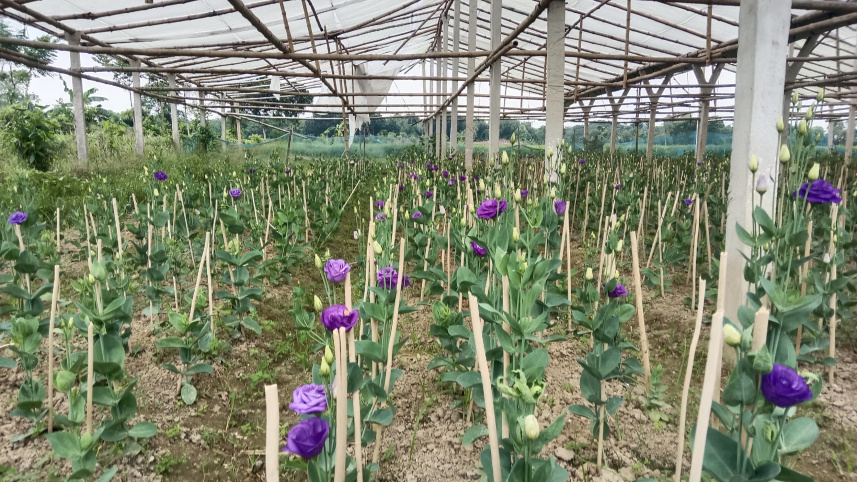
A farmer in Jhenaidah has earned more than Tk 100,000 in profit from cultivating Nandini, a foreign variety of flower, on a small plot of land in just two months.
Nazrul Islam of Paikpara village under Ganna union in Jhenaidah Sadar upazila cultivates several varieties of flowers. This July, he experimented with Nandini on three kathas of land under a polythene shed alongside his other flower crops.

He is now harvesting the flowers every day and selling them in the Dhaka market.
Nandini is known in English as Lisianthus or Eustoma. Native to North and Central America, it is now commercially cultivated in Japan and India. Resembling roses, the thornless flowers bloom in several colours. A single plant can produce flowers twice.
The wild flower was developed by Japanese scientists into varieties capable of tolerating Japan’s weather conditions. While it is cultivated in greenhouses or controlled environments in Japan, Nazrul believes it can be grown under polythene sheds in Bangladesh in almost all seasons.
Nazrul told The Daily Star that he built a polythene shed over three kathas of land at the beginning of the second half of July and planted 1,836 Nandini seedlings collected from a nursery in Rangpur.
The plants began flowering when they were around 40-45 days old. Although some plants died, more than 1,800 remain alive.
He has harvested at least 1,300 flowers over the past four to 10-11 days, selling them in the Dhaka market for Tk 100 each. He expects to harvest flowers from the remaining plants within another four to five days.
After the first harvest, however, a plant can produce flowers again, with the second batch being of better quality than the first.
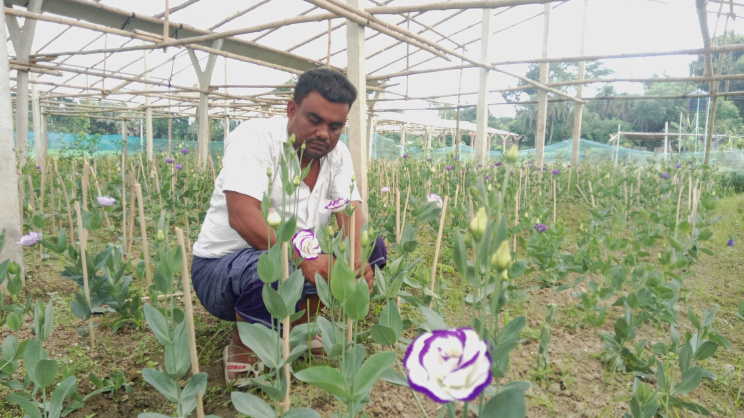
“I have sprayed pesticides on these plants four times so far. I may have to spray them one more time before harvesting all the flowers. However, I have not used any chemical fertiliser in this cultivation. I have used only a moderate amount of organic fertiliser,” Nazrul said.
“The size of the plants and the colour of the flowers are no worse than those grown in Japan or India. I am getting a good price in the market. After harvesting the flowers, I send them to the Agargaon flower wholesale market in Dhaka. The wholesaler sends me the money. I am expanding the cultivation of the flower this year,” he added.
Imamul Hossain, general secretary of the Bangladesh Flower Society and a flower trader in Dhaka’s Agargaon area, told The Daily Star that there is strong demand for Nandini flowers in the domestic market.
“Various flower traders import this flower from abroad. If it is possible to cultivate the flower locally, it will help reduce expenditure of foreign currency. Besides, the flower is growing well in Bangladesh’s soil and climate. Its price also remains good throughout the year,” he said.
Professor AFM Jamal Uddin of the Department of Horticulture at Sher-e-Bangla Agricultural University brought Lisianthus seeds to Bangladesh from Japan and gave the flower its Bengali name, “Nandini”, according to a 2023 report.
In 2007, he succeeded in producing the first Nandini flowers in Bangladesh. He has conducted research on the variety for many years with the aim of promoting its commercial cultivation in the country.
Seedlings of the flower are now available at nurseries in different parts of Bangladesh, but its commercial cultivation has yet to expand widely.
Dr Md Mahfuzur Rahman, additional deputy director (Horticulture) of the Department of Agricultural Extension in Jhenaidah, told The Daily Star that the flower can be cultivated in all types of soil in Bangladesh.
“If the plants are properly cared for, good yields can be obtained. If anyone wants to cultivate this flower, we will provide all-out assistance with information and advice,” he said.
 For all latest news, follow The Daily Star's Google News channel.
Comments