Partition, Bor Porong and the Chakmas’ unfinished struggle for belonging
The 1947 Partition fundamentally reshaped the political map of South Asia, creating the independent nation-states of India and Pakistan, and subsequently Bangladesh. Driven by a hasty division along religious lines, it precipitated the largest mass migration in human history, forcing an estimated 15 million people from their ancestral homes and turning them into refugees. While historical narratives often frame this event as a singular political milestone, critical Partition studies emphasise that its impact extends far beyond political boundaries and state formation. For the Buddhist Chakma people of Arunachal Pradesh, the wound inflicted by Partition continues to bleed, manifesting itself in their ongoing struggle for national identity, citizenship and political recognition. The abrupt transformation of neighbours into enemies, ancestral homelands into foreign territories, and established identities into contested ones created an enduring trauma for the Chakma community.
The radio announcement on the evening of August 17, two days after independence, declaring that the CHT would be incorporated into Pakistan, represented the ultimate betrayal for this community. That solitary voice over the radio suddenly changed the fate of a people who had once been a dominant group with an autonomous kingdom during the pre-colonial period and enjoyed semi-autonomous status under British rule, only to be reduced to stateless refugees in the postcolonial period.
Partition as an unending historical chapter: Subalternity and indigenous reality
“Years of genocide have desensitised us.” — Sneha Kumar Chakma (The Indian Post, 1987)
The postcolonial Chakma experience aligns closely with a theoretical framework that redefines Partition from a single event in the past into an ongoing historical process. Early scholarship on the 1947 Partition of South Asia focused heavily on “high politics”, particularly the closed-door negotiations between British colonial administrators and nationalist elites. This macro-historical approach mapped out how the borders were drawn while largely ignoring the human cost of the event. The lived experiences of the millions caught in the crossfire were largely omitted from the “history from above”.
From the late 1980s through the 1990s, subaltern, feminist and critical historians such as Urvashi Butalia, Ritu Menon, Kamla Bhasin, Veena Das and Gyanendra Pandey radically challenged this methodological silence by embracing oral histories and survivor narratives. This approach recognised that the trauma of Partition, including sexual violence, massacres and the displacement of millions from their homelands, cannot be understood through official state archives alone. As Urvashi Butalia writes in her book The Other Side of Silence: “…but I began to realize that Partition was not, even in my family, a closed chapter of history — that its simple, brutal political geography infused and divided us still…It took 1984 to make me understand how ever-present Partition was in our lives too, to recognize that it could not be so easily put away inside the covers of history books. I could no longer pretend that this was a history that belonged to another time, to someone else.”
Extending this subaltern framework to the Chittagong Hill Tracts reveals that, for indigenous populations, Partition initiated an unending sequence of dispossession. While subaltern and feminist historians of Partition broke the silence of state archives by elevating the voices of Punjabi and Bengali refugees, the experiences of indigenous communities remain distinctly nuanced and complex. The Chakma experience introduces a critical third dimension: the intersection of cartographic trauma, indigenous dispossession and ongoing statelessness. The theoretical lens of “Partition as an unending historical chapter” captures how, for the Chakma, Partition was not a single event in the past, but the beginning of an ongoing cycle of state-led violence against them. This continuity stretches from the drawing of the Radcliffe Line in 1947 to the submergence of their ancestral homeland following the construction of the Kaptai Dam in the 1960s, continues through decades of persecution, and persists in their present condition as disenfranchised refugees in Northeast India.
The Kaptai Dam and the Bor Porong (The great exodus)
While 1947 reshaped the Chittagong Hill Tracts (CHT), the homeland of the Chakma community, the socio-historical trajectory of the Chakmas is inextricably tied to the Bor Porong (the great exodus), triggered by the construction of the Kaptai Dam, which led to their mass displacement from their ancestral homeland. Under the banner of development and modernisation, the Pakistani government implemented aggressive industrial policies in the Chittagong Hill Tracts (CHT), a political strategy that undermined the indigenous population. These state-led development projects drew a steady influx of non-indigenous people into the CHT, an area that had been designated an “Excluded Area” with restrictions on outsiders since colonial times. Over time, these constitutional protections were systematically dismantled under the postcolonial regime. As Amena Mohsin points out, “The constitution of 1962 changed the status of the CHT from an ‘Excluded Area’ to that of ‘Tribal Area’. A recognition of its distinctiveness was given, but CHT could not remain excluded.”
The erosion of political safeguards coincided with devastating development-induced displacement, and the Chakmas were among its primary victims. The construction of the Kaptai hydroelectric project on the Karnaphuli River, which created Kaptai Lake, severely affected the Chakma community by submerging more than 40 percent of their arable land. Harikishore Chakma and others point out that “The original Rangamati town went into the lake. It swallowed the homes of 125 Moujas rendering about 100,000 people, belonging to 18,000 families, homeless.”
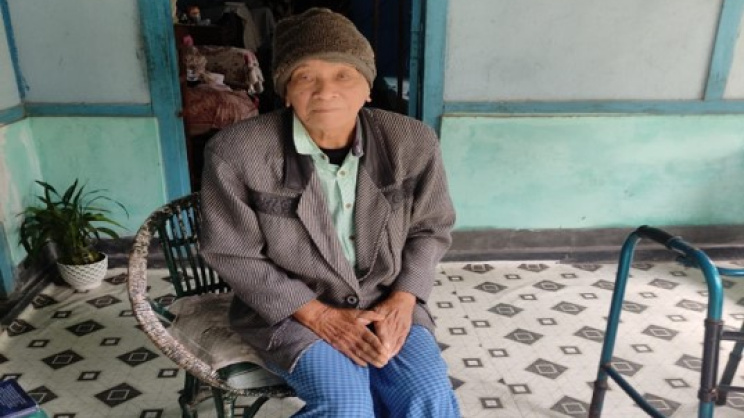
For those who lived through it, the official promises of modernisation ring hollow. Hriday Chakma, now a resident of Jyotipur Village in Arunachal Pradesh, vividly recalls the episode:
“I am originally from the Chittagong Hill Tracts. Back in the 1960s, when the dam was constructed there with significant funding and assistance from the U.S. government, we were promised employment and a permanent end to electricity shortage for residents. Based on these assurances, construction began. Even our King, Tridiv Roy, under government pressure, agreed to this development. Dam construction began in 1960, and a massive flood in 1964 submerged the land of thousands of our people. The government provided very little compensation, so to survive, we moved to India.”
Facing negligible state support for rehabilitation and the loss of their agrarian livelihoods, large numbers of Chakmas were forced to cross the border into India. Remembered in the Chakma language as the Bor Porong, this mass displacement stands as one of the major population movements of early postcolonial South Asia. After crossing the border into India, many were ultimately resettled in the Lohit, Tirap, Changlang and Papum Pare districts of present-day Arunachal Pradesh, then part of the North-East Frontier Agency (NEFA).
Oral history from below: Journey into an uncertain future
This large-scale displacement was not simply an unforeseen consequence of the project. The Pakistani government was aware that the dam would cause extensive flooding, but the state prioritised development over the socio-economic consequences for local communities, reflecting the severe costs imposed on indigenous people in the name of development.
Reflecting on the political climate of the time, the Headman (Gaon Burah) of Shantipur Village in Diyun Circle, Arunachal Pradesh, explains why remaining there became impossible:
“We realized that we could no longer stay under Pakistani rule. Given the atrocities and injustices, exploitation, we would not be able to live there peacefully in the future. So, when we got the opportunity, we abandoned our belongings there and left.”
Initially, although the East Pakistan government officially designated low-lying areas in Longadu, Baghaichari and Barkal for the resettlement of displaced Chakma families, these relocation sites were themselves flooded, forcing many families to endure displacement for a second time. As the Gaon Burah of Shantipur Village continued:
“We came to India in two separate groups. One group went to Tripura and from there they were relocated to Bihar because of inadequate vacant land. Our group came through Mizoram. When our homeland was submerged by the creation of the Kaptai Dam, we were first given settlement in Bhagnachari. From there, we had to travel on foot to reach Demagiri. From there, we moved to Cachar district, where we were provided shelter in the Dholai and Bhaga camps. There were many groups of displaced persons arriving in India, and some of them were accommodated in the Monacherra camp located in the Hailakandi district. We were then taken to Ledo, crossing a total of 18 camps along the way.”
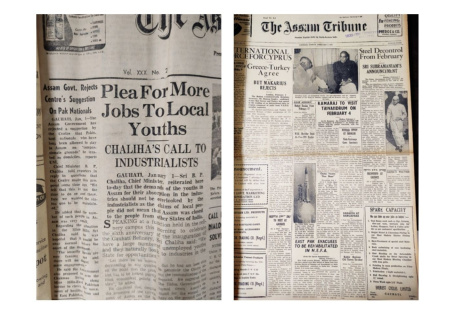
Independence brought hope to many, but for indigenous communities such as the Chakmas and Hajongs, it marked the beginning of a profoundly different experience. While the end of colonial rule brought the promise of freedom across the region, these minority groups found themselves under an administration that ultimately compelled the Gaon Burah, who was 27 years old at the time, along with his family and many others, to abandon their belongings for an uncertain future. The government initially relocated his family, along with others, to Bhagnachari, but the rehabilitation plan failed. This forced them to cross the newly drawn border on foot into India to seek refuge.
Hriday Chakma, sharing his vivid childhood recollections of the exodus, corroborates this dual-route migration and describes the state-arranged transfer to the North-East Frontier Agency (NEFA):
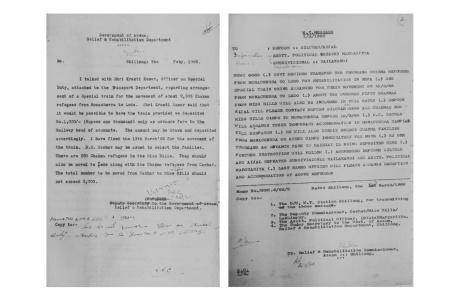
“We migrated to India in two streams—one group moved to Mizoram, and our group to Tripura. We were a population of about 500 people, comprising roughly 150 families, who arrived in Tripura. At the time, under the leadership of Prime Minister Jawaharlal Nehru (shortly before his passing in May 1964), the Government of India agreed to our accommodation and rehabilitation. After spending 20 to 25 days in Tripura, the government relocated us to Margherita (Assam). We stayed there for two to three weeks before moving to Namchik, situated along the border between Assam and North-East Frontier Agency (now Arunachal Pradesh). From there, we spent two to three months in Namphai before being permanently resettled. There were two types of established settlements: the Khagam settlement and the Diwan settlement.”
The large-scale migration of the Chakmas, Hajongs and other communities into Assam in 1964 sparked serious concern among local authorities about its impact on indigenous tribal populations. The state government initially suggested resettling the Chakmas in Dandakaranya, a region designated for the rehabilitation of Bengali refugees from East Pakistan. However, after the Union Home and Finance Ministries rejected this proposal, the Chakmas were ultimately redirected to the North-East Frontier Agency (NEFA) between 1964 and 1969.
In another piece of official correspondence (D.O. letter No. GA-71/64, dated April 10, 1964), Vishnu Sahay, then Governor of Assam, warned Chief Minister Bimala Prasad Chaliha that the continuing influx of Chakma refugees into Mizoram could trigger conflict with local indigenous communities. In response, the authorities identified the sparsely populated Tirap division of the North-East Frontier Agency (NEFA) as a suitable location for their resettlement. Some critical historical interpretations contend that the plan also served a strategic purpose by placing the refugees along the remote frontier as a “human wall”, or defensive buffer, against potential Chinese aggression following the 1962 border war. However, after Arunachal Pradesh became a full-fledged state, sections of the local population strongly opposed the permanent presence of the Chakmas, thrusting the community back into a continuing struggle for political rights, social acceptance and basic security.
Living reality: The unresolved crisis of citizenship
Six decades after the Bor Porong, the legacy of cartographic displacement remains unresolved. Despite being settled in Arunachal Pradesh under government directives in the 1960s, successive generations continue to navigate a deeply contested postcolonial citizenship framework. As Hriday Chakma observes:
“We have been living here for 60 years, but we have not been declared full citizens of India.”
The postcolonial definition of citizenship has proved particularly complex for communities that crossed newly drawn borders in search of security and a better future. In this context, the Chakma experience occupies an important place in the history of postcolonial South Asia. Despite landmark rulings by the Supreme Court of India in 1996 and 2015 concerning the protection of Chakma rights and the processing of citizenship applications under the Citizenship Act of 1955, the government of Arunachal Pradesh has continued to resist their broader inclusion. Many also face administrative hurdles over electoral enrolment, leaving access to voting rights uneven and their legal position uncertain. Hriday Chakma claims:
“Across the Diyun, Bordumsa, and Miao circles, there are about 6,500 voters in total. However, voting rights only apply to the generation born here; early migrants like us are not eligible to vote.”
In its March 3, 2004 order (No. 23/ARUN/2003), the Election Commission of India (ECI) invoked Articles 325 and 326 in addressing their electoral inclusion. Yet the process initially resulted in the enrolment of only 1,497 individuals across three assembly constituencies: 323 in Chowkham, 1,164 in Bordumsa-Diyun and merely 10 in Miao. With eligibility restricted to those who had acquired citizenship by birth under Section 3(1)(a) of the Citizenship Act, 1955, by being born in India before July 1, 1987, the electoral status of the wider Chakma population in Arunachal Pradesh remained deeply fragmented, with one generation receiving constitutional recognition by birth while many first-generation migrants remained disenfranchised.
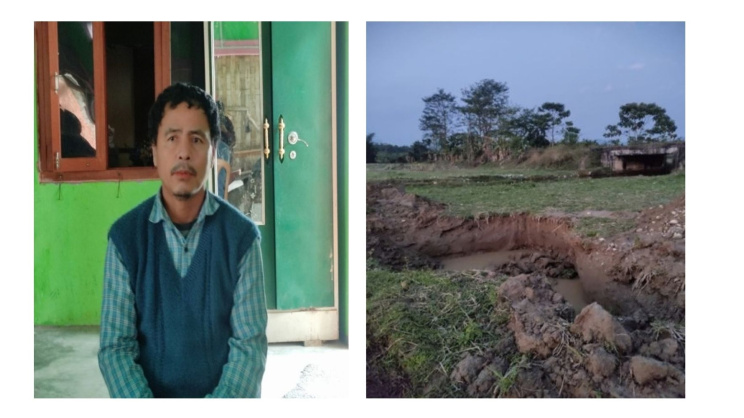
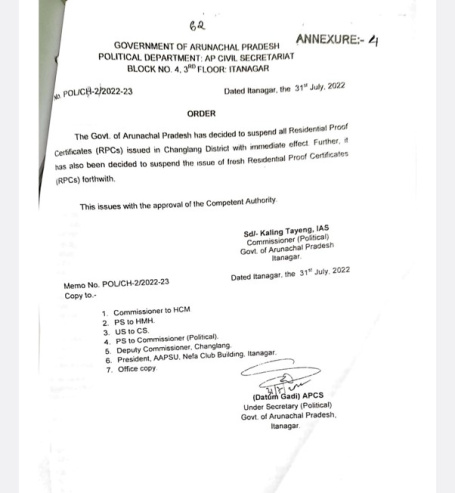
But the situation facing the current generation of Chakma youth remains precarious. Although many are eligible voters, they face barriers to applying for government jobs because they lack the residency documentation required by the state. In an interview, Premananda Chakma, a representative of the younger generation, expressed deep concern over these structural barriers, noting that the continuing absence of basic civil rights and economic inclusion leaves the future of Chakma youth uncertain and severely constrained.
“Education is something we continually strive for, despite severe economic hardship. Many of us manage to complete higher studies against all odds. Yet, upon graduation, we are barred from applying for government employment because the state refuses to issue us Permanent Resident Certificates (PRCs). The stark irony is that individuals from other states can secure employment here, while those of us born on this soil are denied the fundamental right to compete for public sector jobs.”
Land alienation and legal marginalisation
The Chakma population is primarily concentrated across three districts of Arunachal Pradesh: Changlang, Namsai and Papum Pare. During the initial period of their settlement in NEFA, they enjoyed a range of rights and access to public services; it was during the Gegong Apang era that questions increasingly began to be raised about their status and civil rights in the state. Consequently, since the 1980s, they have faced continued marginalisation and restrictions on access to basic rights and essential public services, including voting rights, government employment opportunities, trade licences and ration cards.
The vulnerability of the Chakma population is further exacerbated by growing land insecurity and institutional barriers to land ownership. When Chakma families were resettled in Arunachal Pradesh by the government between 1964 and 1969, each household was allotted approximately five acres of land. Today, however, many families lack formal documentation of land possession. Environmental degradation and riverine erosion have further diminished or submerged some of these original holdings, leaving affected households completely landless. Additionally, there have been instances in which the Arunachal Pradesh government has acquired land belonging to Chakma families for development projects without providing compensation. Kalai Chakma, a resident of Abhaypur Village in Changlang district who says his family has been affected by such a case, describes what he sees as structural dispossession:
“The government intends to acquire my inherited land for a transmission project. While we support regional development and are willing to give up our land, the administration is denying us compensation. Despite possessing valid land documents, they claim our locality is officially designated as a Reserved Forest area. The state uses this regulatory classification to withhold compensation from us, while other indigenous communities whose land was taken for the same project are receiving compensation.”
The last word
The Chakma narrative demonstrates how postcolonial border-making and state-centric development can transform an indigenous population with deep historical roots in its homeland into a people struggling for secure political and legal belonging. Resolving their plight requires moving beyond majoritarian approaches to state-building and recognising those for whom Partition remains a lived reality. The continuing consequences of Partition actively shape their memories, daily lives, identities and political realities rather than belonging to a closed chapter of history. The community remains caught in a state of continuing precarity, between the legacy of past displacement and the realities of present-day institutional exclusion.
Anita Mondal is a doctoral scholar at Diamond Harbour Women’s University and an Indian Council of Social Science Research (ICSSR) Doctoral Fellow. She completed her postgraduate degree at Presidency University, Kolkata.
Send your articles for Slow Reads to slowreads@thedailystar.net. Check out our submission guidelines for details.
The young radicals who challenged 19th-century Bengal
More men are cooking. But is patriarchy leaving the kitchen?
Everyday secularism and the Bangladesh we rarely talk about
Reading Sarat Chandra at 150, with empathy

Who really owned Britain’s royal jewels?
The 25,000-year history of betel nut chewing
The world map we know is distorted. Why does it matter?

Bengal and the coming of Islam: A story of soil and spirit
Xuanzang’s travels to Bengal and beyond : The man, the pilgrim and the Monkey King