


Retailers lose up to 30% of sales after early closures

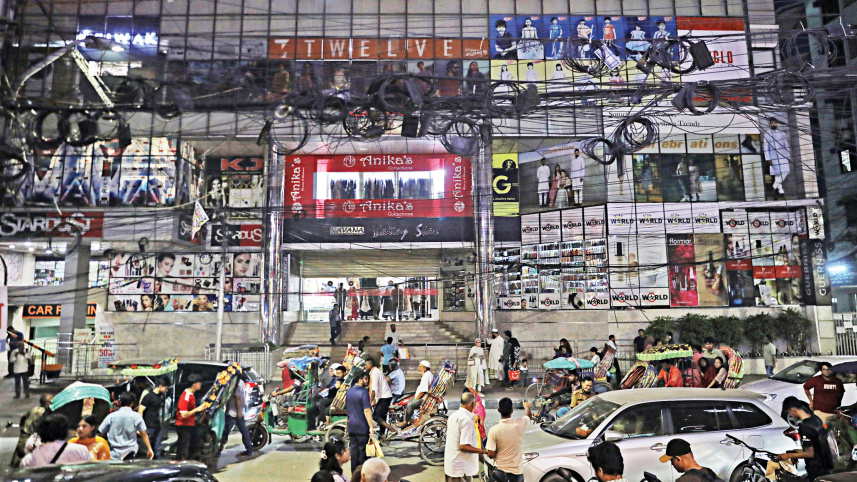
Closing shopping malls earlier to save electricity amid an energy shortage has wiped out up to 30 percent of retail sales, according to traders, who say customers are particularly used to buying footwear and fashion items after finishing work in the afternoon.
In August, the authorities instructed shops, markets and shopping malls across the country to close by 8 pm, bringing the deadline forward from 10 pm.

The shorter shopping hours came at a time when retailers were already dealing with prolonged inflationary pressure, which had weakened people’s purchasing power and hit sales.
Yet businesses still have to pay the same, if not more, for shop rents, staff salaries and other operating costs, putting further pressure on already shrinking profit margins.
“Sales have fallen over the past month, putting significant pressure on cash flows,” said Khalid Mahmood Khan, co-founder and managing director of Kay Kraft, a popular fashion retailer.
Khalid said people in Bangladesh generally feel more comfortable shopping after sunset, especially during hot weather. Reducing shopping hours is disrupting a long-established lifestyle pattern.
He estimated that sales in the fashion and lifestyle sector have fallen by around 25 percent to 30 percent over the past month because of the combined impact of inflation and reduced shopping hours.
“Costs have increased, but revenue has declined. Salaries and shop rents, however, have not come down,” he said.
In April, the government initially ordered shops, markets and shopping malls to close by 6 pm as part of energy-saving measures. The deadline was later relaxed to 7 pm following pressure from business groups and temporarily extended to 10 pm during Eid-ul-Azha.
It was then restored to 7 pm before being extended to 9 pm from June 11. The latest order cut the closing time to 8 pm.
According to businesses, the repeated changes to operating hours have made it harder for retailers to plan sales and staffing.
EVENING SALES TAKE A HIT
The impact has been particularly pronounced for retailers whose sales peak in the evening.
Apex Footwear, one of the country’s major footwear brands, says about 60 percent of its domestic sales normally take place after 8 pm.
Firoze Mohammad, chief executive officer of the company, said domestic business had fallen by 20 percent to 30 percent following the latest restriction on operating hours.
“Closing shops at 8 pm is having a very significant impact on our business,” he said.
Kazi Jamil Islam, managing director of Lotto Bangladesh, which operates 240 outlets, said the company’s sales fell by around 20 percent within a month of the latest restriction.
“Our major sales take place between 7 pm and 9 pm,” he said, adding that rents and other operating costs had remained unchanged despite the decline in sales.
International retail chain Mustafa Mart has also seen a sharp decline in business since the latest restriction.
BM Saleh Musa, manager (accounts and finance) at Mustafa Mart Pvt Ltd, said customers generally feel more comfortable shopping between 6 pm and 10 pm.
 For all latest news, follow The Daily Star's Google News channel.
 “Our revenue has declined by around 30 percent over the past month compared with the regular sales level of the previous month,” he said, adding that at one outlet, daily revenue fell from around Tk 3 lakh to Tk 70,000.
“Even after 8 pm, salesmen are compelled to turn away customers who want to make purchases,” Saleh said.
Local retail chain Daily Shopping, a concern of PRAN-RFL Group, also said it had seen an immediate impact from the restrictions.
“Customers are yet to get accustomed to completing their necessary shopping by 8 pm. As a result, we have seen an immediate impact on sales and revenue earning,” said Heron Mahmud, manager of an outlet of the retail chain in Uttara.
At Transcom Electronics Ltd, sales at its Gausul Azam Avenue outlet in Uttara have fallen by around 10 percent since the closing time was reduced, said Md Shorif Sarker, branch operation head.
“If our average daily sales were Tk 4 lakh, a 10 percent decline means Tk 40,000 less in sales. We are now doing around Tk 3 lakh to Tk 3.5 lakh a day,” Shorif said.
The outlet previously remained open until after 10 pm.
COSTS KEEP RISING
The shorter selling window comes as retailers are already dealing with weaker purchasing power and higher operating costs.
Footwear retailers are also facing higher prices for petrochemical-based inputs, which have reduced margins.
“Our business is a mix of exports and the local market. The export business generates only a small manufacturing margin,” said Apex’s Firoze.
Apex has absorbed much of the increase in input costs rather than passing the full increase on to customers, he said.
For smaller retailers, the combination of lower sales and unchanged fixed costs has become increasingly difficult to sustain.
Md Nasir Khan, vice-president of the Footwear and Leather Industries Association of Bangladesh and managing director of Five-R Footwear, said the company had permanently closed around 70 outlets amid weak demand, rising costs and the broader energy crisis.
“Running a business in the domestic market has become extremely difficult in Bangladesh,” he said.
NO EARLY RELIEF IN SIGHT
The government, however, says the 8 pm closing requirement is unlikely to be relaxed while the power supply remains inadequate.
“Currently, we still have loadshedding and the supply is not enough. Unless the situation improves, we cannot consider that,” said Muhammad Arif Sadeq, public relations officer of the Ministry of Power, Energy and Mineral Resources.
Power Grid Bangladesh PLC data show that the power shortage remains significant during the evening. At 9 pm on September 14, during the evening peak, power demand stood at 17,348MW while supply stood at 15,435MW, leaving a deficit of 1,913MW.
When asked if there was a possibility of the restrictions being lifted during winter, when energy consumption typically falls, he said it would have to be seen.
“We will reconsider if the situation improves,” he reiterated.
Comments