


Rising costs, falling prices push poultry farmers to the brink

Mazedul Haq has decided to leave poultry farming behind.
The farmer from Nolua village in Noakhali’s Kabirhat upazila plans to shut down his farm after selling his current batch of broiler chickens. For him, the numbers no longer add up.

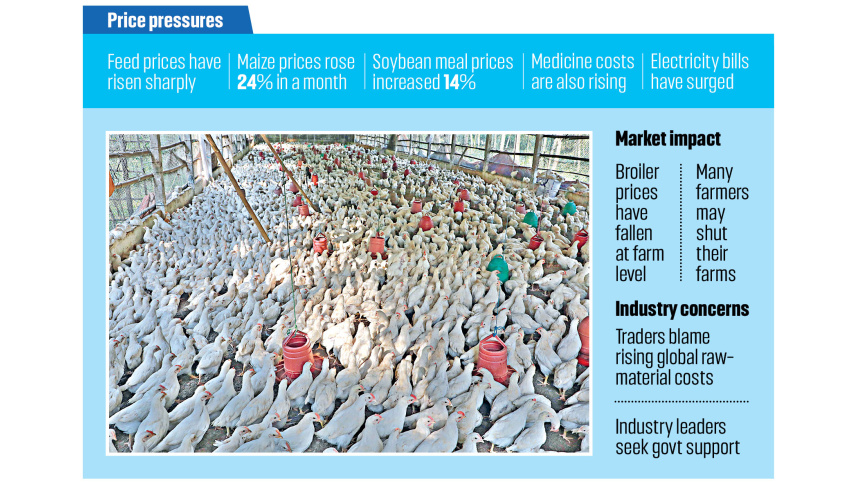
The cost of running his farm has risen sharply, with feed, medicine and electricity becoming more expensive. At the same time, chicken prices have fallen, leaving him with mounting losses.
“A sack of feed that cost Tk 3,475 a month ago now sells for Tk 3,600 to Tk 3,650,” Mazedul said. Soybean feed has also become costlier, rising from Tk 950 to Tk 1,200 over the same period.
Medicine prices have increased too. A medicine that cost Tk 300 now sells for around Tk 360 to Tk 370.
Electricity has added to the burden. Mazedul paid about Tk 6,000 last month, but his bill has jumped to Tk 10,000 to Tk 11,000 this month.
Yet the price of his chickens has moved in the opposite direction. Mazedul, who has around 3,000 broilers, sold his birds for Tk 132 per kg three days ago, down from Tk 140 a month earlier.
With costs rising and returns falling, he sees little reason to continue. Once he sells the current batch, he plans to leave his sheds empty rather than risk another round of losses.
Mazedul is not alone. Poultry farmers across the country are facing similar pressure.
Over the past month, the price of maize, a key feed ingredient, has increased 24 percent, from Tk 31.30 to Tk 38.80 per kg, according to industry data.
Prices of other major feed ingredients have also risen. De-oiled rice bran has increased 27 percent, from Tk 26 to Tk 33 per kg, while rice bran oil has risen 18 percent, from Tk 33 to Tk 39.
Mustard oil cake has gone up 9 percent, from Tk 36.50 to Tk 39.70 per kg, while soybean meal has increased 14 percent, from Tk 58 to Tk 66.
According to the Feed Industries Association Bangladesh (FIAB) and the Bangladesh Poultry Industries Central Council, around 150 registered feed companies produce about 75 lakh tonnes of commercial feed a year.
Unregistered companies produce an estimated 5 lakh tonnes more. About 70 percent of the total output is poultry feed, while the rest is used for aquaculture and cattle.
INDUSTRY SEEKS POLICY SUPPORT
Feed traders say prices of key raw materials are rising unchecked. Most of these ingredients are linked to international markets, leaving local producers with little control over price movements.
They say the industry cannot tackle the problem on its own and are calling for targeted government support and policy measures to keep the poultry sector afloat.
Md Anwarul Haque, general secretary of FIAB, told The Daily Star that unchecked increases in feed raw material prices have sharply raised farmers’ production costs.
He warned that if the situation is not brought under control soon, raw material prices could rise further, putting more pressure on farmers and consumers.
Import costs have already risen sharply due to soaring global prices, a burden that no single company can bear alone, he added.
 For all latest news, follow The Daily Star's Google News channel.
 Anwarul said timely steps are needed to bring local prices in line with the international market and ensure adequate stocks and supplies at home. Without such measures, poultry production costs will remain high, eventually putting more pressure on consumers.
As global prices and supply chains are beyond local control, the government needs to provide effective policy support to protect the poultry industry and keep protein and nutrition affordable, he added.
To ease pressure on the feed industry, FIAB has called for tighter controls on exports of de-oiled rice bran and rice bran.
It also urged the government to review VAT, tax and duty rates on imported raw materials and provide special support to the industry. At the same time, it called for closer market monitoring to prevent traders from creating artificial shortages.
The association also stressed the need for joint efforts by the government and private sector to boost local production of raw materials, ensure a steady supply and ease pressure on the market.
Bapon Dey, professor of poultry science at Bangladesh Agricultural University, said the poultry industry is facing rising fuel and transport costs, higher feed prices, raw material shortages and unstable market conditions.
He also highlighted the wide gap between farmer and consumer prices. While consumers pay nearly Tk 180 for a kg of broiler chicken, farmers receive only Tk 135 to Tk 140, leaving a gap of around Tk 40 that he largely blamed on the sector’s unorganised marketing system.
Bapon called on the government and private organisations to bring greater discipline to marketing and distribution through regular market monitoring and inspections, public display of prices and monitoring teams, with law enforcement agencies involved when necessary.
He also urged measures to ease farmers’ rising costs, including lower import taxes, greater policy flexibility and temporary subsidies on electricity and fuel.
Comments