


Tighten anti-money laundering rules for capital market: BFIU
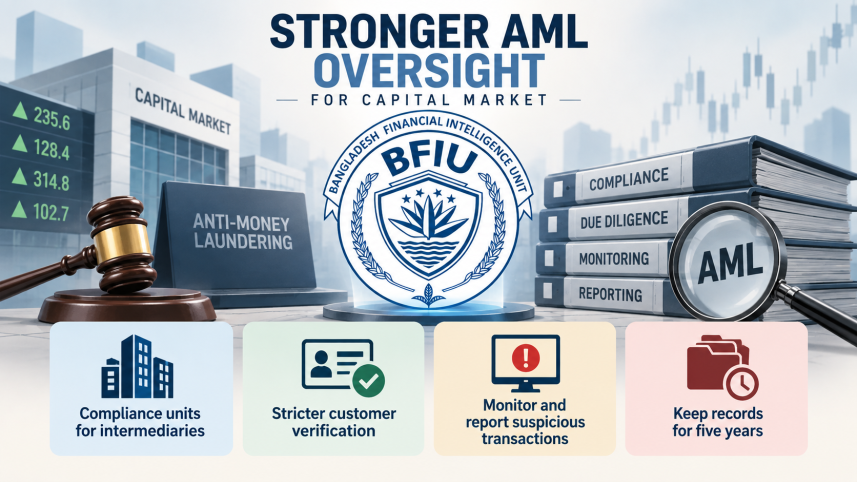
The Bangladesh Financial Intelligence Unit (BFIU) has directed capital market intermediaries to establish separate compliance units to prevent money laundering and terrorist financing.
The anti-money laundering agency issued a directive in this regard today.

Under the new directive, brokerage houses, merchant banks, portfolio managers, securities custodians and asset management companies will have to take stricter measures to prevent money laundering.
The BFIU issued the directive and sent it to the chief executives of the institutions concerned.
According to the new directive, each institution must establish a Central Compliance Unit at its head office, headed by a chief anti-money laundering compliance officer.
They must also appoint branch anti-money laundering compliance officers at the branch level.
In addition, each institution must formulate and implement specific policies to prevent money laundering and terrorist financing.
The directive said institutions must collect accurate and complete information from reliable sources, including national identity cards, passports and birth registration certificates, when opening customer accounts. Electronic KYC procedures may also be followed where necessary.
They must also conduct regular screening to determine whether any customer has links with individuals or entities listed under United Nations Security Council resolutions or by the Bangladesh government.
The BFIU has also instructed institutions to regularly monitor customer transactions.
If a transaction appears complex, inconsistent or apparently illegal, it must be reported in writing to the branch anti-money laundering compliance officer. The Central Compliance Unit will then examine the matter.
Subsequently, the institution must report the matter to the BFIU immediately through the GoAML Web system. Strict confidentiality must be maintained when filing such reports.
The institutions must also conduct self-assessments twice a year using prescribed checklists to evaluate the effectiveness of their anti-money laundering measures.
They have also been instructed to conduct independent assessments through their internal audit departments.
The directive further requires institutions to conduct background checks when recruiting officers and employees and ensure regular professional training for staff on preventing money laundering.
In addition, all customer and transaction-related information and documents must be preserved for at least five years from the date a customer's account or business relationship is terminated.
 For all latest news, follow The Daily Star's Google News channel.
Comments