


Why Bangladeshi unisversities should consider offering online degree programmes
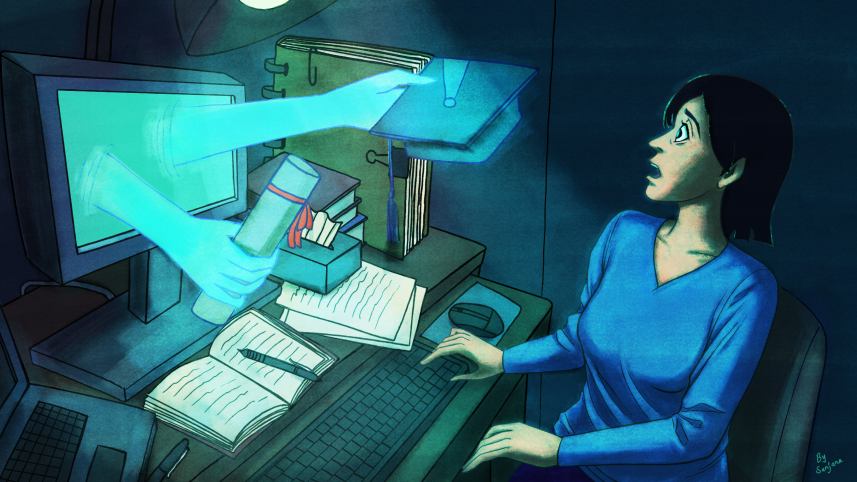
For the last two years, I have been pursuing two undergraduate degrees simultaneously: an in-person degree at a private university in Bangladesh and another online one at the Indian Institute of Technology (IIT), Guwahati. The online degree programme has enabled me to study data science and artificial intelligence, hone my technical skills, and, above all, has given me the opportunity to pursue a degree with both the flexibility to manage my workload and the structure to keep me focused and engaged.
The pursuit of this online degree has also made me wonder whether or not Bangladeshi universities are ready to start offering similar online programmes. If they are, is there really a market for such programmes in the country, and what would it take for them to be successful?

Firstly, a question that many might have is, why would anyone want to enrol in an online degree? Convenience and flexibility are the obvious strengths of online education. But for most people, university is much more than lectures and exams. For many, it is where lifelong friendships are formed, where students discover new interests, join clubs, develop soft skills, and gradually learn to become independent adults. Many students willingly move hundreds of kilometres away from home just to experience campus life at a reputable university. Online education cannot replace that experience, nor should it try to.
But we may be asking the wrong question. The real question is not whether online degrees can replace traditional universities; it is whether they can serve students whom the traditional system is failing to reach.
Every year during university admissions, many students fail to get into their dream universities. Some narrowly miss the cutoff for public universities, while others cannot afford the tuition at private institutions. Many are already working to support their families, running businesses, or living far from major cities where quality universities are concentrated. For a demographic like this, a well-designed online degree programme could make a difference.
A report published by the University Grants Commission (UGC) in 2025 states that public and private universities together offer a little over a million first-year undergraduate seats, but the competition for the most-desired universities and programmes is brutal. At most public universities, it is common for many candidates to fight over a single seat. In public universities, getting enrolled on programmes or subjects that students actually want to study is also a big factor.
Given this immense competition, there is naturally a gap between what a majority of students want to pursue and what they end up pursuing. And this is the gap that some countries, like India, have learned to close.
In 2020, India's University Grants Commission stopped treating online degrees as a special exception requiring case-by-case permission and allowed accredited universities to start offering them. The results were optimistic. For instance, IIT Madras's online BS in Data Science and Applications, at the time of writing, has over 36,000 students actively enrolled. Over 20,000 of them are pursuing the online degree the same way as I am: alongside a full-time, on-campus programme. Moreover, over 3,000 students pursuing the online programme are working professionals who are getting to upskill themselves without quitting their jobs.
This success is in the design more than in the ambition. When I mention my online degree, the first two questions are: does the quality not suffer, and how do they stop people from cheating?
As for the quality, it is true that not all degrees can be, and should be, offered online. Medicine or equipment-intensive engineering subjects and programmes, for instance, that need large lab setups or clinical wards to be learnt properly, are not that well-suited for online delivery.
If an instructor is comfortable and competent, and the student is eager to learn, there is minimal distinction between an online and in-person class. Online degrees offered by the IITs in India also have a stackable credential system, where students can exit with a foundation certificate after a year, a diploma after the third, or push all the way to a full degree over as long as eight years. This flexible exit system prevents the feeling of “sunk cost” from bothering students if they decide they do not want to continue the programme.
Certain measures are also taken to prevent academic misconduct in online programmes. The use of proctoring software and mandating a full upper-body visible setup for exams makes adopting unfair means during exams just as hard as they are in in-person exams. In certain cases, a more hybrid approach can also be taken where specific exams or types of exams—such as finals—are held in person at designated centres.
Bangladesh has no equivalent framework for online degree programmes yet. The Bangladesh UGC does not currently authorise any conventional university, public or private, to offer a fully online undergraduate degree. The Private University Act still assumes that a real university is defined by its physical infrastructure, a rule written in 2010 to stop diploma mills.
Offering online degrees in Bangladesh, of course, is far from as easy as it may sound, as the country still faces several tangible barriers to making online education work effectively. Frequent internet disruptions and load shedding, particularly in rural areas, remain among the biggest challenges, as they can make it difficult for students to consistently attend classes, access course materials, or complete assignments.
Beyond connectivity issues, establishing the proper infrastructure needed for the effective delivery of online courses also poses a significant challenge. There is also a need for secure and reliable testing infrastructure, especially because online exams in Bangladesh have already earned a reputation for being relatively easy to cheat on. Besides these concerns, there is also the important factor of ensuring that faculty members are comfortable, confident, and sufficiently proficient in using the digital tools and platforms required to teach online effectively.
But as discussed earlier, all these are solvable problems, not permanent ones. It will take time, effort and resources, but if it means Bangladeshi universities can start reaching a student in a remote area who dreams of studying computer science at a reputed university, or a working professional who wants to enhance their skills, or someone who is unhappy with their job and wants a career change, maybe, with the right approaches, the investment in online degree programmes might be worth it.
References:
1. Daily Sun (December 9, 2025). Private universities in admission crisis.
2. New Age (October 8, 2025). Seats, students rise in pvt univs, drop in public ones.
3. PR Newswire (May 12, 2020). E-Learning Market Revenue to Cross USD 375 Bn by 2026.
 For all latest news, follow The Daily Star's Google News channel.
 4. University Grants Commission New Delhi, India. Distance Education Bureau (ODL and Online).
5. IITM BS Degree Office - Non-Campus Undergraduate Programs.
6. University Grants Commission (2025). 50th Annual Report 2023.
Comments