


Wars, conflicts deepen global economic woes
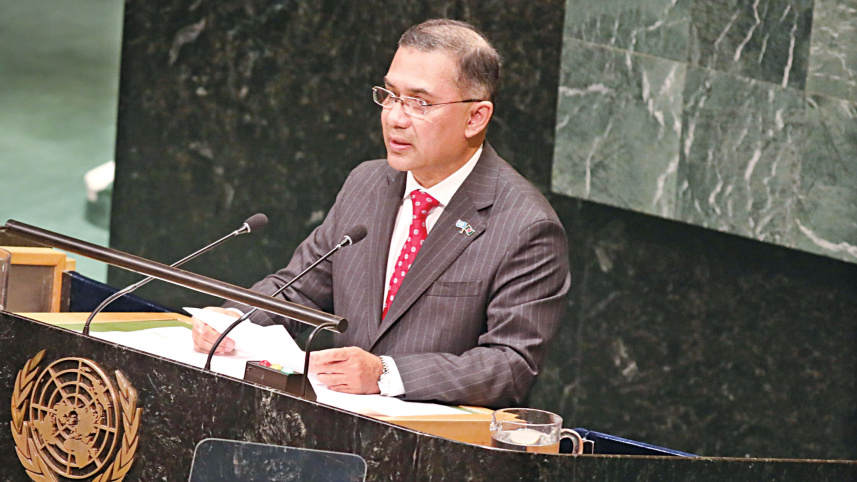
Wars and conflicts continue to weigh heavy on the world economy, with disruptions to energy supply chains and inflationary pressures exacerbating the economic situation across the globe, Prime Minister Tarique Rahman has told the United Nations General Assembly.
In his first ever address to the global forum, he explained that in this era of globalisation, events in one part of the world inevitably reverberate across borders, affecting nations to varying degrees. Ongoing man-made conflicts have created instability in many regions, displacing large populations and triggering humanitarian crises.

“We believe that any conflict should be resolved through dialogue, diplomatic processes and mutual cooperation,” Tarique said in his speech at the UN headquarters in New York early yesterday (Bangladesh time).
Articulating his vision of a peaceful world and a humane international community, he expressed hope that reason and debate, diplomacy, education and human values, rather than instruments of destruction, would emerge as the driving forces of change.
Describing the United Nations as the cornerstone of a global order founded on dialogue, consensus and peaceful coexistence, Tarique said, “Today, I once again reaffirm Bangladesh’s support for all United Nations initiatives aimed at advancing global peace and upholding the values of humanity.”
The growing tendency among countries to divert development budgets to military spending, he believes, is a major impediment to global peace. “As a peace-loving nation, Bangladesh remains committed to the objectives of general and complete disarmament, nuclear non-proliferation and arms control.”
Stating that the people of Bangladesh remain deeply concerned about the suffering of the Palestinian people in their struggle for self-determination, Tarique asserted, “Bangladesh reaffirms its steadfast support for their legitimate aspirations, including their right to self-determination and the establishment of an independent Palestinian state.”
Throughout his address, Tarique highlighted a range of pressing issues, including the protracted Rohingya refugee crisis, his government’s policy priorities, Bangladesh’s exposure to climate change impacts, and broader regional and international concerns.
ROHINGYA CRISIS
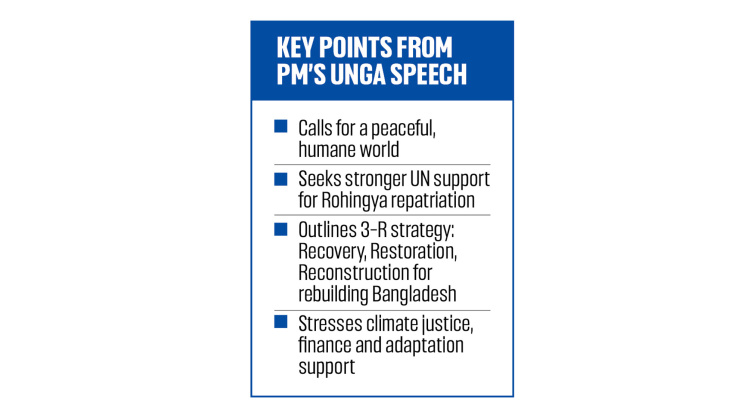
The prime minister said for more than nine years, Bangladesh has been providing shelter to more than 1.2 million forcibly displaced Rohingya refugees from Myanmar. “As a result, immense pressure has been placed on the country’s resources, environment, security and local communities.”
He believes that the source and origin of the Rohingya crisis lie in Myanmar, arguing that its solution also lies there. “The only solution to this problem is the safe return of the displaced Rohingya population to their homeland.”
Bangladesh expects firm and effective support from the United Nations and the international community for a lasting solution to this crisis, Tarique said.
He also called upon the United Nations and the international community to continue life-saving assistance programmes for the displaced Rohingya population until they are repatriated to their own country, Myanmar.
“If the international community fails to ensure justice for the displaced Rohingya population, this may turn into a humanitarian crisis in the near future,” he warned.
Tarique Rahman began his address to the General Debate at around 6:15pm (New York time), with the session chaired by UNGA President and Bangladesh Foreign Minister Khalilur Rahman.
The occasion also carried personal significance for Tarique, as both his late parents, former president Ziaur Rahman and former prime minister Khaleda Zia, had addressed the UN General Assembly from the same podium.
3-R STRATEGY
Bangladesh is pursuing a three-R strategy -- Recovery, Restoration and Reconstruction -- to rebuild the country after more than a decade-and-a-half of what Tarique described as fascist rule and exploitation.
“The country became free from fascism in 2024, bringing an end to more than one and a half decades of fascist rule. It is now once again embarking on the path of democracy.”
Insisting that an immense horizon of possibilities was now open before Bangladesh, he stated that the government had begun implementing extensive programmes to transform the country’s working-age population into skilled human resources by taking advantage of the demographic dividend.
 For all latest news, follow The Daily Star's Google News channel.
 Tarique stressed that Bangladesh aims to emerge as a regional “manufacturing hub” and called on development partners to support the country’s efforts to achieve that goal.
The prime minister noted that more than half of Bangladesh’s population were women and the government was giving priority to women’s education, employment and entrepreneurship.
He also mentioned that the government wanted to ensure not only electoral democracy but also the “democratisation of the economy” so that the benefits of economic growth and prosperity reached every family and citizen.
To achieve this, he said the government has introduced support programmes for economically disadvantaged people through various social protection schemes, including the Family Card, Farmers’ Card, Sports Card and e-Health Card.
He further said the government also planned to introduce a “Universal Card” by integrating the cards introduced to provide support in every sector.
As he outlined his vision for Bangladesh, the prime minister said a state can never become strong by keeping its citizens powerless.
“Bangladesh wants to establish a prosperous, self-reliant, welfare-oriented democratic state where people, regardless of political affiliation, religion or race, could live safely with equal rights, respect and dignity.”
“Bangladesh First: Bangladesh for All,” he said, outlining the government’s vision of a country where young people could pursue their dreams without fear, women could live with confidence and every child could realise their full potential.
CLIMATE CHANGE
Highlighting Bangladesh’s vulnerability to climate change despite its limited contribution to global carbon emissions, the prime minister called for stronger global action at COP31 on climate justice, climate finance and adaptation support.
The government, he said, had also begun implementing the Teesta Master Plan and the Padma Barrage project to increase freshwater flow to the Sundarbans and conserve water through large reservoirs.
Tarique said science and technology would shape the future, with artificial intelligence, biotechnology and other scientific advances creating new opportunities. But he warned against allowing today’s digital divide to become tomorrow’s “artificial intelligence divide.”
As Bangladesh prepares to graduate from the UN’s Least Developed Countries category, he sought continued international support in financing, market access, technology transfer and capacity building to make the transition sustainable.
Tarique said the Covid pandemic also had delivered a message to the world that mutual assistance, empathy and cooperation are essential for the global community to survive. It is essential to ensure sustainable production of vaccines, medical supplies and diagnostic equipment in developing countries so that these become readily accessible to all.
Paying tribute to the martyrs of Bangladesh’s Liberation War, he also recalled those killed and injured during the July uprising early on in his speech.
Comments