


Fuel shock to ripple across economy



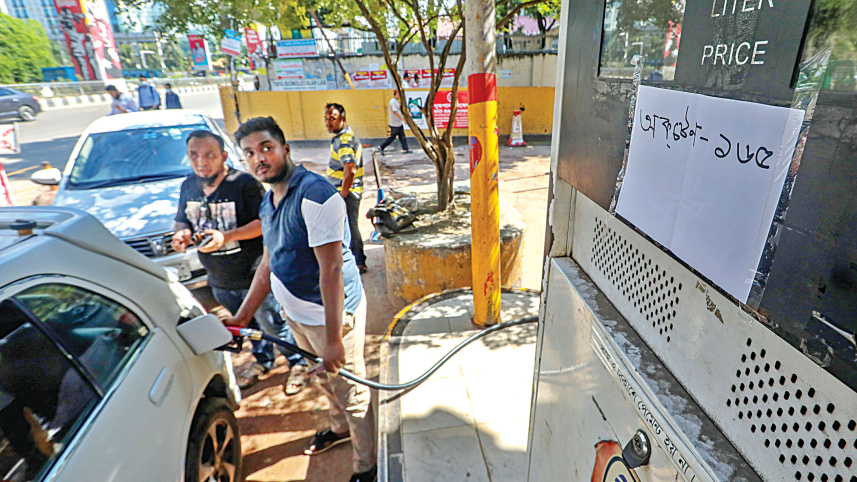
The government’s latest fuel price hike is set to ripple across the economy, threatening to rekindle inflation just as it had begun to ease, experts say.
Higher transport fares, freight charges, irrigation expenses and production costs are now expected to push up the prices of goods and services, adding to the burden on households and businesses already grappling with elevated expenses.

The Tk 20-a-litre increase, which took effect yesterday, pushed diesel, petrol, octane and kerosene to their highest-ever retail prices. This marks the third fuel price hike since the BNP government assumed office in mid-February.
Diesel, the country’s most widely used fuel and the backbone of transport, agriculture and industry, now costs Tk 135 per litre, up from Tk 115. Before the US-Israeli war on Iran began, diesel was selling for Tk 100 a litre.
The government has defended the decision, saying it had become unavoidable amid surging import costs, a growing subsidy burden and rising risks of cross-border fuel smuggling.
Speaking at a press conference at the Secretariat yesterday, Anindya Islam Amit, state minister for power, energy and mineral resources, said maintaining the previous prices was no longer financially sustainable.
According to the minister, diesel would now cost about Tk 205 per litre had Bangladesh fully implemented its automatic fuel-pricing mechanism, under which domestic fuel prices are adjusted in line with international market rates. Even after the increase, the government is still subsidising diesel by about Tk 70 per litre, down from roughly Tk 90 previously.
“There was no alternative before us. Otherwise, the government would neither want nor choose to take such an unpopular decision,” he said.
The move comes amid volatility in the global energy market, with Brent crude remaining above the $100-a-barrel mark for much of the past two weeks.
Economists say the decision may reduce pressure on the government’s fuel subsidy bill but argue that the relief is largely fiscal rather than economic, as the burden is effectively being transferred to commuters, farmers, businesses and households.
They warn that the increase could drive up food prices, raise operating costs for firms already struggling with high borrowing costs and further weaken a job market that has struggled to recover for years.
The impact on transport has been immediate.
Bus operators on the Dhaka-Khulna route and other southern routes have already decided to raise fares by Tk 50 per passenger, according to transport owners.
Some operators imposed even steeper hikes. Islam Paribahan has raised fares by as much as Tk 100, said Md Hamid, one of its counter managers, taking the Dhaka-Thakurgaon fare to Tk 700. On some long-distance routes, passengers reported paying up to Tk 200 more.
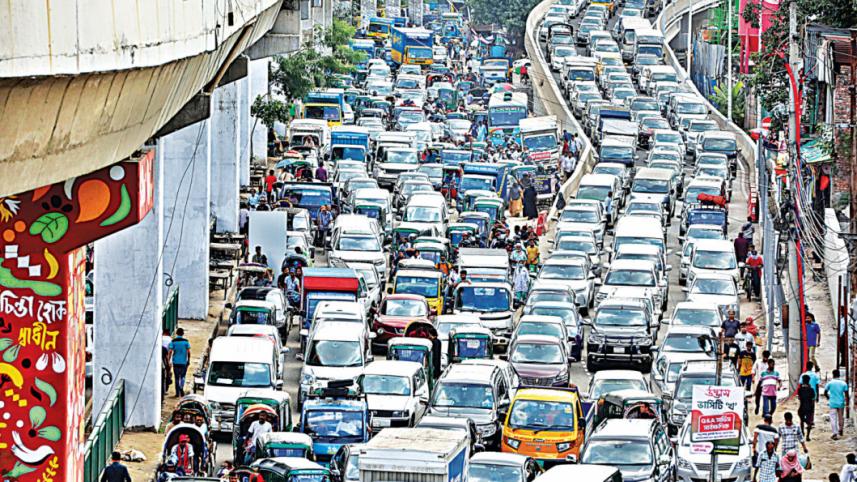
The speed with which fares rose has heightened concerns that higher fuel costs will quickly spread through the broader economy via increased transport and freight expenses.
The Bangladesh Inland Container Depots Association (BICDA), for instance, has raised six service charges related to handling import, export and empty containers by 9.85 percent.
“The decision was taken to adjust the additional fuel cost,” said Md Ruhul Amin Sikder, BICDA secretary-general, following a meeting of association members yesterday morning.
The fuel price hike comes at a particularly sensitive time for the economy.
 For all latest news, follow The Daily Star's Google News channel.
 The government has recently announced a revised pay scale for public sector employees, but millions of workers in the private and informal sectors are unlikely to receive comparable wage adjustments. Real incomes are already under pressure. The wage rate index slowed to 8.05 percent in August from 8.22 percent in July, remaining below the inflation rate.
Nazneen Ahmed, executive director of the Centre for Policy Dialogue (CPD), said higher fuel prices would have economy-wide consequences, affecting everything from agricultural production and transportation to industrial operations.
“Think about how much the cost of operating a bus will increase from one end of the city to the other and the impact that will have on fares.”
Evidence of that was already visible on Dhaka roads yesterday.
Passengers said Meghla Transport buses operating between Gulistan and Kalabagan via Shahbagh, as well as Rajanigandha buses on the Chittagong Road-Mohammadpur route, were charging an additional Tk 5. Ride-sharing drivers were also demanding higher fares.
Some commuters also reported fewer buses on the roads.
Moni Begum, who works at BIRDEM Hospital, was waiting in Shahbagh for a bus to Jatrabari. She said she usually caught one soon after office hours, but few were running. “It was the same when I came to work in the morning.”
CPD chief Nazneen Ahmed argued that a more gradual adjustment could have achieved the government’s objective without generating such a sharp economic shock. “Inflation had slowed over the past two months, but this will create a new kind of pressure.”
Nazneen also believes diesel and kerosene prices should have been left unchanged because they have a disproportionate impact on lower-income households, public transportation and industries.
The timing of the fuel adjustment alongside the implementation of the new pay scale, she warned, could fan the flames of inflation.
“…because two things are happening simultaneously, inflationary expectations will increase and push prices higher.”
Deen Islam, an economics professor at Dhaka University, said the impact would extend well beyond transport costs. “The cost of getting loans and marketing will raise the prices of goods and services in one go.”
He suspects that Bangladesh may not have been adequately prepared for rapidly changing geopolitical realities and that the timing of such a policy intervention therefore required careful consideration.
In his view, policymakers face a difficult trade-off between maintaining subsidies and safeguarding fiscal stability. While higher prices create immediate economic pain, sustained subsidies merely defer the adjustment while adding longer-term fiscal risks.
“There is no optimal policy here,” Deen said.
Bangladesh is not alone in confronting this dilemma.
Several import-dependent economies in the region have faced similar pressures. Pakistan, which relies heavily on oil imports from Saudi Arabia and the United Arab Emirates through the Strait of Hormuz, raised diesel prices by about 20 percent in March.
The Energy and Mineral Resources Division maintains that fuel prices in neighbouring and several other Asian countries remain significantly higher than those in Bangladesh.
Anu Muhammad, former professor of economics at Jahangirnagar University, argued that the government could have cut the taxes and fees it collects on fuel rather than, in his words, “putting the burden on the entire economy”.
Tight revenue collection may explain why the authorities were “choosing the easy means”, he said. “Judging by the government’s approach, it seems to be trying to become unpopular very quickly.”
Beyond the policy debate, the effects are already being felt by consumers and workers.
Shaheen Al Mamun, a grocer in Dhaka’s West Kafrul area, said customers’ purchasing power had been declining steadily over the past two to three years. “Now, with fuel prices rising by such a large amount all at once, people’s suffering will only increase.”
Abdul Mannan, who has been pulling a rickshaw in Dhaka for 16 years, said he was uncertain whether he would be able to continue sending money home every week if essential goods became more expensive.
Saidul Islam, a rice farmer in Habiganj, estimated that the fuel hike would add around Tk 200 per katha to his cultivation costs. Expenses related to operating power tillers are expected to increase, while labour costs are likely to follow.
Mohammad Lutfor Rahman, an economics professor at Jahangirnagar University, said production costs are about to rise across almost all sectors.
Rising agricultural costs would affect food prices and disproportionately hurt daily-wage earners and private-sector workers whose incomes are unlikely to keep pace, he said.
“We may move towards stagflation, which means high inflation, declining purchasing power, rising inequality, and an increase in joblessness,” he said. With the job market stagnant and industrialisation unlikely to pick up, “the situation ahead may be challenging for Bangladesh”.
Business leaders said they were not surprised by the direction of the move but questioned its scale and timing.
“We knew the government would eventually raise prices, but the timing and magnitude of the increase are concerning,” said Taskeen Ahmed, president of the Dhaka Chamber of Commerce and Industry.
He said businesses were already struggling with a prolonged energy crisis and that the fresh fuel price hike would place additional strain on production, logistics and household spending.
Taskeen urged all stakeholders to use fuel more efficiently and adopt austerity measures.
Comments