


Govt support services for persons with disabilities see low awareness, use: Study
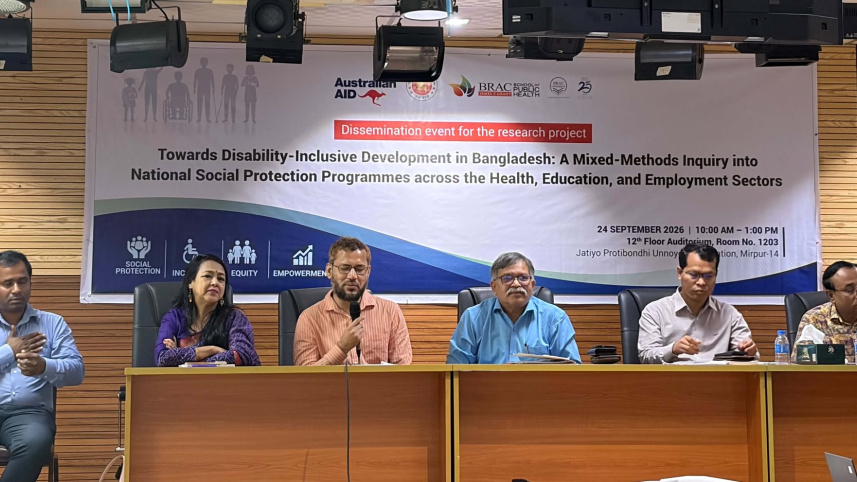
A new study has found gaps in awareness and access to several government support services for persons with disabilities, with participants citing distance, staffing, accessibility and inadequate allowances as some of the key barriers.
The study, conducted by the BRAC James P Grant School of Public Health of BRAC University, surveyed 396 persons with disabilities in 10 upazilas across all eight divisions. Of them, 79.52 percent were from rural areas, 77.7 percent were unemployed and 81.21 percent lived in households with monthly incomes below Tk 25,000.

The findings were presented at the Jatiyo Protibondhi Unnayan Foundation (JPUF) in Dhaka today. The research also included interviews, focus group discussions and a stakeholder workshop.
The study, titled “Towards Disability-Inclusive Development in Bangladesh: A Mixed-Method Inquiry into National Social Protection Programs across Health, Education, and Employment Sectors”, was supported by Australian Aid.
Presenting the findings, Sristi Chakma, a research associate at the school, said awareness of some services was low. Only 10.41 percent of respondents knew about the Mobile Therapy Van service, 16.70 percent about Shishu Bikash Kendros and 19.44 percent about the Education Stipend Programme.
Awareness of Protibondhi Seba O Sahajjo Kendras (PSOSKs) was higher at 25.92 percent, but actual use of the services was lower.
Only six percent of respondents had received Mobile Therapy Van services, while 11.37 percent had used a PSOSK. They cited irregular visits, lack of follow-up, long distances, inaccessible infrastructure, and the absence of female service providers as barriers.
The Disability Allowance Programme, however, had much wider reach, with 90.73 percent of respondents aware of it and 84.41 percent receiving the allowance.
Participants said the amount was insufficient and also reported receiving fraudulent calls seeking mobile financial service information.
Faruk, one of the participants, said he had repeatedly received calls from people claiming to be government officials and asking for personal information, including his PIN.
Md Tarikul Alam, managing director of JPUF and an additional secretary, acknowledged staffing and equipment problems at some of the foundation’s 103 centres.
He said plans were underway to establish 528 centres nationwide and introduce 64 mobile therapy vans, one per district.
Salma Mahbub, executive director of B-SCAN, said the one percent quota for persons with disabilities in government recruitment was not being followed in many cases.
She claimed candidates with disabilities also faced practical barriers during recruitment examinations, including being assigned examination rooms on upper floors.
Kajol Khan, a student, claimed bus operators sometimes refused passengers with white canes, while metro rail stations lacked audio directions for visually impaired commuters.
Sona Moni Chakma, director of administration and finance at JPUF, suggested adjusting allowance amounts based on the severity of disability.
 For all latest news, follow The Daily Star's Google News channel.
Comments