


Blaming ‘Tesla’ drivers is easy, but the problem runs deeper

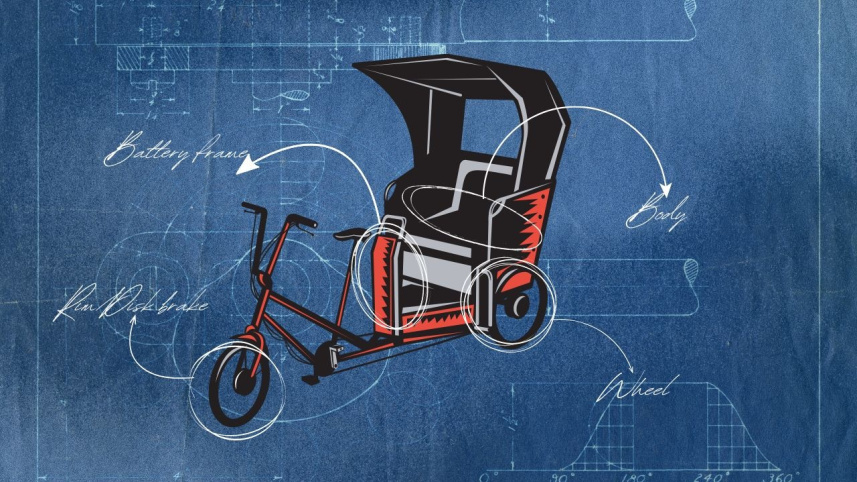
What causes Dhaka's traffic? Ask around, and the answer comes fast: battery-run autorickshaws, colloquially known as the "Tesla." People say their drivers ignore traffic rules, skip basic safety standards, and clog every road in the city. Ban them, the argument goes, and the roads will finally breathe.
But is that really the problem? Or is it just the easiest place to put the blame?

The more I look into it, the more I think this is a familiar pattern. We blame the smallest, most visible symptom instead of confronting the larger failure behind it. The "Tesla" driver is not the disease. He is a product of it.
I started asking the drivers what brought them here, on rides across the city. One conversation stayed with me.
“Mama, where are you from?”
“Dimla.”
“How long have you been in Dhaka?”
“About a month. This isn't my regular work.”
“What do you do for a living?”
“I'm a farmer. I have a pukka house back home. I'm not from a very poor family, honestly.”
“So, you come here to make good money in a short time? How much do you earn a day?”
“I pay Tk 500 a day to rent the vehicle. They give me lodging. I spend some money on meals. After that, I save around 1,500.”
“That's more than I make in a day, mama.”
He laughed.
“Are you married? Children?”
“Yes. A daughter and a son. One goes to madrassa, the other to school.”
I told him, half joking, that I should take up this work myself on weekends.
This man is not destitute. He has land, a proper house, a family back home. But even someone like him is being squeezed. Bangladesh's average inflation stood at 8.68 percent in FY2025-26, according to the Bangladesh Bureau of Statistics. Non-food costs, the things people cannot easily cut back on such as housing, transport, and healthcare, rose even faster, at 9.20 percent. And according to the BBS Labour Force Survey 2023, about 19.4 lakh young people aged 15 to 29 were unemployed nationwide, bringing the youth unemployment rate to 7.3 percent nationally, and higher still in cities, at 10.5 percent. Nearly four out of every five unemployed people in the country were under 30. None of this shows up during a single rickshaw ride. But it explains why a farmer with a house back home still finds it worth working a month away as a Tesla driver.
The system also makes that choice easy. Bangladesh has no unemployment insurance and no scheme to bridge the gap between harvests. So, the informal economy fills that gap. A supplier hands a driver a “Tesla,” gives him a place to sleep, and takes a major share of his daily earnings in return. It is not a good deal. But it is an available one. In a country where the formal job market cannot absorb its youth, and where prices keep rising faster than wages, an available deal is enough to pull people in.
The winners in this arrangement sit further up the chain. Rickshaw and battery suppliers, often protected by political connections and largely outside any regulatory reach, lease out cheap vehicles and shelter to a constantly rotating pool of seasonal migrants. Without that supply chain, entry would not be this cheap or easy. The driver would not be on the road at all.
 For all latest news, follow The Daily Star's Google News channel.
 Bangladesh now has an estimated 50 to 80 lakh of these battery-run three-wheelers on its roads, according to the government. The Bangladesh Road Transport Authority puts Dhaka's own share at 10 to 12 lakh. Unauthorised electricity used to charge them costs the country thousands of crores in lost revenue every year. Courts have ordered bans. Drivers have protested within days. The vehicles have returned every time. This cycle should tell us something. The problem is not weak enforcement. The problem is that nobody has addressed why the supply of untrained, unprotected labour never ends.
So, if we actually want to fix Dhaka's traffic, banning the driver will not work. Someone else will replace him within the week, from Dimla, or Rangpur, or Kurigram. The fix has to sit higher up the chain. Regulate the suppliers who profit from this informality. Require basic safety and traffic training as a condition of leasing these vehicles out. And separately, invest in rural income opportunities so that a month in Dhaka's traffic stops being necessary in the first place.
Blaming the smallest, most visible actor in the system is easy. Fixing the system is the real work.
Dipa Das is senior research associate at SANEM. She can be reached at dipadas.sandwip@gmail.com.
Views expressed in this article are the author's own.
Follow The Daily Star Opinion on Facebook for the latest opinions, commentaries, and analyses by experts and professionals. To contribute your article or letter to The Daily Star Opinion, see our guidelines for submission.
Comments