


Where old ideas meet a new generation: A morning at the UN with Prof Yunus

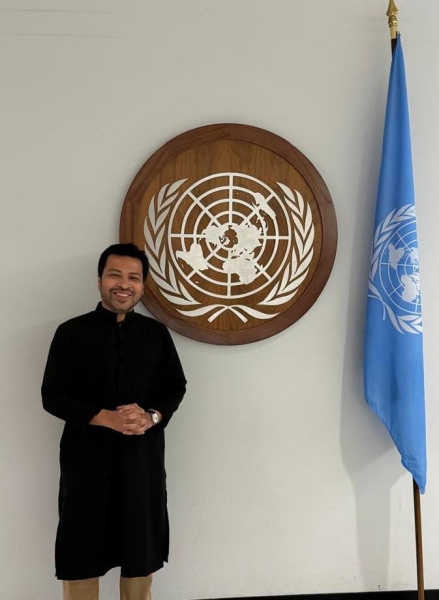
On Monday, September 21, I had the opportunity to sit in a conference room at the United Nations Headquarters in New York among diplomats, Nobel laureates, ministers, and members of the international press for the high level side event on social business, youth and technology. The event was one of hundreds convened during UNGA's high-level week. But the people in that room had gathered that afternoon for an idea born 50 years ago in a remote Bangladeshi village. Today, that very idea -- microcredit -- is central to how the world thinks about development.
The event, "Social Business, Youth and Technology," was held on the sidelines of the 81st session of the UN General Assembly, under the theme "2026: 50 Years of Micro Credit, 2030: The Year of Social Business." The timing was significant as this year marks half a century since microcredit first saw the light of day and 20 years since Professor Muhammad Yunus and Grameen Bank were jointly awarded the Nobel Peace Prize. The anniversaries gave the gathering its weight, but the conversation looked firmly ahead rather than back.

Professor Yunus, the keynote speaker, opened by congratulating Dr Khalilur Rahman on his presidency of the 81st UNGA session and welcomed José Ramos-Horta, president of Timor-Leste and a fellow Nobel Peace laureate, who was seated in the room. He discussed Grameen America's healthcare centres, including their specific services and eye care clinics, built to reach people conventional systems do not. He also spoke about Grameen University, scheduled to go live in December and aimed at producing job creators, not job seekers. Keeping social business at the centre, he said, will equip students to start businesses of their own.
In his speech, Dr Khalilur Rahman described social business as a pathway for societies to move past short-term relief toward solutions that sustain themselves.
President Ramos-Horta recalled his visit to Bangladesh in December 2024 and praised the country's democratic transition. There was an ease among the three men that suggested people who had worked alongside one another, not merely shared a stage.
The event also included conversations on topics outside of microcredit such as financial inclusion and artificial intelligence. Pakistan’s Minister of State and Chairman of Virtual Assets Regulatory Authority, Bilal Bin Saqib, argued that artificial intelligence and tokenisation could extend financial inclusion to the roughly 1.3 billion adults worldwide still outside the formal financial system. Kashifu Inuwa Abdullahi, director general of Nigeria's National Information Technology Development Agency, pressed for AI governance that guarantees representation and agency, not just access.
As someone from Bangladesh who has spent two decades in FMCG, telecom, logistics, e-commerce and now media, I found the panel discussions repeatedly bringing me back to my country. Bangladesh held the floor that afternoon: an idea born there 50 years ago has become central to any serious conversation about development.
What struck me most was that the conversations that afternoon looked beyond the past 50 years. They asked what the next 50 should look like. As a Bangladeshi, I came away with a powerful reminder: we have stories the world can learn from and ideas that can shape the decades ahead.
Md. Tajdin Hassan is the Chief Business Officer at the Daily Star. He is also an IVLP alumni member of the U.S. State department.
 For all latest news, follow The Daily Star's Google News channel.
Comments