


Eroded homes can be rebuilt, but some climate losses are irrecoverable
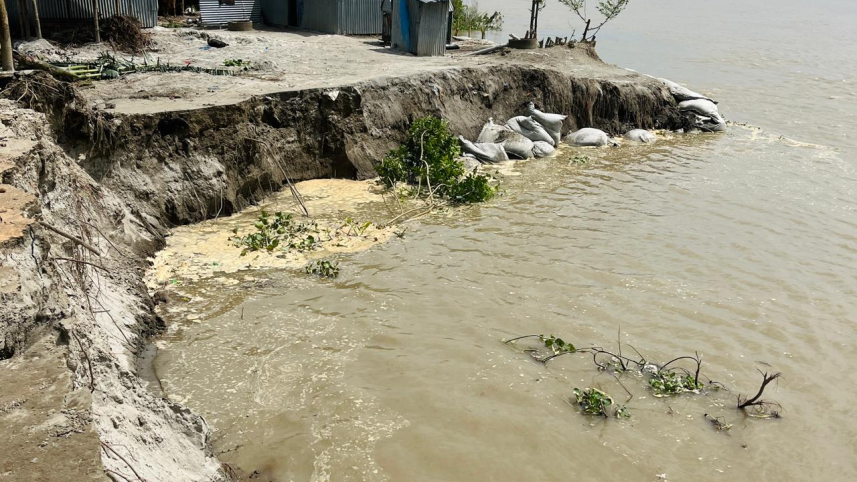
The story of Char Khedaimari: A community's struggle to survive in the shadow of river erosion
Md Jamil Hossain

Suggested: The river didn’t just take their homes, but memories too
When the river takes their homes and their memories
As part of the "Evidence-based Approach to Address Non-Economic Loss & Damage (EBAAN)" project under the International Centre for Climate Change and Development (ICCCAD), I recently had the opportunity to conduct a field visit to Rowmari Upazila in Kurigram. A significant part of this visit took me to Char Khedaimari, along the Brahmaputra River, a remote riverine char where more than 20,000 registered voters live. In this piece, I have tried to capture what I saw and heard there, stories that go far beyond economic loss, touching on memory, relationships, culture, and identity.
Despite its considerable population, Char Khedaimari has no health complex, community clinic, or community centre. Reaching the char from Rowmari town takes four to five hours, and there is no direct road. The journey begins with a car ride from town, followed by a short auto-rickshaw ride to the river ghat, and finally a motorboat crossing that takes close to an hour. This long, uncertain journey is not merely inconvenient; in many cases, it becomes a matter of life and death. When a pregnant woman falls suddenly ill, no dedicated boat or vehicle can rush her across; she must wait at the ghat until the next scheduled boat arrives. One local woman told me that last year, two pregnant women died during the river crossing after being unable to reach treatment in time. Another woman recounted a different incident: a young woman went into sudden, severe labour, but when her family reached the ghat, no boat was available. After a long wait, a boat finally arrived, and she delivered on board. The baby survived, but the mother died from excessive bleeding before they could reach the other side. Such incidents are not isolated in this char; over the years, there is a long history of pregnant women and critically ill patients losing their lives before they could reach care.
While collecting data, another pattern became clear: rates of visual, intellectual, and physical disability among Char Khedaimari's residents appeared strikingly high. When I tried to find the answer, residents explained that people from outside the char are reluctant to marry into families here, even when offered incentives such as a motorcycle as dowry. As a result, most marriages take place within extended families or among neighbours. This pattern has also contributed to the spread of conditions such as thalassemia, an inherited blood disorder that lowers the body's ability to make normal hemoglobin and healthy red blood cells, leading to anemia. One man told me that both of his children have thalassemia. He had married his own first cousin. Furthermore, as there is no community clinic or health complex, routine childhood vaccination does not reliably reach the char, and mothers are often not fully aware of its importance. Residents themselves pointed to this as a possible contributing factor to the high rate of disability.
Signs of river erosion are visible along nearly every bank of Char Khedaimari. According to residents, the river's mouth was once far from their settlement, but over the years, as its banks have eroded, the river has advanced more than two to three kilometres inlands. Families whose homes stood along the riverbank have lost their homesteads, along with ancestral land and cultivated fields. Many now live temporarily on other people's land, given shelter out of goodwill for six months to two years at a time, after which they must move again. Most of the people I interviewed had been displaced between four and 12 times in their lives.
A forty-year-old man told me his home has now been washed away six times. He lives with his wife and three daughters, and this time, too, his house sits right at the river's edge, and it could collapse at any moment. His face appeared visibly sorrowful as he thought about his forefathers’ homestead, where beautiful crops once grew for generations, crops that had comfortably supported the family and even brought in outside labourers. Having lost that homestead, he said, he became so destitute that working as a day labourer was his only option. He grew emotional as he spoke, and after a pause, he added that the river had also swept away his father's and grandfather's graves. Once, several related families lived together on their own land, sharing small occasions like making pitha and payesh. But after the erosion, everyone got scattered—some to other chars, others to the city in search of a livelihood. Now they rarely see or speak to one another.
I had the opportunity to interview a woman from the Hindu community, and she told me that before the erosion, their home had its own temple where large pujas were held, and people came from several neighbouring unions to attend them. The cost of these celebrations was covered through contributions collected across the union. But when the river took their homestead, it took the temple with it. They now live on a small plot of land beside a Muslim family's house, given to them out of kindness. She said that in this new place, she no longer feels able to perform the evening ulu or arati, worried about how the host family might feel. With no other Hindu households nearby, she must now cross the river to the town to worship. When I asked what kind of support, government or non-government, would help her most, she said that if they were given a place to live and a temple of their own, she would be able to perform puja freely again, and people would once more come to her home. As she said this, she began to cry.
When residents spoke about flooding, they said that while the last two years had been free of major floods, they had lived through a severe flood in the past that lasted nearly two months, with waist-deep water everywhere and no dry land in sight. During that flood, an elderly char dweller passed away, but no dry ground could be found to bury him, and the strong river current made it impossible to travel elsewhere. With limited financial means, the family had no choice but to bind the body to a raft of banana-tree trunks and set it afloat on the river. Several other bodies were sent off the same way that year. In other cases, families had to bury their elders in a graveyard on a distant char, a place they often cannot manage to visit again.
An elderly man also recalled that when they still had their own land, and the settlement was larger, the community held regular lathi-khela (stick-fighting) performances, jatra-pala (folk theatre), and seasonal fairs. But with people displaced from their own land and many having left for the cities, these festivals no longer take place. All these stories perhaps remind us that river erosion does not only wash away homes, livestock, and land. It takes away childhood memories, ancestral graves, local festivals, religious practices, recreation, and social bonds built over many years. The monetary value of a house or a cow can perhaps be calculated, and money can rebuild a house. But when a father's grave is lost to the river's current, what can fill that emptiness? The stories of the people of Char Khedaimari remind us that climate change is not only a story of economic loss, but also a story of human existence, memory, culture, and identity.
Md Jamil Hossain is pursuing a Bachelor of Public Health at the Department of Public Health and Informatics at Jahangirnagar University.
Views expressed in this article are the author's own.
Follow The Daily Star Opinion on Facebook for the latest opinions, commentaries, and analyses by experts and professionals. To contribute your article or letter to The Daily Star Opinion, see our guidelines for submission.
 For all latest news, follow The Daily Star's Google News channel.
Comments