


$1.5b local investment plans stalled over past four years

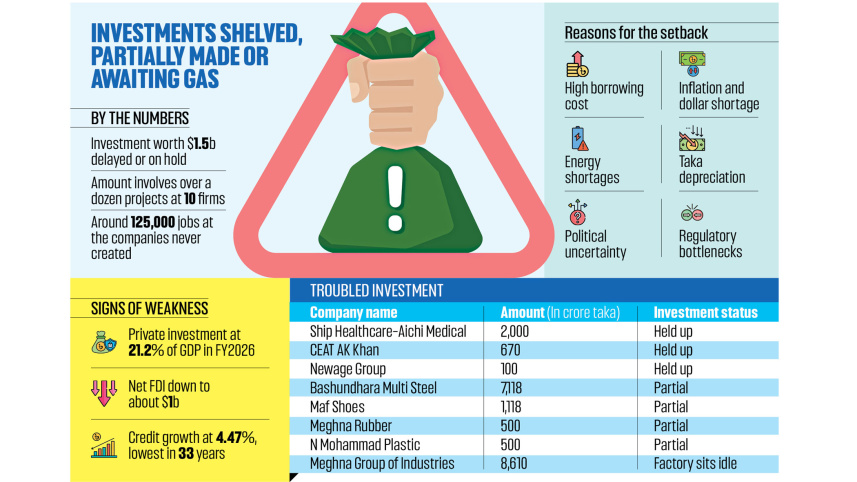
At least $1.5 billion in identifiable corporate investment plan has been affected over the past four years as businesses were hit by external shocks, domestic political uncertainty, high borrowing costs and energy crises.
The investment plans and projects, disclosed by at least 10 companies and reviewed by The Daily Star, show how the turbulent business climate is weighing on private investment.

In taka terms, the total amount is equivalent to around Tk 18,000 crore, while at least 125,000 new jobs could have been created if the investments had materialised.
Some companies have scaled back expansion plans, while others have delayed projects or invested in manufacturing lines that have yet to begin production.
The consequences are being felt across the economy.
Delayed investment means factories remain unproductive, planned production and exports are held back, and thousands of potential jobs do not appear at all.
Businesses and economists say these problems are also discouraging new investment at a time when weak demand, high inflation and tight financing are already hurting economic activity.
BIG INVESTMENTS NEED PREDICTABILITY
Apparel manufacturer and exporter Newage Group planned a factory expansion worth around Tk 100 crore last year. But political uncertainty following the July Uprising got in the way of the plan.
“For me, the biggest concern is not the availability of opportunities, but the predictability required to make a long-term investment decision,” said Asif Ibrahim, vice chairman of the group.
After the general election in early 2026, Newage found its existing plants struggling by mid-year because of energy shortages. The setback led the company to shelve the expansion plan for now.
Asif said businesses need reliable energy, competitive financing, minimum predictable policies and economic stability before making major commitments.
The businessman’s comments show that political uncertainty and energy shortages did not occur in isolation. Rather, they were the latest in a series of business obstacles over the years.
For example, Maf Shoes, a sister concern of TK Group, announced a Tk 1,118 crore investment at the National Special Economic Zone in Mirsarai, Chattogram, in 2023. The investment was meant to set up an export-oriented footwear manufacturing unit and backward-linkage production lines for the shoemaker.
“We wanted to increase our exports and provide backward-linkage products to local footwear manufacturers,” said Mohammad Shahadat Ullah, executive director of Maf Shoes.
But the prolonged Russia-Ukraine war, the latest Middle East conflict, high borrowing costs and persistent energy shortages forced the company to put the plan on hold, he said.
Shahadat said the company has decided to restart the project on a smaller scale, which would be completed within two years. But the revised investment plan is yet to be finalised.
He said uninterrupted gas and electricity supplies are their first requirement for expansion.
DELAYED PROJECTS RAISE COSTS
Whenever a business postpones an investment plan, one of the first and almost certain consequences is that the project will require more money in future.
 For all latest news, follow The Daily Star's Google News channel.
 For example, N Mohammad Plastic Industry Ltd, a concern of Chattogram-based N Mohammad Group, took up an expansion initiative in 2022. The initial cost estimate was Tk 500 crore.
But amid the Covid pandemic, external shocks and a worsening dollar crisis in Bangladesh, the plan was pushed to December 2025.
Though the group resumed the project last year, its cost has risen by more than 60 percent, according to Mohammad Nazrul Hoque, managing director of N Mohammad Group.
He said the company has spent more than Tk 60 crore developing the 10-acre site, but further investment remains stalled because of unreliable gas supplies.
“Without dependable gas, it is not commercially viable to proceed,” said Nazrul.
Another example of delays costing businesses is Bashundhara Multi Steel Industries. In 2022, it announced a 12.5-lakh-tonne-a-year steel plant at National Special Economic Zone, with around 7,000 potential direct jobs.
Masudur Rahman, media coordinator of Safwan Bashundhara Global, said eight banks approved a syndicated loan of Tk 2,305 crore, of which Tk 540 crore had been disbursed.
But the investment then faced a gas supply uncertainty. Currently, machinery worth hundreds of crores has been lying idle at the half-built factory, he added.
Masudur said the project cost has meanwhile risen from Tk 4,146 crore to Tk 7,118 crore because of delays, higher financing costs and taka depreciation.
FACTORIES READY, BUT GAS HOLDS THEM BACK
Three factories of Meghna Group of Industries at the Cumilla Economic Zone have remained idle for four years. The group invested around $700 million in a steel mill, glass plant and paperboard factory but has been unable to start production because gas and electricity supplies remain unavailable.
Since 2022, the group has incurred around Tk 80 crore in annual losses maintaining the idle facilities. It also provided Tk 100 crore each for grid development and Gas Transmission Company Limited (GTCL) pipeline infrastructure to accelerate connections.
The country’s first electric vehicle manufacturer, Bangladesh Auto Industries Ltd (BAIL), has readied its factory at the National Special Economic Zone in Mirsarai of Chattogram.
“We are 100 percent ready. We are only waiting for the gas connection,” said Mir Masud Kabir, managing director of BAIL. “Once we get it, we can start within seven days.”
Masud said BAIL’s investment in the vehicle project has reached around Tk 700 crore.
Contacted over new factories waiting for gas lines, Kazi Mohammad Saidul Hasan, general manager (Operations Division) of Titas Gas Transmission and Distribution PLC, said around 500 applications for industrial connections are currently pending with them.
But there is little prospect of providing new connections because of gas shortage, said Saidul. He said there would be no possibility of providing fresh industrial gas connections until 2030.
“Titas Gas is helpless in this regard,” he said.
The energy weakness is reflected in private credit demand for commercial lenders.
Syed Mahbubur Rahman, managing director and CEO of Mutual Trust Bank, said weak private-sector credit growth reflects subdued business activity. “If exports are not growing, why would an entrepreneur borrow to build a new factory when demand is weak?” he asked.
Taskeen Ahmed, president of the Dhaka Chamber of Commerce and Industry, said private investment stood at around 21.2 percent of GDP in fiscal year 2025-26, while net FDI fell to about $1 billion and credit growth dropped to 4.47 percent, its lowest level in 33 years.
A WARNING FOR ECONOMY, EMPLOYMENT
Selim Raihan, executive director of the South Asian Network on Economic Modeling (SANEM), said the postponement of more than $1.5 billion in corporate investment is a serious warning for the economy and employment.
“Investment delays mean delayed factories, production and exports, as well as thousands of potential jobs,” he said.
The economist said the energy shortage remains one of the most immediate constraints facing potential investors.
M Masurur Reaz, chairman and CEO of Policy Exchange of Bangladesh, said continued high inflation, sluggish demand, energy disruptions and high borrowing costs are weighing on investment and weakening investor confidence.
Reaz said rebuilding confidence would require focused action on energy security, financing, foreign exchange, regulation and policy predictability.
Comments