


Bond market grows, but trust deficit holds it back

Bangladesh’s bond market is growing as banks and companies show greater interest in issuing bonds. But the market remains far smaller than its potential, with concerns over weak accountability of bond issuers, auditors and credit rating agencies holding back growth.
To make the market more vibrant, sustainable and trustworthy, all stakeholders, including bond issuers, financial report auditors and credit rating agencies, must be held accountable, top industry executives said at a discussion titled “Unlocking Bangladesh’s Bond Market: Opportunities, Challenges” at The Daily Star Centre yesterday.

The Daily Star organised the event as part of its discussion series under the broad theme “Business & Beyond”. It was the fifth episode of the series.
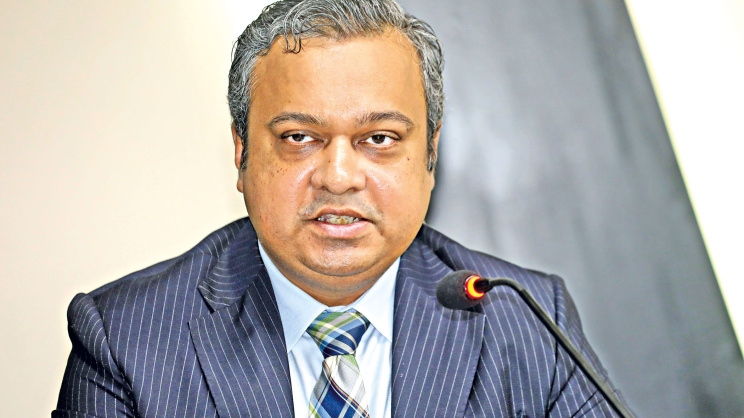
Credit rating is full of fun here. There is no credibility of the rating, so no one invests in bonds based on the rating, but issuers take the rating only for regulatory requirement.
The discussants called for greater market liquidity, increased institutional participation and easier access to bond investments. A top banker also recommended allowing banks to offer wealth-management services focused on sukuk and digital bond investments.
Tanzim Alamgir, managing director and chief executive officer of UCB Investment Limited, said liquidity remains a major challenge for the bond market. Bonds therefore need to be easy to trade.
He said a bond may offer a higher return than a bank deposit, but investors are reluctant to lock in their money for years if they cannot easily sell the security when they need cash.
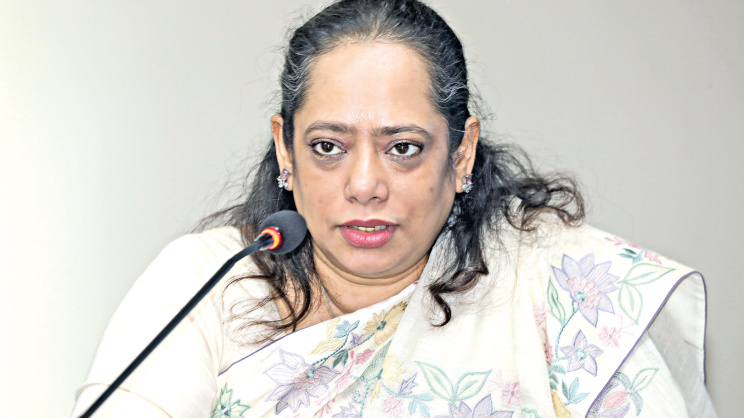
Audit firms should gain trust so that regulators and investors can trust their reports and take decisions quickly. In developed nations, regulators can approve bonds within a couple of days.
The bond market should also be protected from the problems facing the banking sector, he said. Bonds should not be issued simply to repay bank loans.
Banks should stop providing “free money” through lending for their own interest and for the betterment of corporates, he said.
Banks will have to play a key role in making the bond market more vibrant and improving liquidity. Their wide branch network can be used to reach more investors.
Although banks fear losing fixed deposit receipt (FDR) deposits when customers invest in bonds, some banks have already started selling bonds and open-ended mutual funds, Tanzim said.
At the discussion, Nuzhat Anwar, managing director of the Dhaka Stock Exchange (DSE), said tradability is an issue that the Bangladesh Securities and Exchange Commission (BSEC) is working on. The commission is imposing conditions on banks to ensure the listing of bonds.
The DSE has already responded to industry recommendations by reducing bond listing fees by 80 percent, she said.
Tanzim also welcomed the reduction in listing fees, calling it a good initiative by the stock exchange.
On the demand side, the DSE is identifying potential institutional investors, such as mutual funds and pension funds, and examining the barriers they face. Removing these barriers could create sufficient demand for bonds, Nuzhat said.
The DSE is also considering changes to the bond market-maker process so that other institutions can play a bigger role.
Nuzhat said public awareness is also crucial for developing the bond market. Investors should consider investing through mutual funds, which could be more suitable for them.
The stock exchange is already promoting financial literacy among students at private universities to raise awareness about wealth management, she added.
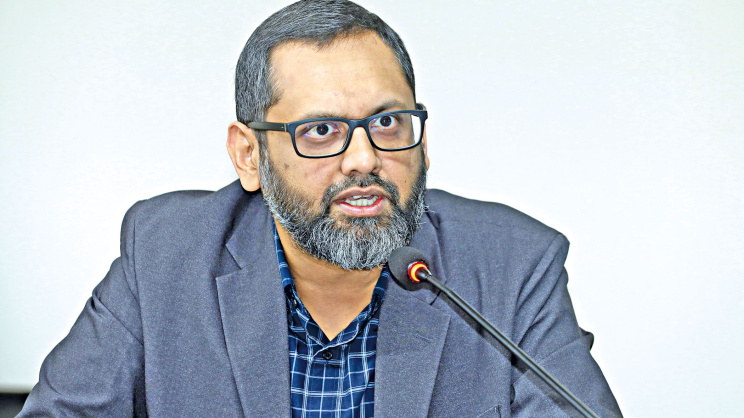
Wealth management should be open for banks; then they will be able to advise savers on how they can diversify their investments and what options they have, like equity, bonds.
Nazmul Ahsan, head of treasury at BRAC Bank, said banks have a wide branch network outside Dhaka, but current regulations limit their ability to offer wealth-management services.
He said banks should be allowed to provide wealth-management services so they can advise savers on diversifying their investments and explain different options, including equities, bonds, mutual funds, sukuk and FDRs.
Tanzim said the bond market must ensure that subscribers get their money back. He recommended starting bond trading with banks’ bonds to avoid bad experiences caused by defaults.
 For all latest news, follow The Daily Star's Google News channel.
 He also called for all bond defaults to be reported to the Credit Information Bureau (CIB), regardless of who subscribed to the bond. At present, only defaults to banks are reported, while defaults to individual investors are excluded.
Tanzim also said JPMorgan’s inclusion of Bangladesh in its new frontier bond index is a positive development. It has put Bangladesh on the radar of global investors and could help attract more foreign investment.
STRONGER STANDARDS NEEDED FOR TRUST
Nuzhat highlighted the importance of sovereign bonds, saying they are essential for creating a benchmark for the country. Although issuing sovereign bonds may seem costly now, they can bring long-term benefits, particularly by helping attract foreign investment, she said.
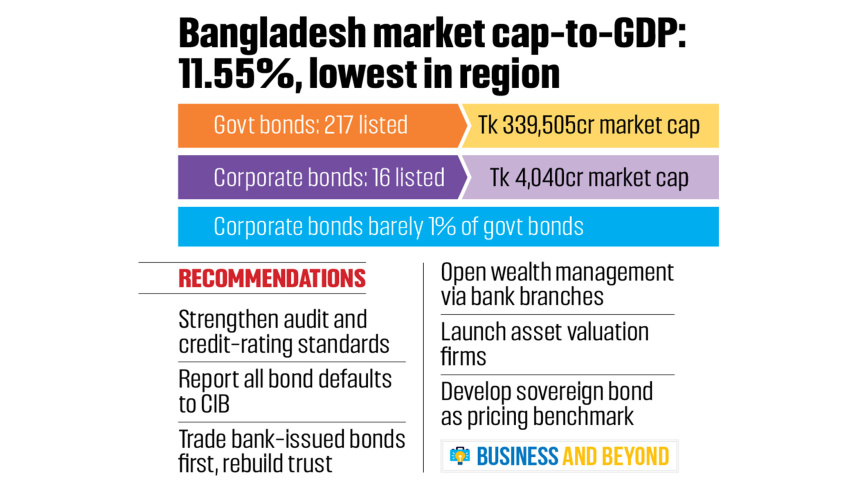
Bangladesh’s market capitalisation-to-GDP ratio is 11.55 percent, among the lowest in the region. It is well behind India’s 128.14 percent, Malaysia’s 96.51 percent and Singapore’s 122.23 percent.
Even smaller economies such as Sri Lanka, at 21.74 percent, and Pakistan, at 14.48 percent, have deeper equity markets.
Explaining the reasons for the weak bond market, Nuzhat said investors have little incentive to buy corporate bonds when more secure government bonds offer similar interest rates. However, the situation is improving as treasury bond yields are falling.
As of August this year, government treasury bonds continued to dominate the fixed-income segment of the DSE Main Board.
A total of 217 government bonds were listed, accounting for 3,384.51 crore certificates. They had an issued capital of Tk 3,38,450 crore and total market capitalisation of Tk 3,39,505 crore.
By comparison, the corporate bond market remained much smaller, with just 16 listed issues covering 29.07 crore certificates. These corporate bonds had an issued capital of Tk 4,939 crore and a combined market capitalisation of Tk 4,040 crore.
Nazmul said the government and companies should focus on sukuk, which are Sharia-compliant financial certificates representing partial ownership in an asset, project or business activity, as they have strong demand among investors.
He also recommended developing a digital platform that would allow people to invest in bonds through their mobile phones.
At present, buying government securities remains cumbersome and relies heavily on paperwork, he said.
Despite these challenges, government bonds have already created a broad investor base. This investor base should now be used to support the corporate bond market by offering investors good-quality corporate bonds, Nazmul said.
He also said Bangladesh needs asset valuation and appraisal firms, as there are currently no such firms in the country.
Nuzhat said audit firms must earn the trust of regulators and investors so that they can rely on audit reports and make quick decisions.
In developed countries, regulators can approve bonds within a couple of days because they trust audit reports, she said. Without reliable reports, regulators cannot easily verify whether an issuing company has properly made its purchases.
The DSE has already held discussions with auditors to improve audit quality, and the situation is improving, Nuzhat said.
At the same time, credit rating agencies also need to bring more discipline to their work, she added.
Tanzim said rating agencies should face punishment if they fail to maintain standards. Credit ratings should be based on merit rather than obtained simply to meet regulatory requirements.
“Credit rating is full of fun here. There is no credibility in the ratings, so investors do not invest in bonds based on them. Issuers obtain ratings only to meet regulatory requirements,” he said.
Comments