


RCEP bid moves forward. What now?

Bangladesh should begin preparing for negotiations to join the Regional Comprehensive Economic Partnership (RCEP), as the 15-member trade bloc has signalled a positive response to the country’s bid for accession, trade experts said.
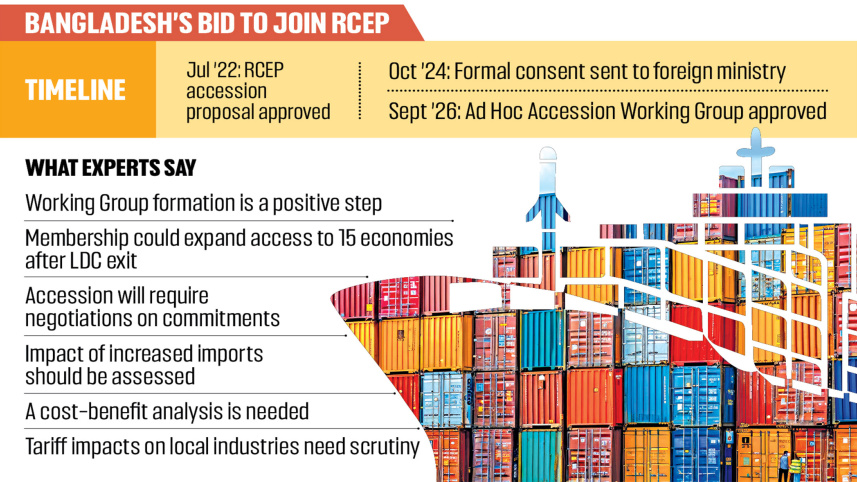
The RCEP ministers approved the establishment of an Ad Hoc Accession Working Group to advance the accession process of Bangladesh, alongside Chile, Hong Kong and Sri Lanka, at a meeting in the Philippines on September 21.

The development comes more than two years after Bangladesh formally expressed interest in joining the world’s largest free-trade agreement.
In July 2022, an inter-ministerial meeting approved the commerce ministry’s proposal to join the RCEP to retain preferential market access after Bangladesh graduates from the United Nations’ least developed country (LDC) category.
Following that decision, the commerce ministry formally sent a letter of consent to the foreign ministry in October 2024, requesting Bangladesh’s accession to the RCEP.
‘A BIG DEAL’
Formation of a working committee by the RCEP ministers’ meeting for Bangladesh’s accession is a positive sign, said Mustafizur Rahman, distinguished fellow of the Centre for Policy Dialogue (CPD).
He said the bloc’s latest decision is significant as Bangladesh applied to join the group several years ago, but the application was not considered earlier.
“Joining the RCEP is a big deal because it is a bloc of 15 countries,” he said, adding that it would give Bangladesh access to improved trade benefits with all the member countries.
He noted that the development comes at a time when the government is seeking bilateral and regional trade agreements to preserve preferential market access after LDC graduation.
Mustafizur suggested that the government start preparing so that it can easily join the bloc.
‘MAKE EXTENSIVE PREPARATIONS’
Mohammad Abdur Razzaque, chairman of Research and Policy Integration for Development (RAPID), said Bangladesh needs to make extensive preparations for the negotiations as accession to the RCEP requires Bangladesh to clear several stages.
The country needs to assess what it can offer RCEP members and whether the economy and domestic industries are prepared for greater competition under the trade agreement, he said.
The government should conduct studies on these issues and prepare its negotiating positions and recommendations before entering the accession process, he said.
Razzaque noted that the accession process could also create opportunities for Bangladesh to attract investment from RCEP member countries.
The bloc’s strong regional supply chains could generate opportunities for Bangladesh in both exports and imports if the country can integrate into them, he added.
At the same time, Razzaque said, Bangladesh needs to assess whether RCEP members could seek greater market access for their goods as part of the accession negotiations.
Member countries may seek commitments from Bangladesh to reduce tariffs or increase market access for their goods, as is common in trade agreements, he said.
‘CONDUCT COST-BENEFIT ANALYSIS’
 For all latest news, follow The Daily Star's Google News channel.
 Mostafa Abid Khan, chief executive officer of the Bangladesh Foreign Trade Institute (BFTI), said Bangladesh should conduct a comprehensive cost-benefit analysis before pursuing accession.
He suggested that the government assess the impact of potential tariff reductions and increased imports from RCEP members on local industries.
Echoing CPD’s Mustafizur, he noted that joining the RCEP could give Bangladesh improved market access to the Association of Southeast Asian Nations (ASEAN) and other member economies.WHAT IS RCEP?
The RCEP is a free-trade agreement among 15 economies — 10 ASEAN members, Australia, China, Japan, South Korea and New Zealand. Negotiations for the agreement formally launched in 2012, and the agreement was signed in November 2020. India participated in the negotiations but withdrew from the process in 2019.
The RCEP represents around 30 percent of global GDP and about one-fourth of global trade, making it the world’s largest free-trade agreement by economic size.
The bloc also accounts for around 31 percent of global foreign direct investment, according to estimates cited by trade researchers.
Comments