


Fuel price hike starts hitting logistics sector


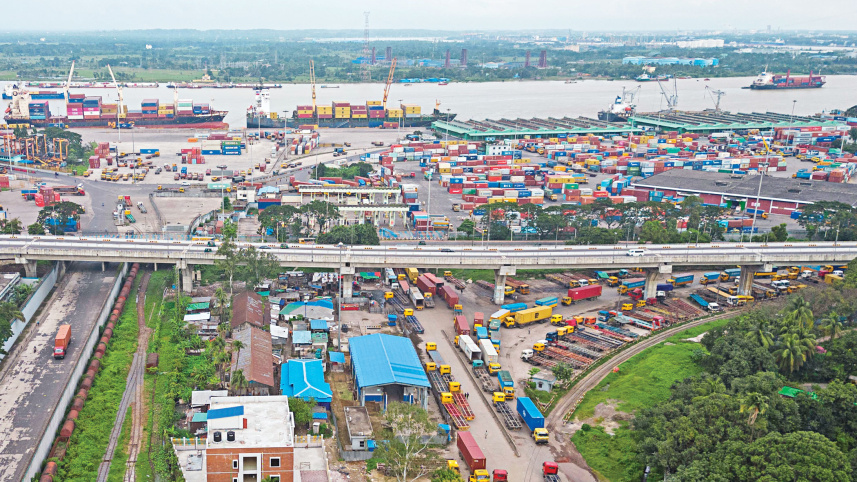
Owners across Chattogram port’s logistics chain have begun raising charges and pressing for rate revisions after the latest fuel price hike, stoking fears of fresh cost pressure on businesses and exporters already struggling to compete internationally.
In immediate reaction to the rising fuel costs, owners of 21 private inland container depots (ICDs) yesterday raised six handling charges, while berth operators wrote to the port authority seeking higher rates. Lighter vessel owners also began discussions on freight rates, and road transport associations held urgent meetings to assess the impact.

Transport leaders across the board warned that fares and charges would rise further unless the government reconsidered the decision.
Businesses, meanwhile, fear that the ripple effects of higher fuel costs across production and supply chains will raise their operating expenses and further hurt the competitiveness of Bangladeshi exports in global markets.
The government yesterday raised the prices of all four major petroleum products by Tk 20 a litre. Diesel, the most used fuel in logistics, now costs Tk 135 a litre. Octane costs Tk 165, petrol Tk 160 and kerosene Tk 155.
The government’s decision came as import costs of petroleum products had risen amid the continuing impact of the US war on Iran.
ICDS RAISE CHARGES
The Bangladesh Inland Container Depots Association (BICDA) yesterday raised six container handling charges by 9.85 percent, citing higher fuel-related operating costs following the government’s 17.4 percent diesel price hike.
BICDA Secretary General Md Ruhul Amin Sikder said the association’s members took the decision at a meeting yesterday morning to adjust for the additional fuel cost.
Container-carrying prime movers and all container-handling equipment at the ICDs run on diesel, with the facilities collectively consuming more than 70,000 litres a day, he added.
The six charges are for empty container transportation between Chattogram Port and ICDs; empty container transportation between Patenga Container Terminal (PCT), also known as RSGT Chattogram, and ICDs; empty container lift-on and lift-off; export goods stuffing and handling; export loaded container VGM (Verified Gross Mass); and import goods delivery.
Under the existing tariff, the export goods stuffing and handling package charge is Tk 8,056 for a 20-foot container and Tk 10,742 for a 40-foot container.
About 93 percent of export goods are stuffed into containers at private ICDs, commonly known as off-docks, located in and around Chattogram before being shipped through the port.
The ICDs also handle 20-23 percent of import-laden containers moving through the port, according to industry estimates, with the goods delivered to importers there.
Empty containers generated after imported goods are delivered directly from the port are also sent to the ICDs, where some are stored for a certain period while others are used to stuff export cargo.
BERTH OPERATORS SEEK RATE REVISION
Berth operators of 12 jetties under the General Cargo Berth (GCB) terminal have demanded higher cargo and container handling rates.
Fazley Ekram Chowdhury, president of the Berth Operators, Shiphandling Operators and Terminal Operators’ Owners’ Association, urged the Chittagong Port Authority (CPA) chairman in a letter to revise the container handling contract rates.
He said repeated increases in diesel prices had made it financially difficult for operators to continue running the berths under their existing contracts.
Diesel prices have increased by nearly 69 percent since operators submitted bids under the open tender method (OTM) system on January 19, 2022, he told The Daily Star. “Diesel price was at Tk 80 per litre when the bids were submitted, but has now reached Tk 135 per litre.”
 For all latest news, follow The Daily Star's Google News channel.
 “Though different sectors saw charges and freight adjustments after each fuel price hike, we are the only sector that have been being paid by the authority at previous rates,” he said.
LIGHTER VESSEL OPERATORS DISCUSS RATE ADJUSTEMENT
The Bangladesh Water Transport Coordination Cell (BWTCC) also called a meeting of vessel owners yesterday to discuss the impact of the fuel price increase and a possible adjustment of freight rates.
The cell’s Convener Shafiq Ahmed said a lighter vessel needs about 3,500 litres of diesel for a round trip between Chattogram and Dhaka.
The cell’s leader Parvez Ahmed said after a diesel price hike in April, the government held discussions with vessel owners and fixed the freight for transporting cement clinker from Chattogram to Dhaka by lighter vessel at Tk 586 per tonne, a 6.5 percent increase from the previous rate.
“Though it was not enough, we accepted it,” he said, adding that vessel owners now want a “logical adjustment” following the latest fuel price increase.
EXPORTERS FEEL THE PRESSURE
Exporters and industry leaders say the fuel price hike could not have come at a worse time, warning that it will pile fresh costs onto a sector already struggling with high interest rates, inadequate energy supply and eroding competitiveness in global markets.
The Tk 20-a-litre increase in fuel prices will push up costs and add to the pressure already facing the industrial sector, said Mohammad Hatem, president of the Bangladesh Knitwear Manufacturers and Exporters Association (BKMEA).
“This will significantly raise our manufacturing costs and hurt exports,” he told The Daily Star.
He said factories have to run generators during load-shedding, and higher fuel prices would increase the cost of generating electricity.
Transportation costs would also rise, including the movement of fabrics and accessories between factories and other locations, as well as the cost of transporting goods for both imports and exports, he explained.
Hatem said the increase in transport costs could also feed into broader inflation, eventually putting additional pressure on consumers, while the higher cost of doing business could add to pressure for wage increases.
“Industries are already going through a difficult period and facing various kinds of crises. At this point, it is not possible for the industry to absorb this additional burden,” said the BKMEA chief.
Syed M Tanvir, managing director of Pacific Jeans, expressed similar concerns.
He said the export-oriented readymade garment sector was already going through a difficult period because of rising operating costs.
“The new price hike will be another blow as we would lose competitiveness, which would be detrimental for the sector,” he said.
“Even when we try to demand higher prices logically owing to rising operational costs, the clients argue that they can get lower prices from other competitor countries,” he added.
Shams Mahmud, managing director of Shasha Denims Ltd, said export-oriented businesses are already facing high costs due to high interest rates, and rising logistics costs.
“Now the fuel price hike will push those costs up further. Ultimately, all these costs come into the cost of doing business. We are losing competitiveness,” he said,
According to Shams, the impact would be particularly severe for factories that rely on diesel generators because of inadequate energy supply.
He added that higher transportation and logistics costs would further increase the cost of moving raw materials and finished goods. On top of these, the recent increase in ICD charges would add to the burden.
Bangladesh’s merchandise exports declined by nearly 5 percent in 2025, falling to $47.74 billion compared with the previous year, according to official data.
Energy and logistics have emerged as two of the biggest constraints. Bangladesh’s electricity tariff increased nearly 19 percent, from Tk 8.95 per unit in February 2024 to Tk 10.63 in June 2026. In April 2025, gas tariffs for new industrial connections rose 33.3 percent to Tk 40 per unit, while captive power gas prices increased 36.6 percent to Tk 42.
Earlier in October 2025, Chattogram port’s tariff revision had raised service charges by an average 41 percent.
Comments