


GSMA seeks 50-75% cut in spectrum renewal fees
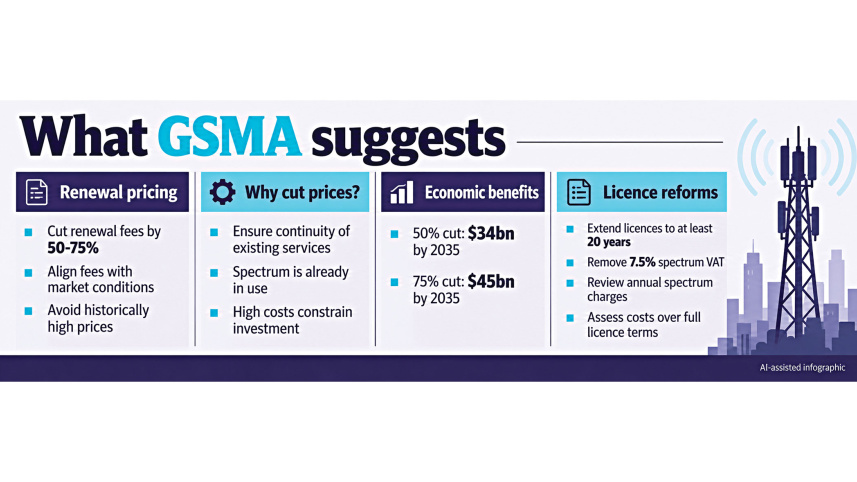
The GSMA, the global body representing mobile operators, has urged the Bangladesh government to cut spectrum renewal prices by 50-75 percent ahead of the November 2026 renewal of the 900 MHz, 1800 MHz and 2100 MHz bands.
In a letter to Post, Telecommunications and IT Minister Faqir Mahbub Anam, GSMA Head of Public Policy and External Affairs for APAC Jeanette Whyte warned that keeping current prices could make spectrum costs unsustainable and slow the country’s digital transformation.

“Spectrum renewal is fundamentally different from the assignment of new spectrum as the spectrum being renewed is already in use to provide mobile services to millions of Bangladeshis,” Whyte wrote.
Spectrum refers to the radio frequencies licensed to mobile operators to carry calls, texts and data between phones and towers. Lower bands such as 900 MHz provide wider coverage and better building penetration, while 1800 MHz and 2100 MHz offer a balance between coverage and capacity.
The GSMA said renewal mainly ensures continuity of existing services rather than creating new economic value for operators. It therefore urged the government to set renewal fees at levels that do not raise service costs or constrain investment in network expansion and quality.
The letter said Bangladesh’s average revenue per mobile user stood at about $1.21 as of June 2026, among the lowest in the Asia-Pacific region.
Citing a GSMA Intelligence study published in 2025, it said Bangladesh’s aggregate spectrum cost was about 15.7 percent of operators’ recurring revenue, compared with an Asia-Pacific median of 10.4 percent and a global median of 7.7 percent.
Inflation-adjusted revenue per mobile connection fell 38 percent between 2014 and 2023, while revenue per MHz declined 69 percent, the study found.
“These trends show that the renewal framework should reflect current market conditions, not historical pricing,” the letter said.
Bangladesh’s historical spectrum prices are about 41 percent higher than international benchmarks for 900 MHz, 66 percent higher for 1800 MHz and 61 percent higher for 2100 MHz -- averaging more than 55 percent across the three bands, according to the GSMA.
“Maintaining historical pricing could increase spectrum costs to approximately 21 percent of operators’ recurring revenues by 2035,” it said.
A 50 percent cut in unit spectrum prices could generate about $34 billion in cumulative economic benefits by 2035, while a 75 percent cut could generate about $45 billion, the GSMA said.
Besides lower renewal prices, the GSMA proposed extending renewed licences to at least 20 years, removing the 7.5 percent VAT on spectrum payments and reviewing annual spectrum charges against operators’ total costs over a licence’s full term.
The GSMA said spectrum payments are regulatory charges for access to a public resource, rather than payments for commercial services. Including spectrum costs, revenue-sharing and other sector-specific charges, total taxes and fees on Bangladesh’s mobile operators amount to 55 percent of revenue, compared with 24 percent in Asia-Pacific and 22 percent globally.
The letter cited recent auctions in Vietnam, Pakistan and Indonesia as examples of how affordable pricing and flexible terms can support both government revenue and connectivity.
However, Pakistan’s 2026 auction left spectrum in the 1800 MHz and 2100 MHz bands unsold even after reserve prices were cut by 55 percent and 52 percent respectively.
The GSMA welcomed Bangladesh’s steps since 2022 to price spectrum in local currency and introduce instalment-based payments. It said the upcoming renewal was an opportunity to address other structural issues affecting the sector’s sustainability.
“With ICT identified as a thrust sector, we are confident that the new Government will take a forward-looking approach to the forthcoming spectrum renewals in November 2026,” Whyte wrote.
“GSMA is committed to supporting the government and other authorities with international evidence, comparative experience and technical expertise as this framework develops.”
 For all latest news, follow The Daily Star's Google News channel.
Comments