


BAFFA argues against 100% foreign ownership in freight forwarding sector
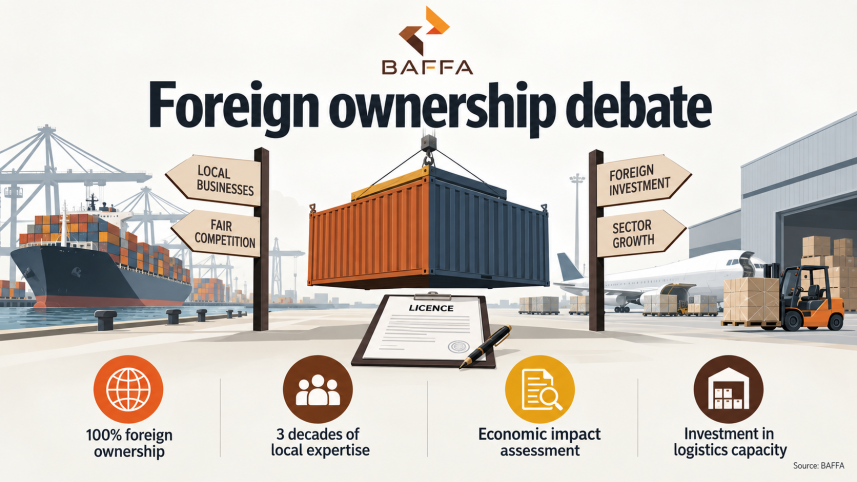
The Bangladesh Freight Forwarders Association (BAFFA) has urged the government not to expand 100 percent foreign ownership in the country’s freight forwarding sector without assessing its economic impact on local entrepreneurs, employment and foreign exchange flows.
The association said freight forwarding is predominantly a service-based industry rather than a capital-intensive sector and raised the question of whether allowing unrestricted foreign ownership would bring substantial fresh foreign direct investment, technology transfer or new employment to Bangladesh.

BAFFA’s concerns came amid renewed regulatory attention to foreign-owned freight forwarding companies. On September 8, the National Board of Revenue (NBR) issued a clarification regarding the renewal of licences of fully foreign-owned companies that had received licences before July 1, 2015, under the Freight Forwarding Agents Licensing and Operations Rules, 2008.
BAFFA recently sent a letter to the NBR and the Prime Minister’s Office arguing against allowing 100 percent foreign ownership in the freight forwarding sector.
In the letters, BAFFA said any broader policy change should therefore be preceded by a comprehensive economic impact assessment and meaningful consultation with local industry stakeholders.
Local freight forwarders have spent more than three decades developing expertise, international agency networks and logistics capabilities that support Bangladesh’s import and export trade, BAFFA said in the letters.
The sector includes a large number of locally owned small and medium enterprises that coordinate international transportation, cargo consolidation, documentation, customs-related processes, supply chain management and other trade facilitation services.
BAFFA warned that allowing financially stronger multinational operators unrestricted access without appropriate regulatory safeguards could create an uneven competitive environment for domestic SMEs and potentially shift a greater share of locally generated logistics income abroad.
The association stressed, however, that its position should not be interpreted as opposition to foreign investment.
BAFFA said Bangladesh needs substantial foreign investment in logistics, but such investment should preferably be directed towards areas where fresh capital, infrastructure, technology and capacity are genuinely required.
These include ports and terminals, inland container depots, multimodal logistics hubs, modern warehousing, cold chain facilities, air cargo infrastructure, automation and digital logistics systems, the letters also read.
 For all latest news, follow The Daily Star's Google News channel.
Comments