


Oil slides after China asks Iran to limit Houthi attacks on Saudi oil facilities
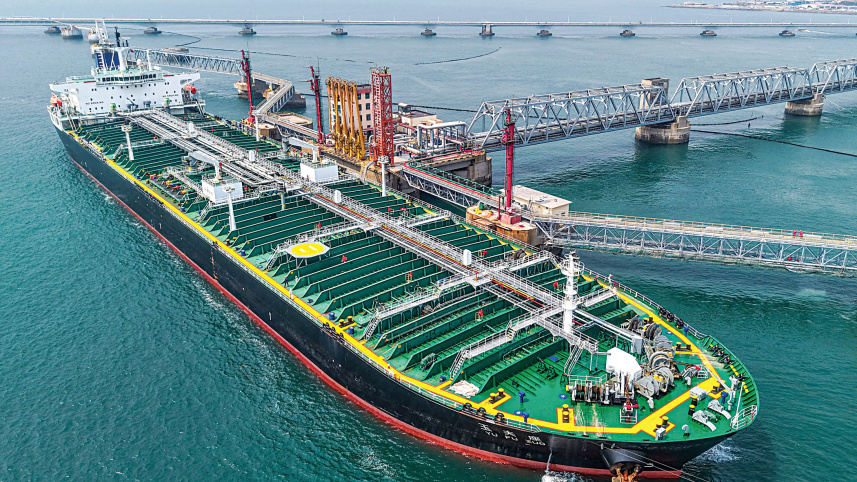
Oil prices fell on Friday after China, acting on a request from Saudi Arabia, asked Iran to limit attacks by Houthi rebels on Saudi oil infrastructure that have threatened a second oil export route in the Middle East.
Brent crude futures settled at $104.87 a barrel, down 95 cents, or 0.93 percent. US West Texas Intermediate futures finished at $100.30 a barrel, down $1.61, or 1.58 percent.

Oil prices have moved up steadily in the last few weeks as the US and Iran resumed attacks on each other and the Iran-aligned Houthis also stepped up their military activities.
The recent action, coupled with refining capacity issues worldwide, has pushed up the price of key fuels like diesel in major markets.
Currently, retail diesel in the United States costs $6.45 a gallon, according to AAA data, a record, while retail gasoline averages $4.47 a gallon, at a time of the year when gasoline prices are usually declining.
IIR Energy, a refining data provider, said on Friday that US refining capacity in production was expected to fall next week by 371,000 barrels per day (bpd).
"Right now it's not a supply problem; it's a refining problem," said Phil Flynn, senior analyst for Price Futures Group.
MURKY OUTLOOK
Despite the reported intervention from China, analysts say the outlook for coming months remains murky.
JPMorgan on Thursday said it does not have a clear baseline view for oil markets for the first time since the beginning of the US-Israeli war on Iran in February.
The Strait of Hormuz is still largely cut off, with just four commodities vessels passing through the strait on Thursday, below the 10-day average of about 16, preliminary shipping data showed on Friday.
Prices climbed to close to four-month highs earlier in the week after sources said crude loadings at Saudi Arabia's Red Sea export hub of Yanbu had been suspended and Riyadh cancelled some deliveries to Europe after its East-West pipeline was damaged in an attack last week.
State-run Saudi Aramco has told at least two European refining customers they will receive no crude oil next month following an attack on Saudi Arabia's key pipeline to the Red Sea, Bloomberg News reported on Friday, citing people familiar with the matter.
Saudi Arabia and Yemen's Iran-backed Houthis exchanged fresh strikes across their border on Thursday and Yemenis took to boats in the Red Sea to escape fighting, as the spreading Middle East war created new threats to supply.
Three pumping stations serving the East-West Pipeline in Saudi Arabia were damaged in an attack last week — one more than assessed previously — with a repair timeline unclear, according to satellite imagery and three industry sources.
Saudi Arabia is seeking to restore about half the capacity of the East-West oil pipeline within days, though sources interviewed by Reuters have given varying estimates of how long it will take to reopen the pipeline and return crude flows to normal.
"The key question is whether physical flows can normalise and what the timeline could be. If we see a sustained improvement in Hormuz traffic, some of the geopolitical premium can unwind further," said Priyanka Sachdeva, head of market insights at Phillip Nova.
The US and Iran have held no peace talks since the collapse of an interim agreement reached in June.
The war will come up for discussion at the United Nations General Assembly next week, and an Iranian delegation will be able to attend, according to the US State Department.
 For all latest news, follow The Daily Star's Google News channel.
Comments