


A novel of radical softness

Last month, in an auditorium of poets, novelists, essayists, artists, I sat in a haunting silence after Palestinian author Sarah Aziza ended a lecture about writing from the ruins. I hesitate to call it something as sanitised as a lecture, for it was instead a conversation, a call to action in long, immeasured breaths and pauses, about what it takes to write from and about the destruction of a homeland. How do you write against, and out of, despair? Despair, said Sarah, doesn’t have to be defeat. Despair can be rage, it can be astonishment. It can be a song, a memory, a memory of the future, a language. “A seed germinating beneath the sidewalk, emerging improbably through some crack in a form that concrete could never dream.”
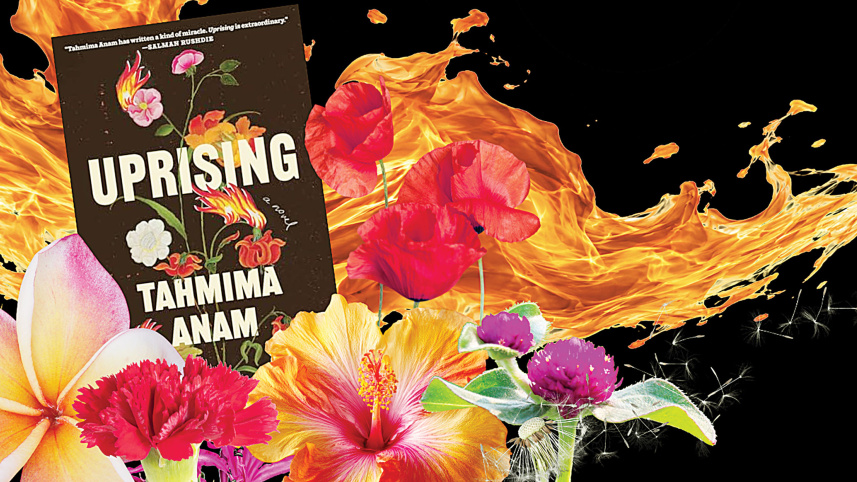
I was reading Uprising that same week. Tahmima Anam’s latest novel takes place amidst other destructions, set in our own country, but it rises out of an adjacent tension, carries a similar ethos of staring unflinchingly at a world order that commits violence on the human body. As Anam shares in her interview with Daily Star Books, her work comes from a place of deep concern for the state of the world. This novel releases at a time when right-wing ideologies are strengthening around the world, Anam reminds us, when technofascism is on the rise, and in a backlash against whatever progress we’d made with the MeToo movement, we are living in “spaces in which men feel emboldened to represent certain values that frankly they were ashamed to 10 or 20 years ago.” In war, in genocide, in the day to day horrors of the world, violence always, disproportionately, targets the bodies of women. The language of news allows us to both live amidst these facts and avert our gazes. The language of fiction demands that we sit in the room with them, where you can see, hear, smell, and risk being touched by the horror. That is the project, the challenge, of Uprising—to witness despair and find in it the strength for action.

The novel takes us to Bani Shanta, which is an island that actually exists in the Sundarbans, “just a few miles from Mongla”. An island of state-licensed brothels, an island full of children. These children are the narrators in Uprising, and they tell the stories of the sex work into which their mothers were forced, trafficked, tortured. These children are young girls, because boys born here get to leave, find work and build lives away from this prison erected upon the scandal, shame, and exploited labour of women. But these young daughters, they witness every part of their mothers’ lives, which awaits them, too, just on the other side of puberty.
The brothel is run by Amma, the madame, a dictator in their lives who was once a young girl herself abused by her family. Through the children’s collective, mythic chant of the stories of the island, we watch as one young girl after another is forced into prostitution. “Our mothers,” the children tell us, “were from Mymensingh and Noakhali and Sreepur and Trishal. Our mothers were from Chittagong and the Hill Tracts and the Sundarbans and the forests and fields and river islands. Our mothers were Bengali and Garo and Chakma and Santal. Our mothers were from slums and villages.” And the men came to them from all over the country, city men, rivermen, hill men, rickshaw pullers, farmers, mechanics, railwaymen, sweet makers, drivers, beggars.
But there is an inevitable climax to their story, and this is not a spoiler. As the children reveal to us early in the novel, it all began to end when Kusum Khan was brought to the island from Dhaka, when she was tricked through the promise of a job into becoming one of Amma’s prostitutes. Kusum, who had walked and been beaten in the July protests that toppled the dictator of her country not too long ago. Kusum, whose singing made grown men cry and fall in love and forgive her family’s debts. She had studied till Class 5, could read and write and navigate the internet. In her, the novel finds its charge of electricity. With a literate woman who knows how to use her body and voice, who understands the vocabulary of protest, change is—slowly, terrifyingly, painstakingly—possible.
This lesson is familiar not only to those of us who grew up in Bangladesh, a land liberated again and again through protest, but also to those of us who grew up dreaming of Ladyland. Begum Rokeya’s feminist utopia comes up recurrently in Anam’s work, in a virtual exhibition called ‘Unfinished Business: The Fight for Women’s Rights’ that she moderated for The British Library, in a piece for The Guardian where calls Rokeya Sakhawat Hossain her hero, in a recommendation for npr, where she writes, “You can feel Hossain’s anger at a society that expects nothing from her but to remain within the narrow confines of the home, her daring inventiveness in challenging the prevailing assumptions about women’s abilities, and her scathing criticism of a system that allows what she saw as lazy, violent men to dominate while their gentler, wiser female counterparts are marginalized.”
“The brothel is run by Amma, the madame, a dictator in their lives who was once a young girl herself abused by her family. Through the children’s collective, mythic chant of the stories of the island, we watch as one young girl after another is forced into prostitution. “Our mothers,” the children tell us, “were from Mymensingh and Noakhali and Sreepur and Trishal. Our mothers were from Chittagong and the Hill Tracts and the Sundarbans and the forests and fields and river islands.”
Uprising joins in that anger and performs a daring inventiveness of its own. Where Sultana’s Dream (1905)offers a blueprint, a precocious, if too-perfect, vision for a land run by women, Uprising shows us what such a place would look like, what it would take to create it in our messy and cruel world. If Hossain is an icon of the so-called “respectable” feminist in Muslim Bengal, Anam’s novel shows us how Begum Rokeya, in fact, laid the groundwork for radical imagination that offends and upends the status quo. And so Uprising gets messy, with a precision that feels thrilling. It lays bare, in a matter-of-fact tone devoid of judgment or romance, the indignities borne by the women on the island, their private dreams and pleasures, their cries of pain, “Ma go ma”, “O ma go”, the uncouthness of their tongues. In the face of our limited empathy, which extends only to the clean, gentle, modest victim, Uprising weaponises and throws at us these women’s menstrual fluids, the stench of their pain and anger and revolt. And in its hero, Kusum, the novel manifests an avatar of Bon Bibi, the daughter of our forests, who transforms from being a victim of her circumstances to a cunning, ferocious, brazenly improper agent of change.
There is so much that this book adds to the art it is in conversation with. It strips away the romance we’ve come to associate with sex work narratives from Bollywood films like Gangubai Kathiawadi (2022). It adds a propulsiveness, an urgency of hope, to the version of these stories in Rizia Rahman’s Letters of Blood (Seagull Books, 2018), translated from the Bangla by Arunava Sinha. After Megha Majumdar’s A Guardian and a Thief last year, Uprising offers an even more intimate look at how ecological changes are eroding livelihoods and literal flesh and blood along our coastlines. And it is steeped so very deeply in the storytelling traditions of our land, our hearsay, or whispers, our myths passed along by chattering women and the wind water trees and soil that they inhabit.
But what feels most radical about this novel is its ability to say the things we hate saying in this country scaffolded by propriety. That sex work is a legalised economy in Bangladesh, fueled by ever-present clients, and those who bear its abuses are also made to carry its shame. That innocence is a product of fate and class and gender. That it takes feral, uncouth rage to beget freedom, and in its sanitised aftermath, we’re quick to forget how women’s bodies are both its catalyst and casualty. How many of us, I wonder, have what it takes to sit in the discomfort that this novel demands of us.
Sarah Anjum Bari is a writer and editor from Dhaka, Bangladesh. She holds an MFA in Nonfiction Writing from the University of Iowa. Her work has appeared in The Rumpus, Electric Literature, Literary Hub, Himal Southasian, and Wasafiri, among others. She served as the former Books & Literary Editor at The Daily Star. Email: sarah.anjum.bari@gmail.com.
 For all latest news, follow The Daily Star's Google News channel.
Comments