


A fixed-income avenue opens for investors


Iftekher Ahmed had specific requirements when he decided where to put his savings. He wanted to withdraw his money whenever he needed it, without facing a penalty. He wanted to track his investment through regular statements. And he did not want a ceiling on how much he could invest.
Those three requirements left him with few options. Among the popular tools, savings certificates cap how much an individual can invest. Fixed deposits and direct bond purchases come with penalties, or practical difficulty, for anyone who wants their money back before maturity. The stock market is highly volatile and risky.

Iftekhar, a top official at a buying house in the capital, went with a relatively new instrument instead: open-ended fixed-income mutual funds.
“I don’t know when I will need my money, so this type of instrument is convenient for me,” he told The Daily Star. “I can liquidate and get my investment back anytime with profits, even if I want to withdraw a portion. It also seems secure, as I can see my statement every day.”
His search for that combination reflects a broader shift taking shape in Bangladesh’s investment market. Open-ended fixed-income mutual funds, which invest mainly in government securities, corporate bonds and other debt instruments, have grown around exactly the gaps he ran into.
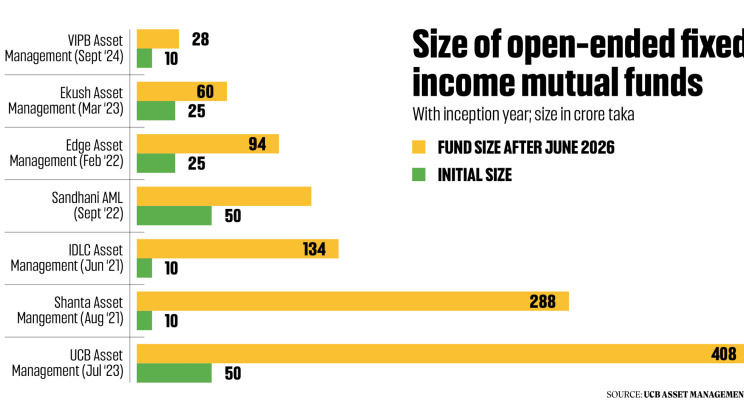
Over the past five years, investment in the category has grown rapidly, reaching a combined size of Tk 1,128 crore from Tk 160 crore when the products were launched, according to industry data.
WHAT THE FUND ACTUALLY DOES
Fund managers say they launched fixed income mutual funds for investors who want to invest in fixed income securities but with some potential of the stock market.
Mutual funds pool money from a group of investors to buy shares, bonds and other assets.
Investors then receive returns based on the profits the fund earns. Open-ended funds allow investors to redeem units from the fund manager, subject to the fund’s applicable terms and conditions, based on the fund’s net asset value (NAV), rather than waiting for a fixed maturity date.
Fixed-income mutual funds are a category of open-ended funds whose underlying assets are fixed-income securities, such as government securities, debentures, corporate bonds and other money market instruments.
Industry players say most fixed-income funds maintain more than 40 percent of their portfolio in government treasury securities, with the more conservative funds holding above 60 percent.
Much of the remaining allocation goes into fixed-income instruments issued by banks with strong capital adequacy.
The result, according to fund managers, is a portfolio built around preserving capital while still delivering competitive returns, without the multi-year commitment a savings certificate or a bond purchased directly would require.
WHY INVESTORS ARE CHOOSING IT
Savings certificates, known locally as Shanchaypatra, offer the highest guaranteed returns in the market, backed by the government, along with tax rebate benefits and reliable monthly or quarterly income.
However, an individual can invest only up to Tk 45 lakh, and the money is locked in for years, with penalties for early withdrawal. Institutional investors and high-earning non-residents cannot use them at all.
Fixed deposits are available at almost any bank or non-bank financial institution, with tenures ranging from three months to five years. Investors can borrow against them for quick liquidity, and returns are predictable.
However, interest rates tend to run lower than savings certificates, and the underlying risk sits with the issuing bank. Income is also taxed at 10 to 15 percent in advance, on top of what inflation already erodes.
Mohammad Rashedul Hasan, managing director and CEO of an asset management firm, said few individual investors know which financial institutions are strongest to park money with, but professional fund managers do.
 For all latest news, follow The Daily Star's Google News channel.
 Fund managers can also shift between interest rate cycles in a way someone locked into a fixed deposit or Shanchaypatra cannot, he said.
Returns are size-blind in a way deposits rarely are, according to Rashedul. Providing an example, he said an investment of Tk 5,000 earns the same rate as one of Tk 500 crore, and unlike Shanchaypatra, there is no ceiling on how much an investor can put in.
The tax treatment adds to the appeal. Mutual fund investments qualify for a tax rebate up to Tk 75 lakh, with capital gains tax-free up to Tk 50 lakh.
Deposit pension schemes cap rebate-eligible investment at Tk 1.20 lakh, and fixed deposits receive no rebate at all.
Prof Al-Amin, dean of the Business Faculty at Dhaka University, said fixed-income open-ended mutual funds tend to attract institutions with mid-sized portfolios and limited in-house capacity to manage them directly.
Institutions with larger funds generally invest in treasury and corporate bonds on their own, he said, while small investors also tend to make their own choices between a bank or a savings certificate.
“If the fund managers do not want to make money overnight and exit the market, these funds will remain sustainable,” he said, “since they invest in treasury bonds, corporate bonds, and the like, which will ensure a good return to investors in comparison with the market situation.”
A RAPIDLY GROWING MARKET
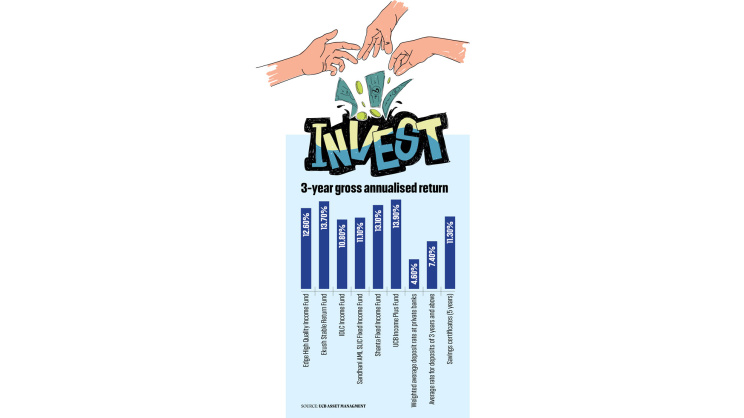
Average returns across the sector now sit above 11 percent, according to Shahidul Islam, CEO of VIPB Asset Management Company.
His firm currently holds the highest annualised return among fund managers, at 18.9 percent, he added.
“Because these funds are backed by fixed-income securities, and people have low confidence in the stock market, people have rushed to invest,” said Shahidul.
All the open-ended fixed-income mutual funds launched in the past five years and their fund size soared a couple of times, he said, adding that this alone shows how much interest in these funds has grown.
Speaking about his own fund’s highest return, Shahidul mentioned that he has tracked two treasury bond cycles in nearly 25 years of managing money and invested at the peak both times.
“However, that doesn’t mean I will always be able to invest right at the peak,” he noted, explaining that fixed-income funds cannot guarantee an absolute rate of return because bond yields fluctuate.
However, he added that they lack the stock market’s intense volatility, making them an attractive option for many investors.
Among fund managers, growth has been uneven. UCB Income Plus Fund leads the sector, with assets under management surpassing Tk 400 crore, up from Tk 50 crore at its 2023 launch.
IDLC Asset Management, which introduced the country’s first open-ended fixed-income fund in 2021, has grown its fund from Tk 10 crore to Tk 134 crore, posting an annualised return of 8.7 percent through June and 52 percent since inception.
Shanta Asset Management, EDGE Asset Management and others have also built a significant presence in the space.
Bangladesh’s mutual fund industry had run almost entirely on equities for nearly four decades before these funds appeared.
An earlier attempt at a fixed-income fund, launched by RACE Bangladesh in 2011 as a closed-end product, invested heavily in equities despite its fixed-income label and failed to generate returns strong enough to attract investors.
IDLC’s fund, launched a decade later with a fully fixed-income mandate, took a different approach, and its growth since has become a reference point for the funds that followed it.
Kazi Monirul Islam, CEO of Shanta Asset, said the appeal of buying treasury bonds directly comes down to exit options. Bonds can be difficult to sell before maturity if a buyer cannot be found, he said, whereas fund units can be bought and sold at any time.
WHAT COULD GO WRONG
Fund managers who invest in corporate bonds must vet issuers carefully, since a default would cost investors directly, VIPB’s Shahidul said.
Investors can track where their money is allocated through fund websites, he added, and market risk remains, particularly when long-term bonds are bought during periods of low yield.
UCB’s Rashedul said the majority of the risk in these funds rests with the skill of the fund manager.
Weak funds may lose money, he said, while stronger ones consistently choose high-quality, investment-grade securities, generating better risk-adjusted returns over time.
Bangladesh’s mutual fund industry carries the memory of past misconduct, when some asset managers mismanaged or misappropriated investor funds.
Mir Ariful Islam, managing director and CEO of Sandhani Asset Management, said that risk has been largely engineered out of the current structure.
Fund managers cannot act on a fund’s money independently, he said, since custodians are signatories on withdrawals and trustees are involved even in routine transactions such as creating a fixed deposit.
There will always be some market risk, Ariful said, though not at the level associated with equity investing.
If an investor enters a fund when treasury rates are low, and rates subsequently rise, the fund’s income may decline, and returns may fall short of expectations, he explained.
A skilled fund manager, he said, can navigate that kind of shift better than an unskilled one, which makes the choice of manager as important as the choice of product.
A MARKET STILL FINDING ITS SHAPE
The scale of open-end mutual funds has been growing in the region. India’s fixed-income funds hold roughly $200 billion in assets, about 23 percent of that country’s mutual fund industry.
Pakistan’s open-end fixed-income funds totalled 3,236.87 billion Pakistani rupees, or $11.66 billion, as of June 2026, while Sri Lanka’s stood at 481.87 billion Sri Lankan rupees, or $1.46 billion.
Md Nafeez Al Tarik, a commissioner at the Bangladesh Securities and Exchange Commission (BSEC), said the sector is new but growing in popularity.
“The commission is now working on money market mutual funds, which are more money market securities-driven,” he said.
A money market mutual fund is an open-end mutual fund that invests in safe, short-term debt securities like treasury bills and commercial paper to provide high liquidity and low risk to its investors.“It will help investors earn profits from money market securities through asset managers, which is now quite difficult for an investor to earn through individual investment,” the commissioner added.
Comments