


Dhaka’s combat sports revolution
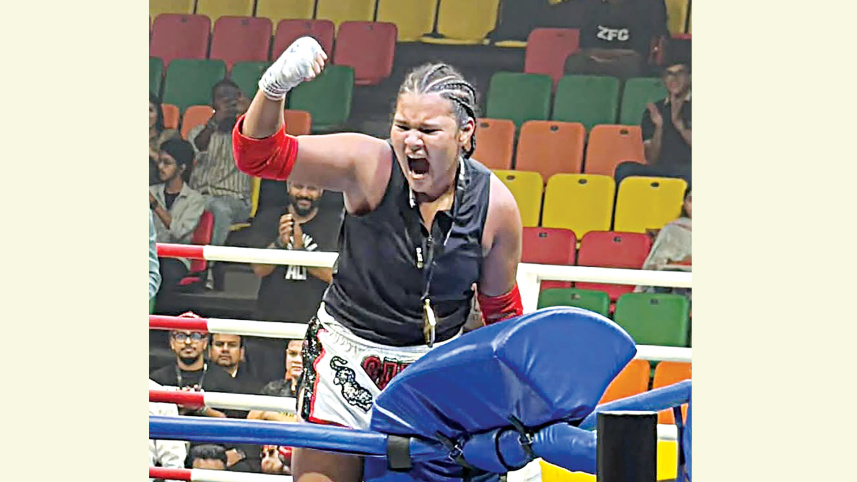
Sticking her tongue out in playful defiance, Gazi Arnaz Ahmed, a young Bangladeshi fighter, didn’t just win her bout at Zulcan Fighting Championship 2 (ZFC) -- she won the crowd’s heart. The semi‑pro Muay Thai fighter, her hair pulled tight in braids, carried herself with an aggressive composure that felt both smart and rebellious, a presence that lit up the ring.
Organised by Zulcan, a concern of the Bashundhara Group, ZFC was billed as Bangladesh’s biggest combat sports event, bringing together elite boxing and Muay Thai fighters for both global and local titles. What set it apart was its international scale -- out of 11 bouts, 10 featured foreign competitors from Thailand, Malaysia, Singapore, the Philippines, Iran, and the United States, testing local fighters against seasoned opponents.

The high‑octane arena, where homegrown talent clashed with global names, turned Dhaka’s Bashundhara Sports City into a theatre of grit and glamour. Every cheer, gasp, and roar built into a rhythm that matched the fighters’ energy, amplifying Bangladesh’s ambition to carve out a place on the world combat sports map.
From the moment the doors opened, the atmosphere was electric. When Arnaz outlasted Shampa Islam in her semi‑pro Muay Thai debut, the victory was more than a personal milestone; it was a spark in Dhaka’s growing combat sports culture, proof that young women are stepping into the spotlight with confidence and flair. The cheers were high‑pitched and electric, a wave of support for a new generation of women entering the ring.
Arnaz’s debut win at ZFC was described by her coach, Mohammad Rashed Ali, as the beginning of her journey. He highlighted the months of discipline and training behind the moment, noting that a first victory builds confidence while reminding a fighter there is always more to learn. For the young teenager, sharing the stage with international and legendary fighters was deeply humbling.
Then the crowd favourite Masjedul Reza Omio faced Thailand’s Thanapat Titham, and chants of “Bangladesh! Bangladesh!” thundered through the stands. His victory for the WMO Asia Muay Thai title felt less like a personal triumph and more like a national moment, the crowd erupting as if Dhaka itself had claimed the belt.
The bare‑knuckle bout between Will Chope and Mostafa Ashouri was raw theatre --every strike echoing in the hush between gasps, the audience torn between awe and shock at witnessing Bangladesh’s first fight without gloves. When the final bell rang, ZFC 2 had become more than a fight card. It was a spectacle -- part sport, part cultural festival -- where sweat, glamour, and grit collided under the floodlights.
For Dhaka, it was proof that combat sports had found their stage, and for its fighters, a promise that the world was finally watching.
The popularity of combat sports and fitness mania across genders has surged in Dhaka. Coach Rashed attributes this rise to growing awareness of physical and mental benefits, while gym culture and social media visibility may have amplified the trend.
Arnaz acknowledges that breaking into combat sports as a young woman came with challenges, particularly the lack of opponents in her category, and insists that female fighters are not treated differently by trainers. Coaching adapts to individual strengths and weaknesses, but the standards of discipline and commitment remain the same. In the ring, fighters are fighters first.
The curiosity about Muay Thai that Arnaz has sparked has made the sport feel more real and relatable, encouraging others to explore it beyond treadmills and weights.
 For all latest news, follow The Daily Star's Google News channel.
Comments