


The easy money trap

“Teer chara amar cholei na!” (I can’t do without Teer) is the iconic, nostalgic advertising catchphrase for Teer flour and food products.
For a generation, that is not just a jingle. Teer atta, flour, suji, soybean oil -- these are kitchen staples, and City Group, the company behind them, is a name most people grew up trusting. The smiling face of the toddler in the jingle somehow became the perceived happy face of the company.

Then came the news.
In June, reports surfaced that City Group had run up more than Tk 26,000 crore in bank loans, spread across around three dozen banks. Weaker taka, delayed utility connections and rapid expansion pushed the conglomerate into a tight corner, and banks are now restructuring a chunk of its debt.
But how does a business this familiar end up carrying this much debt?
Part of the answer is that City Group is not the villain here. Its problem is a symptom, and the disease has a name people have seen before.
South Korea’s chaebols, the family-run conglomerates that became national champions, grew fat on borrowed money too.
Hanbo Iron and Steel went under in January 1997, Kia followed, and by year’s end the 30 biggest chaebols carried debt-to-equity ratios of roughly five to one, with trouble at one spilling over to others through cross-guarantees. Daewoo collapsed two years later.
Bangladesh is not South Korea. It is a different economy, different companies and a financial system at an earlier stage entirely. But the warning still holds. When big companies, banks and the wider economy get too tangled together, a corporate debt problem stops being just a corporate problem. It becomes everyone’s.
South Korea’s response was to force deleveraging, better disclosure, tighter governance, fewer cross-guarantees, and a push toward capital markets. Bank loans did not disappear. The goal was options.
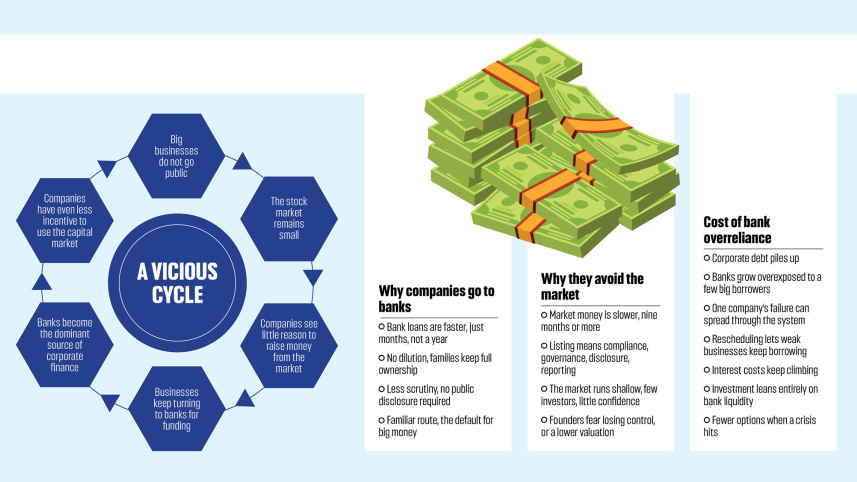
Bangladesh has not gotten anywhere near that point. The imbalance is stark, nearly 99 percent of private-sector financing comes from banks, while the capital market accounts for just 1 percent.
That is not diversification, it is one bank crisis away from becoming a national one, according to Mamun Rashid, former managing director of Citibank NA Bangladesh and now chairman of Financial Excellence Ltd.
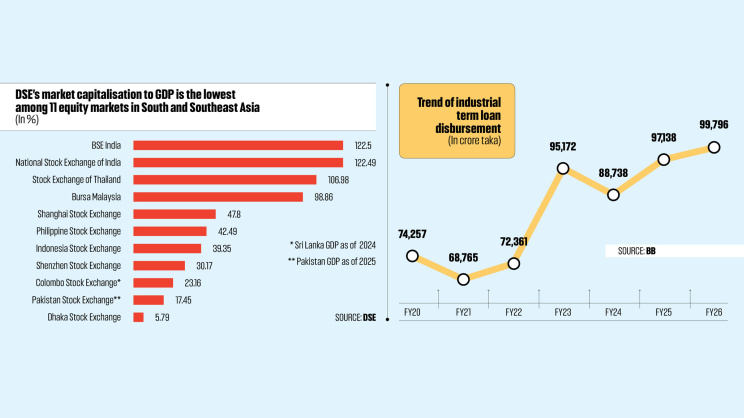
Industrial term-loan disbursements hit Tk 97,138 crore in FY25. In the same period, companies raised just Tk 302 crore through IPOs and rights shares, and the Dhaka Stock Exchange’s market cap sat at 5.7 percent of GDP at the end of June -- the lowest in South Asia.
So if a company needs billions of taka to build a factory, where is that money supposed to come from?
A bank loan is the easy answer. It funds the factory, and the company pays it back with interest.
Equity works differently, a company sells a stake, sharing both the upside and the risk with the investor. A bond is simpler still, essentially an IOU, repaid with interest on a set date.
A healthy financial system leans on all three. Bangladesh has leaned almost entirely on the first.
WHY LOANS, EVERY TIME?
Convenience, mostly. A bank loan can land within a few months, capital markets take much longer, thanks to disclosure rules, public scrutiny, and shareholders asking questions, a big ask for family-run businesses.
A World Bank survey found only 0.5 percent of Bangladeshi businesses consider equity a viable funding option, compared with 6.9 percent in India.
 For all latest news, follow The Daily Star's Google News channel.
 Kamran T Rahman, president of Metropolitan Chamber of Commerce and Industry, Dhaka, thinks companies should raise equity instead of piling on long-term loans.
“Unfortunately, corporates do not go to the capital market, may be, for some compliance issues,” he said.
Listed firms are supposed to follow strict compliance rules, and many would rather avoid the exercise than deal with it imperfectly. The government, he said, should loosen requirements and offer real incentives; it cannot force anyone to list, but it can make listing worth the trouble.
There is a second reason debt is so tempting.
It does not dilute ownership. A family can keep full control while spending someone else’s money to grow. The trouble starts when the borrowed pile keeps growing and the owner’s actual stake keeps shrinking.
Fahim Chowdhury, managing director at RetailBook, a London Stock Exchange-backed platform, pushes back on that fear.
A family that floats a quarter of its business still runs the board and still collects most dividends, he said, the rest of the company simply carries a price the market accepts, not one only the founder believes.
WHEN BORROWING BECOMES A HABIT
AF Nesaruddin, former president of the Institute of Chartered Accountants of Bangladesh (ICAB), said some large business groups simply fake their equity contributions to unlock bigger loans.
A project that really costs Tk 100 crore gets pitched as a Tk 150 crore one, he said, the company claims 30 percent, or Tk 45 crore, as equity, and banks cover the rest.
“Ultimately, there is no actual equity in the project.”
Banks are not off the hook either, they are supposed to vet a project’s viability before lending, but Nesaruddin said they sometimes overvalue projects just to justify bigger loans. “It sometimes sends a good borrower to bad.”
Mamun Rashid sees the same problem differently.
According to him, internationally, banks fund around 70 percent of a project; in Bangladesh the share runs much higher, and people behave differently when more of their own money is on the line.
He suggested capping corporate borrowing against equity, the way banks already face single-borrower limits, limits companies themselves do not face.
“It will save the firms, along with the banks. It will also force them to go to the stock market,” he said.
Banks, he added, should stop lending purely against collateral and lend instead on “the projection, potential and cash-generating power of a project”, asking whether a business can pay a loan back, instead of what can be seized if it cannot.
THE BILL ARRIVES LATER
Debt looks harmless while a business is growing and cash is moving. The bill shows up later.
More than Tk 600,000 crore in loans were in default by the end of June, or 32.78 percent of total outstanding loans. Bankers say a large share is already bad debt, and it is unclear how much comes back.
Interest costs are climbing too, The Daily Star’s analysis of 166 listed companies found net finance costs rose roughly 26 percent year-on-year, to Tk 8,871 crore, in FY2024-25.
Toufic Ahmad Choudhury, former director general of the Bangladesh Institute of Bank Management, pointed to another issue, almost endless rescheduling that encourages businesses to bask in loans.
“Corporates do not stop borrowing because they do not face big problems if they default; rather, banks find ways to keep the corporates alive,” he said. That keeps a company breathing for another year. It does not make it any healthier.
Sabbir Ahmed, president of the ICAB, thinks companies need more discipline around expansion. “Bankers have now turned into salespersons,” he alleged, arguing expansion means little “if you cannot sustain it after expanding”.
BANGLADESH ISN’T THE FIRST TO LEARN THIS
Indonesia went through this before the Asian financial crisis.
Heavy borrowing through cosy bank relationships left corporate groups exposed to currency and maturity mismatches, and when the crisis hit, defaults dragged the banking system down with them.
Indonesia later cut leverage and diversified its financing, with bank loans falling to about 40 percent of corporate financing by 2007, but the problem never fully went away.
The Asian Development Bank still calls its financial market shallow. Building real alternatives takes decades.
It does not happen overnight.
THERE IS ANOTHER DOOR
Riad Mahmud, president of the Bangladesh Association of Publicly Listed Companies, said some entrepreneurs genuinely do not realise equity is even an option.
Then there is the wait. Bank money lands in three months, capital market financing takes nine or more, and compliance requirements scare off family businesses further, he added.
But none of that means scrapping the rules.
Public investors need real information and protection, and a market without disclosure is not much of one. The challenging task is making the process faster, not weaker.
Bangladesh also needs more than a vibrant equity market. Corporate bonds and Sukuk, tied to underlying assets under Islamic finance principles, offer another route to long-term capital.
Malaysia shows what patience can buy. Its capital market hit a record RM4.3 trillion (approximately Tk 1,29,99,178 crore) in 2025, with bond and Sukuk markets staying active and liquid, and zero defaults that year.
What it really built is not the Sukuk market itself, but everything underneath it, investors, regulation, infrastructure, and trust.
MORE THAN ONE DOOR
After facing the massive bank loan pressure, City Group in mid-August announced plan to raise up to Tk 1,500 crore from the capital market. It would involve an initial public offering (IPO), private equity, preference shares, corporate bonds or Sukuk.
Bankers and economists say that even after the market becomes strong and liquid enough, a bank loan may still remain the easiest way for most Bangladeshi businesses. And there is nothing wrong with that on its own.
The problem is when it is the only way.
Mamun Rashid said that companies need shareholders willing to take on risk, bond investors willing to lend for longer stretches, and, eventually, a real Sukuk market.
According to him, banks need to vet projects harder. Regulators need to break the restructuring habit without breaking the system. Companies need to put actual money into their own expansions.
Nobody is asking businesses to choose between banks and the stock market.
They just need somewhere else to knock. The solution Bangladesh’s business financing needs is not fewer bank loans; it is more ways to fund growth.
Comments