


Prioritise building and maintaining public toilets
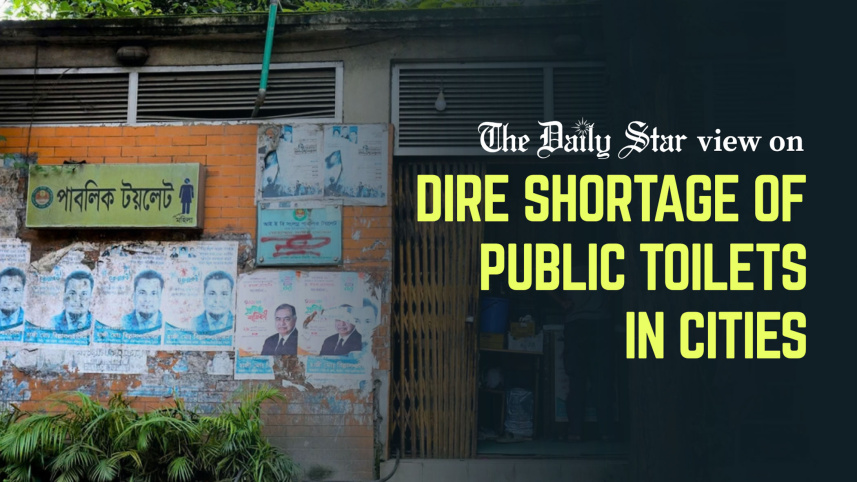
In Bangladesh’s urban areas, we often hear complains about male citizens urinating on roadsides, but fewer complaints are voiced about the dire lack of public sanitation facilities across major cities. A recent report by this daily states that Dhaka city, which sees 1.5 crore pedestrian trips per day, has only 131 permanent and 17 mobile toilets against a requirement of 1,500. The number is based on the global benchmark of one toilet unit for every 1,000 pedestrian trips. In Chattogram, a city of 70 lakh people, there are only 28 functioning toilet facilities against a requirement of 380. Barisal city requires 30 facilities for its 7 lakh residents but, of its 10 existing public toilets, only two are operational. In Rajshahi city, there are only 14 public toilets available for its 5.5 lakh people, against a requirement of 60 facilities.
Unlike in other countries, there are no official guidelines specifying the distribution of public toilets in Bangladesh’s major cities. Even when public toilets are available, they are often unusable due to a lack of proper maintenance. Some facilities are maintained by only one employee, and most are severely unclean and lacking in essential components such as soap and toilet paper. The prioritisation of public sanitation facilities is so weak that no new public toilet has been built in Barisal city for over two decades. And, as in the case of any poorly maintained public facility, women and people with disabilities suffer most acutely. Many facilities have no separate toilets for women, leaving them to either share toilets with men or seek permission to use toilets inside shops, restaurants, and banks. Additionally, besides a few NGO-run toilet facilities, most are not equipped for use by persons with disabilities.

In this situation, women in our cities have learned, intergenerationally, to consume less water before and during travelling or commuting. This is deeply concerning, as health experts warn that reducing water intake and retaining urine for prolonged periods could raise the risk of urinary tract infections, kidney stones and, over time, lead to bladder dysfunction, urinary incontinence, and persistent pain in the lower abdomen and pelvic region.
Factors which contribute to Bangladesh’s public toilet crisis include failures in planning and management, politically influenced lease arrangements, unpaid utility bills, and frequent administrative changes. Ultimately, it is up to the government to prioritise improving our urban sanitation facilities. It is high time for city corporations to collaborate with urban experts and NGOs to not only construct the necessary number of public toilets, but to also employ enough people and funding to maintain them well.
 For all latest news, follow The Daily Star's Google News channel.
Comments