


Why burden citizens with higher fuel costs instead of cutting less urgent spending?

Recently, the chairman of Bangladesh Petroleum Corporation (BPC) wrote to the Energy Division about the corporation’s financial crisis and losses. In the letter, dated September 8, two factors were identified as the main causes of BPC’s financial difficulties. The first was that domestic fuel prices had not been increased regularly in line with global prices. The second was a change in the method for assessing duties and taxes on petroleum products introduced in June 2025.
Under the new system, duties and taxes on imported petroleum products are calculated based on their actual import or invoice value rather than a fixed tariff value. As a result, when international fuel prices rise, the amount of duty payable also increases.

The government has highlighted the first factor (aligning domestic with global prices), but the second (the new method of calculating duties and taxes) has received comparatively little attention. Yet it has contributed significantly to BPC’s losses. According to BPC, the change has increased its tax burden by around Tk 15-20 per litre compared with the previous system.
Before June 2025, the National Board of Revenue (NBR) charged an import duty of Tk 16.76 per litre based on the tariff value. Now, because duties are assessed on the invoice value, the higher the international price of fuel, the more BPC pays in duties and taxes—and the more revenue the government collects.
After the war in the Middle East pushed up fuel prices, the import duty rose to Tk 38.64 per litre in March, Tk 38.90 in April, Tk 29.74 in July after the Iran-US understanding, and Tk 32.44 in August. In September, the duty is expected to be around Tk 38-40 per litre.
To reduce its losses, BPC proposed several options: raising domestic fuel prices in line with international prices; providing the full amount of its losses as a government subsidy; or restoring the previous duty-assessment system; or temporarily waiving duties and taxes until the geopolitical situation improves.
Of these, raising fuel prices is potentially the most damaging to the economy and people’s lives. A hike in fuel prices does not remain confined to petrol stations; it raises expenses across transport, agriculture, industry and services, increasing overall inflation, reducing purchasing power and weakening exporters’ competitiveness.
By contrast, reducing duties and taxes on imported fuel would have the least damaging impact. To protect consumers, governments in many countries temporarily reduce fuel taxes when international prices rise sharply. India has taken such measures following the outbreak of the war in Middle East.
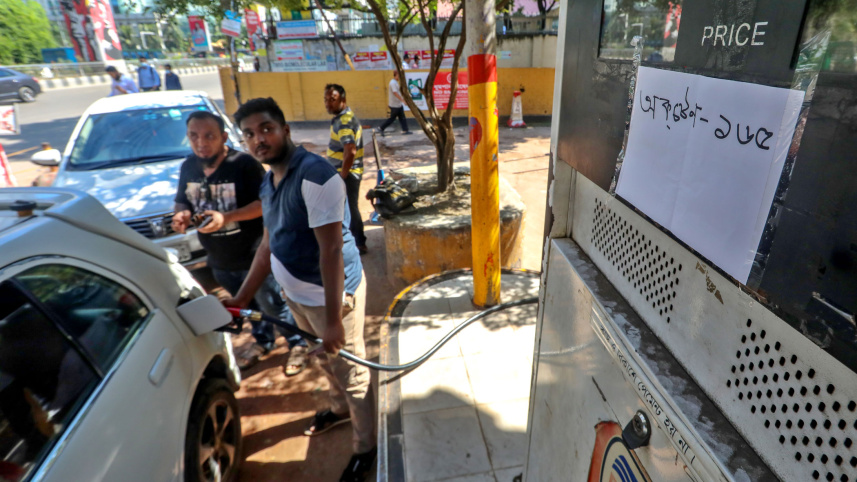
Unfortunately, the BNP-led government has chosen the option with the greatest potential adverse impact. From September 21, it raised diesel, petrol, octane and kerosene prices by Tk 20 per litre. Diesel now costs Tk 135, up from Tk 115; kerosene Tk 155, up from Tk 135; petrol Tk 160, up from Tk 140; and octane Tk 165, up from Tk 145. These are the highest prices in the country’s history. This is the third fuel price increase in seven months under the current government, taking the total increase to Tk 35 for diesel, Tk 43 for kerosene, Tk 44 for petrol and Tk 45 for octane.
Yet when the latest increase took effect, international crude prices were not at their historical peak. After rising to around $126 a barrel in April following the outbreak of the war, crude prices have fallen to around $100 and are trending downwards. Nevertheless, the government cited higher international prices to raise domestic fuel prices to record levels.
The effects are already becoming visible. The government has raised bus fares by Tk 0.17 per kilometre, while long-distance bus fares have already risen by Tk 50-100. Local buses on the Dhaka-Chattogram route are charging an additional Tk 5-10. Truck freight rates have increased by Tk 2,000-8,000. Private container depot owners have also imposed a 9.85 percent fuel surcharge on container handling.
The higher diesel price will be an additional burden on farmers already struggling with the fertiliser crisis. Around 24 percent of diesel consumed in Bangladesh—about 10.44 lakh tonnes—is used in agriculture. Diesel is needed not only for irrigation but also to operate different machines and tools used for land preparation, planting, harvesting, threshing and transporting agricultural produce. The increase will therefore affect almost every stage of agricultural production, putting further pressure on farmers, food production and food security while fuelling inflation.
Inflation has remained above 8 percent for a prolonged period. Wages have not risen at the same pace; new employment opportunities are limited and economic activity remains sluggish. Raising fuel prices in such circumstances will only worsen the situation.
In justifying the increase, the government cited higher fuel prices in various countries. But it did not compare people’s purchasing power, minimum wages, or inflation rates in those countries. Such comparisons matter. For lower-income people, higher fuel costs are harder to absorb because a larger share of their income goes towards essential goods, whose prices are heavily affected by fuel costs. Therefore, fuel prices cannot be compared without also considering incomes.
There are also factual inconsistencies in the government’s statement. It claimed that diesel costs Tk 134.76 per litre in Kolkata. In reality, diesel was priced at Rs 99.82 per litre in Kolkata throughout September. At an average exchange rate of around Tk 1.26 per Indian rupee, that is roughly Tk 125.77—Tk 9.23 less than Bangladesh’s current price.
In New Delhi, diesel was even cheaper, at Rs 95.20, or around Tk 119.95—about Tk 15 less than Bangladesh’s new price. Yet Delhi’s minimum wage is Rs 18,456, or around Tk 23,254, which is 86 percent higher than Bangladesh’s garment-sector minimum wage of Tk 12,500. India’s inflation rate was also 4.82 percent in August, roughly half of Bangladesh’s.
Thus, despite higher minimum wages and lower inflation in India’s capital, diesel is cheaper there than in Bangladesh. One reason is that the Indian government has reduced fuel taxes to keep strategic fuels such as diesel affordable.
Bangladesh’s government could have done the same by reducing duties and taxes. Instead, it has passed higher international fuel costs directly on to consumers. According to the government, the Tk 20-per-litre increase will reduce BPC’s annual losses by around Tk 10,000 crore.
But at precisely the same time when the government has chosen to impose additional costs on the public to save Tk 10,000 crore a year, it has also decided to implement a new pay scale for government employees. This will increase government expenditure by Tk 1,05,380 crore over three years: Tk 37,372 crore in the current year, Tk 44,838 crore in 2027 and Tk 23,170 crore in 2028.
At the same time, the government has decided to spend thousands of crores on new purchases, including Boeing aircraft from the US, Airbus from France, England, and Germany and fighter jets from China, as well as implementing two metro rail projects with Japanese loans at roughly twice the originally estimated cost.
 For all latest news, follow The Daily Star's Google News channel.
 The contradiction is obvious. On the one hand, the government considers reducing BPC’s annual loss by Tk 10,000 crore so important that it has raised fuel prices and imposed additional costs on the public. On the other hand, it has committed to expenditures many times larger through higher government salaries, new purchases and infrastructure projects.
The central issue, therefore, is not simply fiscal savings or an economic crisis. It is a question of priorities: is keeping fuel prices affordable for ordinary people less important than increasing government employees’ salaries and undertaking new purchases and projects involving substantial expenditure?
If the public interest is to be prioritised, the government should withdraw the increase in fuel prices, particularly diesel. If expenditure needs to be reduced, the government should first identify unnecessary and less urgent expenditures and cut them. Fuel is a strategic and essential commodity whose price directly affects transport, agriculture, industrial production and the wider economy.
Instead of placing an additional burden on consumers through higher fuel prices, the government should reconsider the costs of new purchases and infrastructure projects and suspend or limit additional expenditures such as increases in government employees’ salaries and allowances. If fiscal restraint is genuinely necessary, the economically rational place to begin is unnecessary expenditure—not fuel, which is essential to the economy and people’s daily lives.
Kallol Mustafa is an engineer and writer who focuses on power, energy, environment, and development economics. He can be reached at kallol_mustafa@yahoo.com.
Views expressed in this article are the author's own.
Follow The Daily Star Opinion on Facebook for the latest opinions, commentaries, and analyses by experts and professionals. To contribute your article or letter to The Daily Star Opinion, see our guidelines for submission.
Comments