


For women, ‘diversifying income’ can become another form of depletion

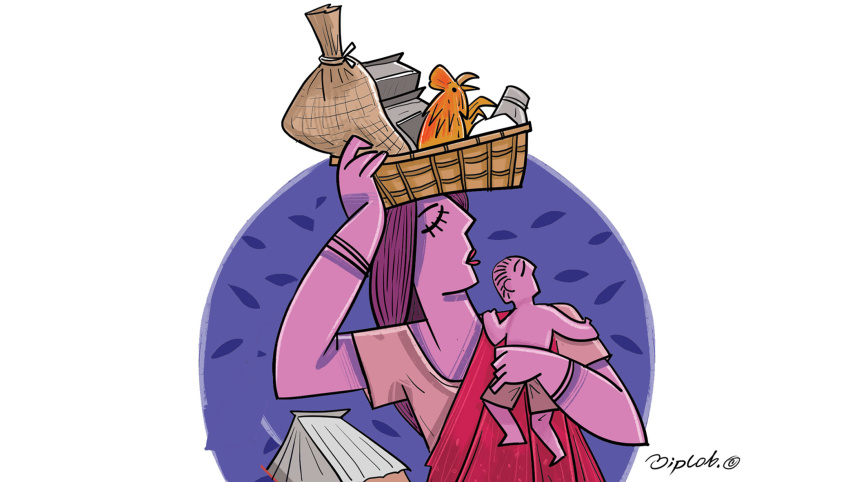
“I can’t manage anymore, but who will listen?”
I have heard versions of this from women I met in Korail in June. On paper, they were doing well. One had a stitching contract. Another had started a small poultry business but was also a domestic worker. Another had joined a skills-training programme. Some were combining three or four of these activities. They were, by every conventional measure, becoming more economically active.

But none of those measures asked how tired they were.
Women spend an average of 5.9 hours a day on unpaid domestic and care work, compared to 0.8 hours for men. This disparity was revealed in Bangladesh’s first-ever Time-Use Survey, published by the Bangladesh Bureau of Statistics (BBS) with technical and financial support from UN Women in 2021. The estimates show that unpaid household and care work was worth Tk 6.7 trillion in 2021, equivalent to 18.9 percent of the country’s GDP. Moreover, women accounted for 85 percent of the total contribution to unpaid care work.
In 2024, women’s labour force participation was 38.41 percent, compared with 79.96 percent for men. The number of women in the labour force also fell from 2.53 crore in 2023 to 2.37 crore in 2024.
The state and employers taking greater responsibility for care, better access to affordable childcare, and for men to start doing more at home are all needed. But what happens when, in the name of boosting women’s economic empowerment, we keep adding to their work?
For years, government and non-government development programmes have encouraged women to diversify their income. A woman may be trained in tailoring, then encouraged to take up handicrafts, join a savings group, sell products through a digital platform, or start a small poultry business. Each activity may make sense on its own and even increase her income. But the problem is that she has 24 hours in a day. If nothing else is removed to make room for the new venture, when does she rest?
A woman does not enter a livelihood programme with an empty eight-hour timeframe waiting to be filled. She already has children to feed, water to collect, meals to prepare, elderly relatives to look after, a household to manage and, often, other paid or unpaid work to do. Adding another income-generating activity means the “extra” hours have to come from somewhere and, very often, they come from her resting time.
This is particularly important for women living in poverty, for whom “diversification” is rarely a lifestyle choice. More income may be necessary simply to keep the household afloat. A woman cannot necessarily refuse the second or third income stream citing her exhaustion.
This is where Shirin Rai’s idea of “depletion” is useful. Published in 2025, Depletion: The Human Costs of Caring looks at what happens when the demands placed on people, particularly women, become greater than the resources they have to cope with them. The result isn’t only that she has a lot to do. Over time, the physical, mental, and social resources she needs to keep going are gradually used up.
This should give those in the development sector a different way of looking at women’s economic participation. We usually ask: did she get training? Did she start a business? Did her income increase? Did she remain in the programme?
But we should also ask what she had to give up to do all of it. Was it sleep? Rest? Time with her children? Time for herself? Another source of income? Or simply the small amount of energy she had left at the end of the day?
This is not an argument against women earning more. It is an argument against pretending that women’s time is infinitely expandable.
My own PhD research on women’s labour market participation grew partly out of this question. I am interested to understand whether women are able to sustain paid work. What happens when paid work is added to unpaid care work? And is a woman’s eventual withdrawal from paid work really a “choice,” if the alternatives are exhaustion, familial conflict, or an unmanageable care burden?
Bangladesh is already beginning to build a stronger care agenda. The FY2026-27 budget proposes the introduction of 20 modern daycare centres in the first phase, followed by another 60. The country also has a National Roadmap for Childcare aimed at improving the quality, accessibility, and affordability of childcare.
But care cannot sit in one policy box while livelihood programmes are under another.
If a programme asks a woman to attend trainings, start a business, or take on another income-generating activity, it should also ask what care responsibilities she is carrying and which kind of support would make the additional work sustainable for her. The indicators of participation should not stop at attendance, income, and business survival. They should also take into account time, care responsibilities, and the burden placed on a woman to make everything fit.
Every programme designed to increase women’s economic activity should have a simple question built into its design: when something is being added to her workload, what is being taken away to accommodate it? If the answer is “nothing,” then we should not be surprised when empowering activities result in exhaustion.
Redistributing unpaid care among men, communities, employers, and the state remains essential. But redistribution of care cannot be the only issue being discussed while development programmes continue to assume that women have another few hours to spare in a given day. A gender-responsive development agenda that aims to help her with multiple income streams perhaps should start with the question of how tired she already is.
Tasmiah T Rahman works as portfolio adviser at Innovision Consulting and is currently pursuing a joint PhD in women’s labour market participation.
 For all latest news, follow The Daily Star's Google News channel.
 Views expressed in this article are the author's own.
Follow The Daily Star Opinion on Facebook for the latest opinions, commentaries, and analyses by experts and professionals. To contribute your article or letter to The Daily Star Opinion, see our guidelines for submission.
Comments