


Bangladesh sees gradual decline in foreign tourist arrivals


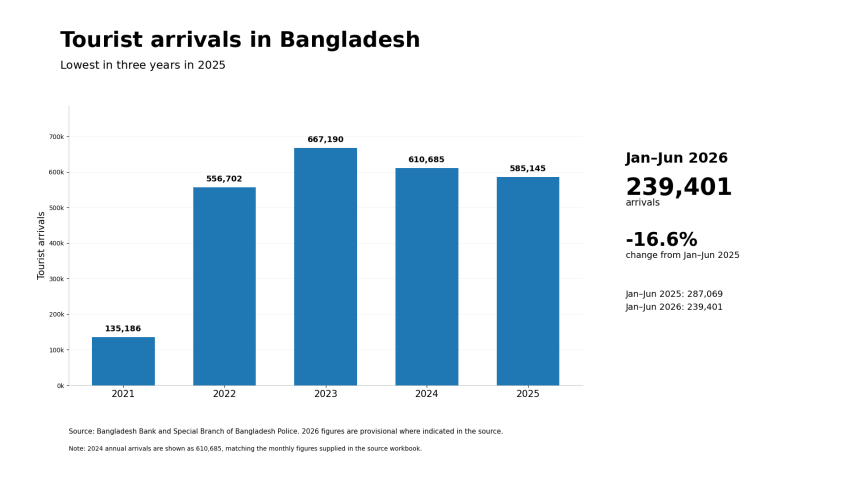
Bangladesh has been registering a gradual decline in foreign tourist arrivals over the last two years amid political turmoil, security concerns and inadequate infrastructure and services.
The country recorded 239,400 foreign tourist arrivals in the first six months of 2026, down around 20 percent year-on-year, according to data from the Special Branch of Police and Bangladesh Bank, compiled by the Bangladesh Bureau of Statistics.

This is the second consecutive year of decline since Bangladesh welcomed more than 667,000 foreign visitors in 2023. The country received 585,145 foreign visitors in 2025, down 4 percent year-on-year.
HM Hakim Ali, president of the United Tourism Stakeholders’ Society of Bangladesh (UTSSOB), said Bangladesh is failing to attract foreign tourists despite its natural attractions because it is not adequately prepared to receive international visitors.
“We need to bring foreign tourists and earn from outside,” he said.
The decline in inbound tourism also comes at a cost to foreign-currency earnings, particularly as around two million Bangladeshis travel abroad each year.
“Countries such as China and Vietnam are making it easier for Bangladeshis to obtain visas because they understand the value of this market. We need to think about how to bring money into the country, not just how to stop money from going out,” he said.
Hakim said Bangladesh needs better marketing, roads, communication, clean toilets, restaurants and maintenance of tourist attractions.
Md Taslim Amin Shovon, chief executive officer of Innoglobe Travels and Tours, said political turmoil and security concerns were major reasons behind the decline in tourist arrivals.
“Many embassies earlier raised travel alerts regarding travelling to our country. They are yet to give any green signal,” he said.
“The situation has worsened over the last two and a half years,” he added.
“We do not know what is going to happen. We are really worried,” Shovon said. “We do not have any projection of good business.”
Shovon said they had urged the government to introduce e-visas and set up a dedicated desk to provide services to foreign tourists on arrival. It takes a lot of time for foreign tourists to get clearance at the airport, he added.
Santus Kumar Deb, a tourism expert and professor in the Department of Tourism and Hospitality Management at the University of Dhaka, said Bangladesh needs to improve price, quality and service to become more competitive.
“Nearly 90 percent of our tourists are domestic, while only 10 percent are international,” he said.
Bangladesh also needs stronger digital branding, including AI-based storytelling, QR codes and short promotional videos to highlight lesser-known destinations, Deb said. E-reservations, e-visas, self-check-in and cashless transactions could also improve the visitor experience.
Better coordination among government agencies, stronger security and greater involvement of local communities are also needed.
The government is turning to digital technology and artificial intelligence as part of its efforts to revive tourism. The official theme of World Tourism Day 2026 is “Digital Agenda and Artificial Intelligence to Redesign Tourism”.
Fahmida Akhtar, secretary of the civil aviation and tourism ministry, said the government wants to raise tourism’s contribution to GDP to 7 percent from the current 2-3 percent.
The government is also updating the tourism master plan and preparing a tourism satellite account to measure the sector’s contribution.
 For all latest news, follow The Daily Star's Google News channel.
 Mutasim Billah Faruqui, chief executive officer of the Bangladesh Tourism Board, said the government would strengthen international promotion by engaging foreign diplomats, bloggers, influencers and journalists and participating in overseas tourism fairs.
Comments