


Non-complying insurers won’t be allowed to operate


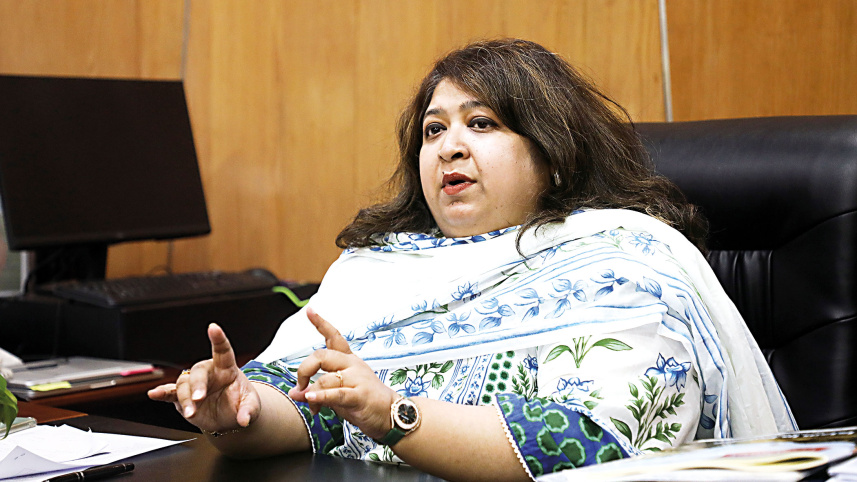
If you sell a policy knowing that you will not be able to pay the claim, that can amount to fraud
The Insurance Development and Regulatory Authority (IDRA) will take stricter measures against non-complying distressed insurance companies, its chairman has said.

“We are prepared to go much further if necessary,” said Mir Nadia Nivin, chairman of IDRA, referring to insurers currently under financial distress.
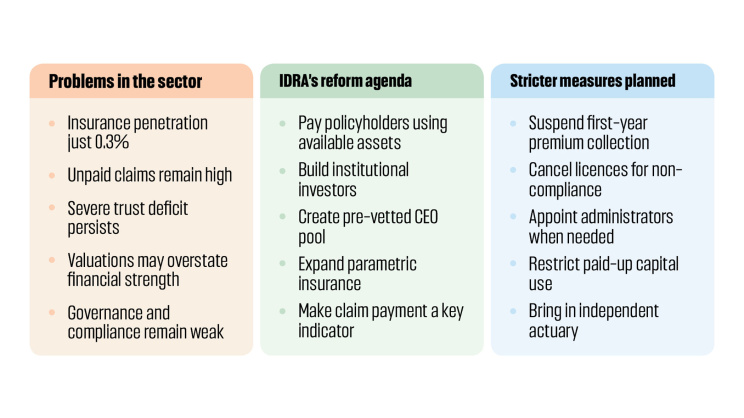
Its regulatory tools include suspending first-year premium collection, cancelling licences, appointing administrators and, ultimately, liquidating companies, she shared in a recent interview with The Daily Star.
“Sixty percent of the time, I will work as a partner to support the companies, but 40 percent of the time I will act as a regulator,” she said. “If they do not comply with the regulator’s instructions, they cannot be allowed to continue doing business.”
Fareast Islami Life Insurance Company Limited illustrates the scale of the challenge. The company has outstanding claims of around Tk 3,000 crore, while its recoverable assets could amount to roughly Tk 1,200-Tk 1,300 crore, according to Nadia.
The company’s first-year premium collection has been suspended, preventing it from expanding its business while its existing obligations remain unresolved.
“If you sell a policy knowing that you will not be able to pay the claim, that can amount to fraud,” she said.
Nadia said the regulator’s immediate objective is to use available assets to pay as much as possible, rebuild confidence and then assess whether the company can be turned around.
But resolving the sector’s immediate crisis is only one part of her reform agenda. Her longer-term goal is to transform insurers into a significant institutional investor class.
In developed economies, she said, life insurers invest over long periods because their liabilities themselves are long term. Bangladesh could use the same model to finance infrastructure.
The government appointed Nadia as the chairman of the IDRA for a three-year term in June this year.
A Bangladeshi governance and institutional reform specialist, she served as a member of the Electoral System Reform Commission, established by the interim government in October 2024.
She said Bangladesh’s insurance sector needs deep institutional reform, stronger financial discipline and a fundamental shift in governance if it is to regain public confidence and emerge as a major source of long-term investment.
Nadia said she took charge of IDRA because she believed her reform experience could be applied to a sector facing entrenched irregularities and a severe trust deficit.
Her immediate priority, however, is ensuring that policyholders receive the money they are owed.
Insurance penetration in Bangladesh is only around 0.3 percent and has been declining, she said, reflecting a growing loss of confidence among customers who often do not receive claims on time.
“When I came into this position, I realised that the biggest reason for the sector’s trust deficit is that people are not getting their claims on time,” Nadia said.
IDRA has therefore begun with the most distressed insurers, particularly seven or eight companies with large volumes of unsettled claims. Their owners and management have been brought into governance review meetings, while the regulator has begun examining their assets, liquidity and ability to pay.
Nadia said companies cannot use past management failures as an excuse for avoiding their obligations.
 For all latest news, follow The Daily Star's Google News channel.
 “Under Bangladeshi law, a company is a separate entity. Whatever the previous board did is a different issue. The company remains responsible to its policyholders,” she said.
IDRA has collected information on the assets of the distressed companies, including government bonds, fixed deposits, bank balances and land.
It is also working with Bangladesh Bank to release funds trapped in financially vulnerable banks so that the money can be used for claim settlement.
Land assets are being identified, valued and prepared for sale where necessary.
To prevent funds raised through asset sales, bond liquidation or fixed deposits from being diverted elsewhere, the companies have been instructed to maintain separate bank accounts for claim payments. Auditors have been assigned to monitor those accounts, with regular statements being submitted to IDRA.
Payments are being made on a first-in, first-out basis, with claims verified by auditors.
As part of this, a total of Tk 37.54 crore in insurance claims has been paid to 8,417 policyholders of seven troubled life insurers in two phases under an initiative of IDRA.
In the first phase, Tk 14.51 crore was paid to 2,549 policyholders of BAIRA Life Insurance, Fareast Islami Life Insurance, Golden Life Insurance, Homeland Life Insurance, Padma Islami Life Insurance, Progressive Life Insurance and Sunflower Life Insurance.
In the second phase, Tk 23.03 crore was paid to 5,868 policyholders of Padma Islami Life Insurance, Homeland Life Insurance, Fareast Islami Life Insurance, Sunflower Life Insurance and Sunlife Insurance.
Strengthening the industry will require reforms inside individual companies as well. IDRA is examining life funds, actuarial valuations, paid-up capital, special audits, investment practices and compliance with previous audit recommendations, she said.
One concern is that actuarial valuations may sometimes rely on assumptions that make a company’s financial position appear stronger than it actually is, she added.
Because the actuarial market in Bangladesh is small and potential conflicts of interest exist, IDRA plans to retain an independent third-party actuary, potentially from overseas, to review the basis used by insurers for their valuations, she mentioned.
The authority has also tightened controls over paid-up capital. In coordination with Bangladesh Bank, insurers will no longer be able to withdraw, pledge or otherwise transact against paid-up capital without IDRA’s authority.
Investment practices are another area of scrutiny.
Nadia said insurers need to reduce their exposure to land, with the regulator seeking to bring land investment within the permitted 20 percent threshold. Companies with excess land holdings may be required to liquidate those assets and place the proceeds into appropriate investments.
At the same time, IDRA is trying to improve the quality of company leadership. Several insurers still have interim or acting chief executives and managing directors. The regulator plans to create a broader, pre-vetted pool of candidates rather than limiting recruitment to people with insurance-sector experience, she said.
“We do not believe they necessarily have to come from the insurance sector,” Nadia said. “They can come from banking or other parts of the financial sector.”
Climate risk is another area where she sees scope for innovation.
IDRA is working on parametric insurance products, where payouts are triggered automatically by predefined events rather than requiring conventional claims assessment.
A flood insurance pilot linked to the Jamuna River project has already made payouts of around Tk 14 crore across five districts through mobile financial services, she said.
Crop insurance is also being developed with the Ministry of Agriculture, while a small heat-insurance pilot is being considered with support from the Asian Development Bank.
The regulator plans to use its regulatory sandbox to test innovative products before wider rollout. Ultimately, however, Nadia believes the sector cannot be transformed without better data and stronger supervision.
IDRA’s public dashboard, which previously provided information on claims, lapsed policies and other indicators, has not been regularly updated in recent years.
The authority now plans to restore the dashboard as part of a broader shift towards risk-based supervision, she added. Once the system is fully operational, IDRA should be able to monitor insurers in near real time, including how many claims they are settling.
“Claim settlement will be one of our indicators,” Nadia said. “If claim settlement keeps increasing, we will know that our initiatives are working.”
For her, the broader challenge is to move insurance away from being viewed primarily as a product sold to customers and towards becoming a financially disciplined institution capable of protecting policyholders, supporting the capital market and mobilising long-term funds for the economy.
That will require stricter regulation, but also cooperation from insurers, she added.
Comments