


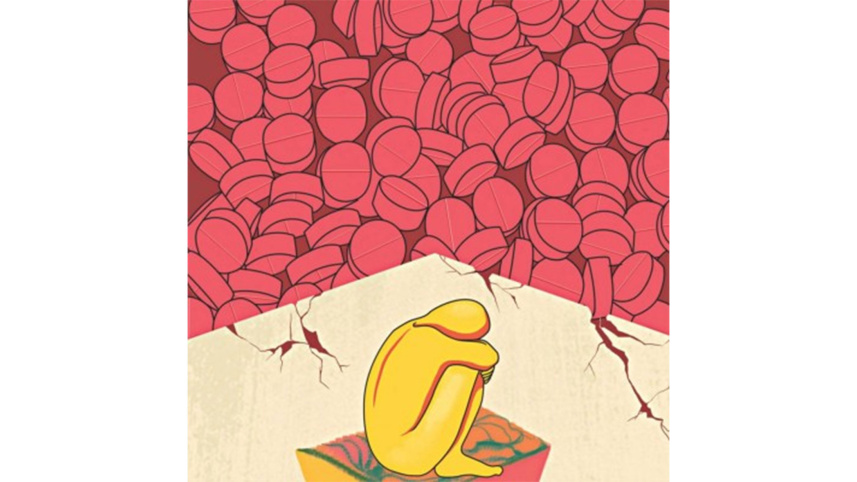
Yaba is devouring our children, and we are still looking away

Thirteen-year-old Ishiat Shahriar Opratim left home on Friday afternoon with his mother’s iPhone. By Saturday, he was dead in the hillocks outside Cumilla city, and police found the phone at the home of one of three young men, aged 15 to 20, whom they detained.
Police have not said whether drug use influenced the actions of the accused, and I am not trying to guess at this stage. But many parents who consume news knows the combination: young men barely out of their teens, a phone sold for a few weeks’ worth of cash, and violence out of all proportion in comparison to the prize. That calculation of cheap lives and quick money is exactly what yaba has been teaching a generation of Bangladeshis.

A national survey supervised by the Department of Narcotics Control estimates that 82 lakh Bangladeshis, nearly one in every 20 people, now use illegal drugs; about 23 lakh of them use yaba. Last year, law enforcers seized 4.35 crore yaba and similar pills, one of the biggest hauls on record. Having worked with the United Nations Office on Drugs and Crime (UNODC) as a consultant on trafficking in the Bay of Bengal, I have seen this economy up close. In 2020, a pill bought for Tk 80 in Myanmar sold for Tk 200 here, its profits flowing back through hundi via multiple routes. Today it sells for Tk 150 to 200.
The UNODC’s June 2026 report records 349 tonnes of methamphetamine seized across East and Southeast Asia in 2025, 48 percent above the previous record. Swedish journalist Bertil Lintner has long argued that this trade is not a sideshow to Myanmar’s wars but part of how they are paid for. Ethnic armed groups are widely accused of moving the pills through Rakhine to our border.
And the result is a looming social catastrophe. Chronic users suffer paranoia, sleeplessness and stimulant psychosis, and heavy use breeds impulsive aggression. A habit costing several hundred taka a day must be paid for, and for a jobless delinquent, sometimes the fastest way to pay is with a knife and a snatched phone.
American sociologist Robert K Merton’s strain theory holds that when a society dangles success before young men but bars the legitimate doors, some take the illegitimate route. Social learning theory explains how older boys use social media and encrypted platforms to teach younger recruits about gang names and turf. The Dhaka Metropolitan Police (DMP) counts 118 such “kishor gangs” in the capital alone. They sell yaba, use it and fight over it.
There is a gendered dimension we often ignore. Yaba feeds a performance of hyper-masculinity, where domination is the only currency a jobless youth still feels he possesses. Women pay twice over: they are recruited as couriers because they are less likely to be searched, while also absorbing the rage at home when a husband’s or child’s habit turns ugly.
The home minister has reiterated a policy of zero tolerance. But remember, in 2018 a “war on drugs” left hundreds dead in so-called crossfires, yet the trade soon boomed again. An overstretched, distrusted and, in places, compromised police force cannot enforce laws that parts of society have grown accustomed to flouting. Real zero-tolerance has to mean four things.
First, go after the money and the patrons. BNP should remember Abdur Rahman Bodi. The Awami League MP for Ukhia-Teknaf was named as a yaba godfather on official lists, yet was never charged with a drug offence. When the scandal grew too loud, his party nominated his wife, who won the seat twice. The Awami League chose its MP over the country’s youth, and the trade flourished. A narcotics financial intelligence cell that freezes the assets of godfathers, not carriers, would frighten the trade more than any checkpoint. BNP’s test is whether it will turn that cell on its own men.
Second, run the border as one operation. BGB, the Coast Guard and the Navy need shared real-time intelligence, and Dhaka must press Naypyidaw, the Arakan Army and other players alike. Seek international support to curtail the supply chain. Choking the trade around Cox’s Bazar also serves Rohingya camp security, because yaba money feeds the armed groups that terrorise the camps and profit from their limbo. No easy money, no easy peddlers.
Third, bring educational institutions in. A screening programme and confidential referral line in every secondary school can be an effective deterrent against children using drugs or being roped in by gangs.
Fourth, and most urgently, the opposition must lead where the state cannot. Jamaat-e-Islami, with its grassroots network, and its ally the NCP, born of the students who led the July uprising, hold something the police lack: growing credibility among the young. They should put it to work in every ward and campus, support local government agencies, back families seeking treatment, and pass on what they know about patrons to investigators. The aim is not vigilantism but a social movement.
If we keep treating drugs as a policing nuisance rather than a threat to national security, there will be many more killings like the ones that recently shook the nation. The politicians should remember who brought down the last government. It was the young, and a generation lost to yaba will not forgive the party that looked away.
In the end, this is political economy too. Since 2020, average incomes have grown significantly in taka terms while the pill has grown cheaper, so yaba is now about three times more affordable. No crackdown survives that mathematics. The government must aggressively dismantle this market and the political and local figures protecting it. They need to choke off the supply, seize the illicit profits, and ensure that legitimate employment is far more appealing to restless young people than dealing drugs.
Shahab Enam Khan is a professor and teaches international relations at Jahangirnagar University and Bangladesh University of Professionals.
Views expressed in this article are the author's own.
Follow The Daily Star Opinion on Facebook for the latest opinions, commentaries, and analyses by experts and professionals. To contribute your article or letter to The Daily Star Opinion, see our guidelines for submission.
 For all latest news, follow The Daily Star's Google News channel.
Comments