


In conversation with Lucky Karim: The story behind ‘Born Lucky’
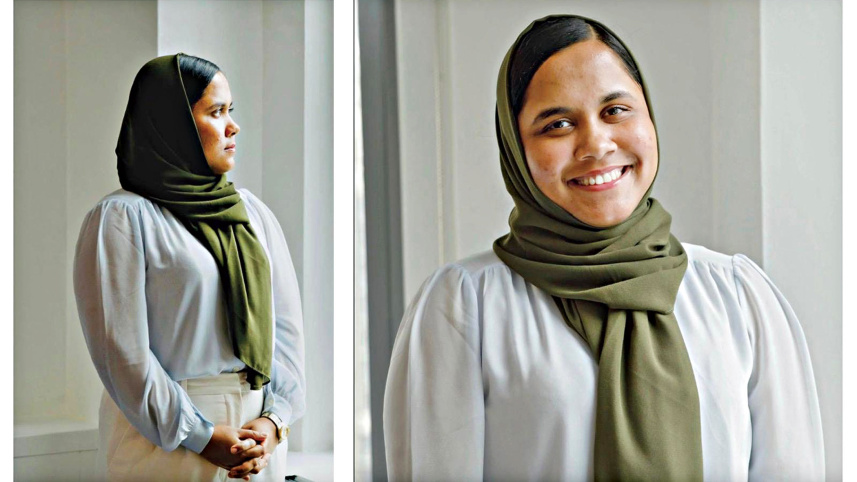
In August 2026, we sat down with Lucky Karim—a fellow at Refugees International and a refugee and human rights activist from Burma (Myanmar). We talked about her journey, her childhood, the trauma of displacement, and her upcoming book that brings it all together: Born Lucky—a memoir about her life in Burma’s Rakhine State, the Rohingya camps, and beyond. As the conversation deepened, we were enamoured by the real-life stories of a true survivor of the camps. The memoir is slated to release in Fall 2027 from Stonefruit Studio and is written with Jessica Olney.
Lucky Karim lived for six years in the world’s largest refugee camp in Bangladesh and has worked for a number of international organisations to serve her community in Cox’s Bazar before she was resettled to the United States in December 2022. Recognising the power of women’s leadership, Lucky founded Refugee Women for Peace and Justice (RWPJ)—the first registered Rohingya refugee-led nonprofit operating directly in Bangladesh’s Cox’s Bazar camps.

Could you tell us a little bit about your memoir Born Lucky?
Well, first of all, I always knew that if I ever wrote a book, it would be a memoir. Because it is a memoir, it addresses my life story and my journey—from the day I was born, the time I spent in Burma, and the years that I spent in the Rohingya camps of Cox’s Bazar. When I started writing, I realised there was so much I needed to talk about—my country, my community, and the camp itself. I also needed to address my personal experiences. So, when I started the book, it went beyond just a memoir—I began to write the entire history of genocide, from when it started to the present time. I wrote about when and why the genocide took place, and why my community had to flee back and forth from Burma to Bangladesh. The memoir also includes how the Rohingya community went back to Myanmar in the 70s and the 90s—only to come back to Bangladesh again in 2017. So, there are all those dynamics from the past, from my grandparents’ generation and from my parents’ generation. I thought of including it all and started writing the book. It isn’t necessarily a political writing, rather a humanitarian one.
What first motivated you to write it down?
The first reason I decided to write the book was because I really hoped that the culture, tradition, and language of my community wouldn’t disappear. I didn’t see a solution magically happening for us overnight. In August 2026, it will have been nine years since we became refugees in this country. I just hoped we didn’t disappear from our land. In case we do end up immigrating and resettling back home, I wanted a solid written document for the people to go back to and learn about the Rohingya community. The second reason was that, in the history of the Rohingya community, there has never been a woman who has written a book. So, this is going to be the first book from my community. Another is that I thought about all the struggles I had to go through in my life, from my childhood to my adult years, and I wanted to inspire not just my community, but everyone, to work hard and become resilient. I especially wanted to inspire the young people to always keep going.
In 2017, at the age of 14, you made an 11-day journey on foot from the Rakhine state to Bangladesh. Do those memories of displacement and your childhood in Burma find a place in the chapters of your book?
When I fled my home in 2017 as a child, I was, as you said, I was only 14. So I could remember everything from Burma, from my village, from my home, from the journey I took on foot all the way to Bangladesh. Honestly, different individuals who took the journey at that time had different experiences. After we came to the camps, a lot of my friends gave up school completely and got married, and had children. I chose the most difficult path—potentially, getting married off was an easy way out, but I spent months with little to no sleep trying to educate myself with what little I had. All these experiences culminated in the memoir, and Born Lucky became a history about how an individual survived a genocide.
You decided to write the book in English, despite it not being your mother tongue. How and where did you learn English, exactly?
It was difficult for me to communicate with foreigners coming to the camp as they didn’t speak the Rohingya language, and I don’t speak Bangla. So I pushed myself to really practice English—which was the fifth language for us in Burma. In the evenings, with the little internet access that I had on a tiny phone that I used to have, I began to practise English by watching American videos on YouTube again and again.
How did you navigate the creative challenge of depicting intense trauma—such as fleeing genocide and facing security threats—while also ensuring an accessible read for a younger audience?
The goal of targeting the young generation and young adult readers was to see how we can start building relationships and communicate with other ethnic groups in Burma through the book. This is also why a Burmese version of the book is coming out. A lot of ethnic groups in Burma have an uneasy relationship with each other. We were restricted by our own government. I thought, if we didn’t have a working relationship with our neighbours, how can we expect a democratic future in Burma? So, I thought about bringing out a Burmese version of the book for people to read and realise the cost of survival.
Do you think a Bangla translation of your memoir could help bridge the gap of communication between Bangladeshi people and the Rohingya community?
I guess Bangla could also be a potential language for translating the memoir. Of course, I have to discuss it with my publishers, but I think it would be important since it is one of the countries that is closest to us, and as I mentioned earlier, we came back here multiple times. And so I think the memoir might be a good understanding for the Bangladeshi host community too.
What is your vision for a sustainable, Rohingya-led education and safe, voluntary repatriation, and how do you hope Born Lucky can serve as a tool for achieving that future?
As refugees, we don’t want to rely on a “third party” forever. It is difficult for people who used to earn and work in the fields back home to come to the camps and remain unemployed for nine years. So, better work opportunities should be ensured in the camps so that people can stand on their own two feet when they are eventually repatriated. But repatriation can only happen if the situation changes in Burma—as of the current situation, it isn’t possible. Our ultimate goal is to go back home. Born Lucky, I hope, will remain as a document of a forgotten history. I want it to remain as a document that changes the minds of global policymakers.
Tasnim Naz works as a faculty member in the Department of English, Bangladesh University of Professionals. Reach her at tasnimnaz46@gmail.com.
K.M. Arefin is a writer and translator. He works as a faculty member at the Bangladesh University of Professionals. Reach him at khanmohammadarefin@gmail.com.
 For all latest news, follow The Daily Star's Google News channel.
Comments