


Lost in translation, looking for home
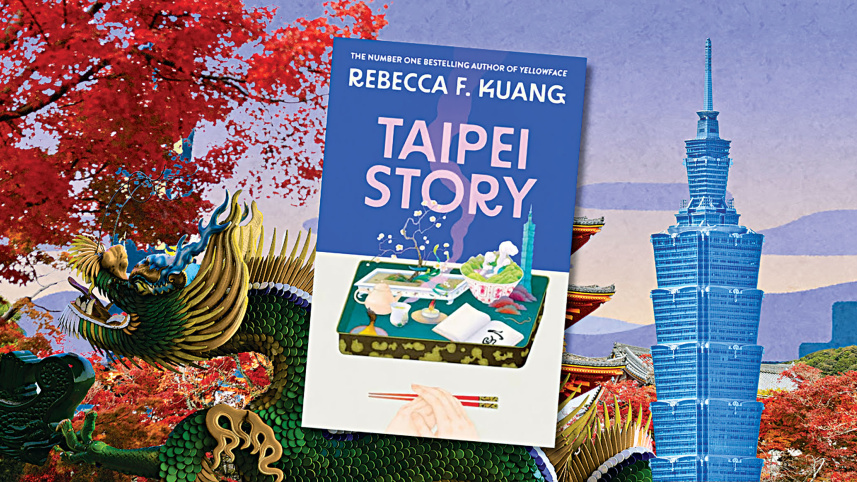
I think what stayed with me most about R. F. Kuang’s Taipei Story was not its politics, its questions about diaspora, or even its fascination with a new language. I felt a strange ache watching someone travel so far in the hope of finding a part of herself, only to realise that some things cannot be recovered simply by going back to them. Lily Chen, the protagonist, arrives in Taipei wanting to become close to the culture of her ancestors, and I found something deeply familiar in that desire: the hope for a place to call home, a language that might finally explain who we are. But the Taipei Story slowly turns that hope into a much more difficult question: what if the home we are searching for exists more in our imagination than anywhere in the real world?
Lily arrives in Taipei to attend a language program, carrying an idea of China that is part inheritance, part fantasy. Her family speaks Mandarin at home, but her own relationship with the language is somewhat fractured. She can understand enough to navigate her Chinese community, not enough to fully feel Chinese. She thinks that her integration into the Chinese-speaking community will fix this. 75 days of intensive study, conversations, food, streets, museums, friendships, and mistakes might finally close the distance between who she is and who she thinks she should become.

Taipei makes that distance visible.Kuang’s greatest strength here is her ability to turn language into something much larger than a communication tool. For Lily, Chinese is a test she keeps failing, and a door she cannot quite open. Even when she begins to speak with confidence, she remains conscious of everything she does not know. In the novel’s author’s note, R.F.Kuang describes the novel’s recurring concern with mistranslation, miscommunication, and misunderstanding, but the idea of the novel actually stretches far beyond vocabulary. Everyone in Taipei Story seems to be translating something: language, history, politics, family, memory, sometimes even themselves.
At the centre of it all is Lily’s complicated relationship with Taiwan. She wants to experience the place authentically, but quickly runs into the problem of trying to define authenticity in the first place. Is Taiwan Chinese? Is it Taiwanese? What does it mean to inherit something from parents who left it? These questions hover over the novel.
Lily, meanwhile, is not an easy character to like. She can be judgemental, insecure and painfully self-conscious about her Chinese identity. At times, one wants to shake her. Then she says or does something that makes her uncomfortably understandable. Kuang has always been good at writing ambitious characters with enough intelligence to analyse themselves but not enough wisdom to stop making the same mistakes. Lily can turn identity into an intellectual puzzle and overthink a conversation long after everyone has moved on. Her flaws are not something the novel asks us to overlook. A more agreeable, likeable, and maybe more righteous protagonist might have made Taipei Story easier to read, but Lily is far more interesting this way.
Kuang is interested in the politics of cultural ownership: who gets to claim a place, who gets to speak about it, and whether wanting to belong somewhere automatically confers the right to do so. This is where Taipei Story becomes more than a novel about a young woman studying abroad.
There are moments when the novel’s arguments become more visible than its story. Kuang has a great deal to say about diaspora, Taiwan and Chinese identity. Readers who prefer politics being quietly hidden beneath metaphor may find some passages a little too direct. Still, Kuang has never been particularly interested in disappearing behind her fiction, even when her opinions occasionally threaten to crowd out the story’s plotline. For this particular book I personally think she has lightly sprinkled the political theme such as the history of Khmer Rouge and the atrocities of Pol Pot on top of the plot, rather than actually diving into the theme.
Kuang is interested in the politics of cultural ownership: who gets to claim a place, who gets to speak about it, and whether wanting.
If Katabasis by R.F.Kuang turned graduate school into a descent through hell, Taipei Story takes on something quieter, though no less exhausting: the pressure to become the right version of yourself. Lily is trying to work out how much of her identity belongs to her and how much has been inherited. Kuang does not turn this into a simple lesson about accepting oneself. Identity remains messy. Taipei Story is at its strongest when it lets Lily remain flawed and occasionally frustrating, rather than turning her into a mouthpiece for a neat argument about identity.
Kuang does not give us a perfect guide through questions of identity and belonging. Lily is confused because the questions themselves are confusing, and there is no simple checklist for becoming the right kind of anything.
By the end, what stayed with me was not a lesson about how to find home. It was the uneasy feeling that perhaps we sometimes go looking for home expecting it to recognise us immediately, only to discover that we have changed too much, or imagined too much.
Nazmun Afrad Sheetol is navigating the world through words, pretending to be a literary diplomat. She can be reached at sheetolafrad@gmail.com.
 For all latest news, follow The Daily Star's Google News channel.
Comments