


The Next Harvest: Financing Bangladesh from seed to shelf
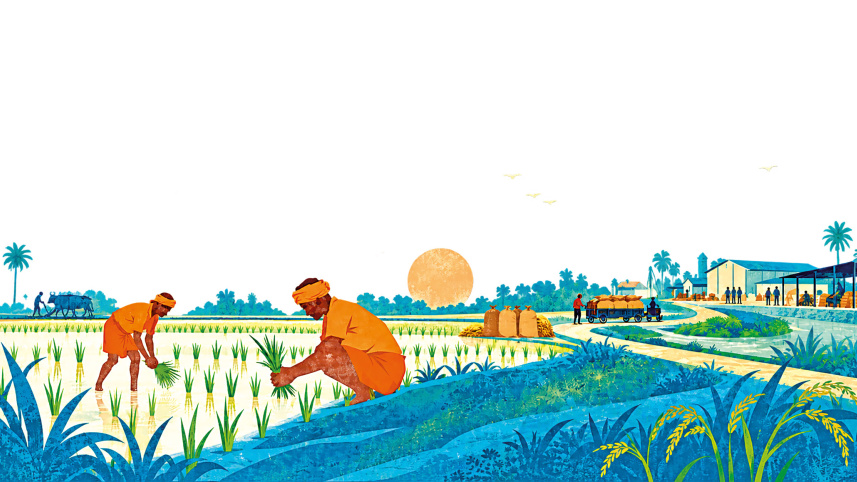
In Munshiganj, the financing question does not necessarily end when potatoes come out of the ground. Sometimes, that is when it becomes most urgent.
At the height of this year’s harvest, cold storages across Bangladesh were already around 80 percent full. In Munshiganj, one of the country’s major potato-producing districts, only around a fifth of storage capacity remained available, according to the Bangladesh Cold Storage Association. At the same time, farm-gate prices were falling under the weight of supply.

For a small farmer caught in that market, the choices are familiar. Sell immediately to a local trader and take the prevailing price. Find space in a cold store and pay to wait for a better market. Or arrange transport to a larger market where the crop may fetch more, while taking on the cost and uncertainty of getting it there.
Only the first choice requires no additional financing. It may also produce the smallest return.
That difference between the economically preferable decision and the decision a farmer’s cash position allows captures an increasingly important part of Bangladesh’s agricultural finance challenge.
The country is not short of agricultural lending targets. Bangladesh Bank has raised its agricultural and rural credit target to Tk 60,000 crore for FY2026-27, up from Tk 39,000 crore the previous year. Banks had already exceeded the FY2025-26 target, disbursing Tk 42,834 crore.
The next question is therefore not simply how much money flows into agriculture. It is what that money enables, and how far along the journey from seed to shelf it can travel.
Agriculture runs on different clocks
The conventional crop loan has a straightforward logic: a farmer borrows before cultivation for seed, fertiliser, labour or irrigation, and repays after harvest.
That farmer has not disappeared. But the rural economy around the farm has changed.
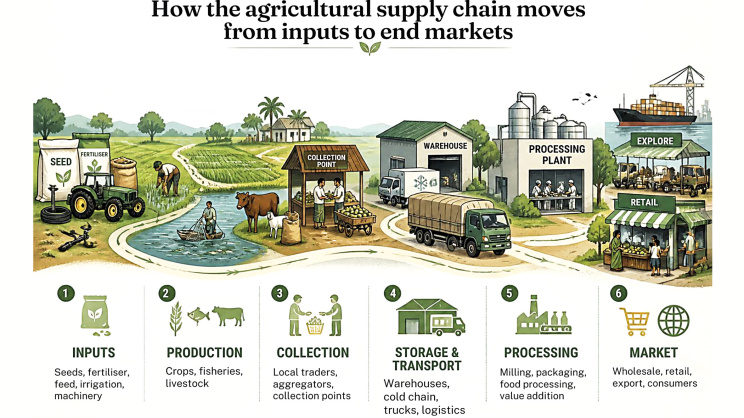
Mechanisation, commercial livestock and fisheries, aggregation, storage, processing and transport all have financing needs of their own. A machine bought today may generate income over several years. A dairy farm produces cash regularly. A poultry operation must continuously buy feed before birds can be sold. A processor may need long-term financing for equipment and, at the same time, short-term working capital to purchase large volumes of produce during harvest.
Banks interviewed for this supplement repeatedly described that shift. City Bank Managing Director and CEO Mashrur Arefin said borrowers increasingly require products designed around particular cash flows and production cycles rather than generic agricultural loans. BRAC Bank, meanwhile, says it has used repayment structures for livestock and fisheries that follow biological growth and harvest cycles instead of imposing rigid monthly instalments.
The distinction matters. A six-month crop and a dairy business producing milk every day cannot sensibly be financed on exactly the same timetable.
It also changes who an agricultural borrower can be.
A combine harvester may be beyond the reach of an individual smallholder, but it can support dozens of farms when owned by an operator who rents the machine out by the acre. The same principle extends further along the chain. A cold-store operator, transporter, hatchery, feed supplier, aggregator or processor may not cultivate land at all, yet financing that business can determine the productivity and income of farmers around it.
Agricultural finance, viewed this way, becomes less about financing an occupation and more about financing a system.
The harvest is only half the value
Much of the value of food is determined after production.
A potato that can be stored does not have to be sold into a harvest glut. Milk that can be chilled can travel farther. Fish transported under controlled temperatures has a better chance of reaching the buyer without losing quality. Tomatoes processed into paste or mangoes turned into pulp are no longer commodities that must find a buyer within days.
All of those steps require capital
 For all latest news, follow The Daily Star's Google News channel.
 Cold storage and processing plants generally need long-term investment. Traders and processors may need substantial working capital during a short procurement window.
Transport businesses need vehicles and equipment. Packaging, grading and preservation add another layer.
That is why Mohammad Mamdudur Rashid, CEO of United Commercial Bank, argues that financing the farmer alone is insufficient when storage and market linkages are missing. Similar themes run through the other interviews: banks are increasingly looking at agriculture as a value chain rather than an isolated production activity.
The approach also changes the logic of the loan. A refrigerated vehicle, for example, is not merely another asset to finance. Its ability to reduce spoilage and preserve saleable produce is what creates the cash flow from which financing can ultimately be repaid.
Creditworthy without owning the land
Yet reaching the farmer remains difficult.
A bank traditionally makes a lending decision using things it can document: income, account history, tax records, business papers and assets that can serve as security. Much of smallholder agriculture sits outside that framework.
Land is particularly complicated
IFPRI estimates that roughly 40 percent of Bangladeshi farm households are pure tenants, meaning they cultivate land they do not own. Around 43 percent of farmers are involved in sharecropping either as pure or mixed tenants.
For a financial system accustomed to immovable collateral, that creates an obvious problem: the person producing the crop may not own the land beneath it.
The credit-access figures reflect that divide. IFPRI’s analysis of the 2022 Household Income and Expenditure Survey found that MFIs and NGOs accounted for 76.5 percent of the agricultural loan sources reported by farming households, compared with 9.3 percent for banks. Households could report more than one source.
The challenge is therefore not necessarily to abandon credit discipline. It is to find better evidence of creditworthiness.
UCB puts the distinction simply: lack of collateral does not necessarily mean lack of creditworthiness. Banks interviewed for this supplement pointed to cash-flow assessment, production records, transaction histories, supply-chain relationships and group or cluster-based arrangements as possible ways of evaluating borrowers who leave only a thin conventional financial trail.
Contract farming can extend that logic further. Where a farmer already has an agreement to supply a processor or aggregator, the commercial relationship itself can become part of the financing structure. Warehouse receipts can serve a similar purpose by turning stored commodities into documented assets against which credit may be extended.
Neither model removes risk. Contracts can be broken, prices can move and crops can fail. But they shift the lending decision away from one question — what property does this farmer own? — toward another: what economic activity is taking place, and how reliably can its cash flow be observed?
The digital trail
This is where Bangladesh’s expansion of agent banking and digital finance may become significant.
At the end of June 2026, Bangladesh had 20,597 active agent-banking outlets, 85.5 percent of them in rural areas. The infrastructure has therefore travelled deep into areas where conventional branches are relatively costly to operate.
But access to a banking point and access to bank credit are not yet the same thing.
Agent banking represented around 14.6 percent of all bank deposit accounts at the end of June, but only 1.4 percent of loan accounts and 0.7 percent of outstanding bank loans.
That gap may be as important as the growth of the network itself.
The next value of digital finance may therefore lie not simply in allowing a farmer to transact without losing a working day travelling to a branch. Regular formal transactions can gradually create a financial record where previously there was little for a lender to assess.
Several banks interviewed for this supplement are already looking in that direction, combining agent networks and e-KYC with transaction data, field verification and partnerships with agritech companies, cooperatives and processors.
Technology does not make agricultural risk disappear. It can, however, make parts of that risk more visible.
Financing uncertainty
Some risks cannot be solved by better documentation.
Agriculture remains exposed to floods, excessive rainfall, drought, heat, disease and sudden movements in market prices. These can turn a perfectly viable borrower into a distressed one without any failure of effort or production planning.
They also create a particular problem for lenders: agricultural shocks can affect many borrowers in the same region at once.
That is why insurance and credit guarantees appeared repeatedly in the banker interviews. Dhaka Bank describes the required transition as one from a loan-and-recovery model towards a broader resilience-and-protection approach, while BRAC Bank points to insurance bundled with agricultural financing and repayment structures adapted to production cycles.
Climate-resilient irrigation, protected storage, renewable energy and diversified production can reduce particular risks. Insurance and guarantee mechanisms can distribute others. None eliminates uncertainty, but together they can influence whether financing remains viable after a bad season.
Beyond the lending target
Bangladesh’s agricultural credit target is rising rapidly. That matters. More credit can mean more inputs purchased on time, more machines operating in the field and more rural businesses able to expand.
But disbursement alone cannot show whether the financing architecture has kept pace with the agricultural economy.
A loan arriving after the planting window may be cheap but ineffective. A farmer may receive production credit and still be forced to sell immediately because storage is unavailable or unaffordable. A tenant may run a viable farm yet remain difficult to assess because the land belongs to someone else. An agent outlet may bring a bank into the village without necessarily bringing much bank credit with it.
Nor can finance solve every problem. A loan cannot repair a road, create a competitive market or guarantee a buyer.
What better finance can do is widen the number of choices available when those other pieces exist.
That brings the story back to the farmer standing beside a fresh potato harvest in Munshiganj. The success of agricultural finance is not measured only by whether he could borrow enough to grow the crop. It is also measured by what happens once the crop leaves the soil — whether there is finance for the storage, machinery, transport and businesses around him, and whether lack of cash forces him to sell at the moment when he has the least bargaining power.
Bangladesh’s next harvest will still begin with the farmer.
But financing it may have to continue all the way to the shelf.

Comments